• 文献检索
  • 文档翻译
  • 深度研究
  • 学术资讯
  • Suppr Zotero 插件Zotero 插件
  • 邀请有礼
  • 套餐&价格
  • 历史记录
应用&插件
Suppr Zotero 插件Zotero 插件浏览器插件Mac 客户端Windows 客户端微信小程序
定价
高级版会员购买积分包购买API积分包
服务
文献检索文档翻译深度研究API 文档MCP 服务
关于我们
关于 Suppr公司介绍联系我们用户协议隐私条款
关注我们

Suppr 超能文献

核心技术专利:CN118964589B侵权必究
粤ICP备2023148730 号-1Suppr @ 2026

文献检索

告别复杂PubMed语法,用中文像聊天一样搜索,搜遍4000万医学文献。AI智能推荐,让科研检索更轻松。

立即免费搜索

文件翻译

保留排版,准确专业,支持PDF/Word/PPT等文件格式,支持 12+语言互译。

免费翻译文档

深度研究

AI帮你快速写综述,25分钟生成高质量综述,智能提取关键信息,辅助科研写作。

立即免费体验

凝视稳定的中枢前庭神经元不对称地投射到眼外运动神经元池。

Gaze-Stabilizing Central Vestibular Neurons Project Asymmetrically to Extraocular Motoneuron Pools.

作者信息

Schoppik David, Bianco Isaac H, Prober David A, Douglass Adam D, Robson Drew N, Li Jennifer M B, Greenwood Joel S F, Soucy Edward, Engert Florian, Schier Alexander F

机构信息

Departments of Otolaryngology, Neuroscience and Physiology, and the Neuroscience Institute, New York University School of Medicine, New York, New York 10016,

Department of Neuroscience, Physiology and Pharmacology, University College London, London WCE1 6BT, United Kingdom.

出版信息

J Neurosci. 2017 Nov 22;37(47):11353-11365. doi: 10.1523/JNEUROSCI.1711-17.2017. Epub 2017 Sep 29.

DOI:10.1523/JNEUROSCI.1711-17.2017
PMID:28972121
原文链接:https://pmc.ncbi.nlm.nih.gov/articles/PMC5700419/
Abstract

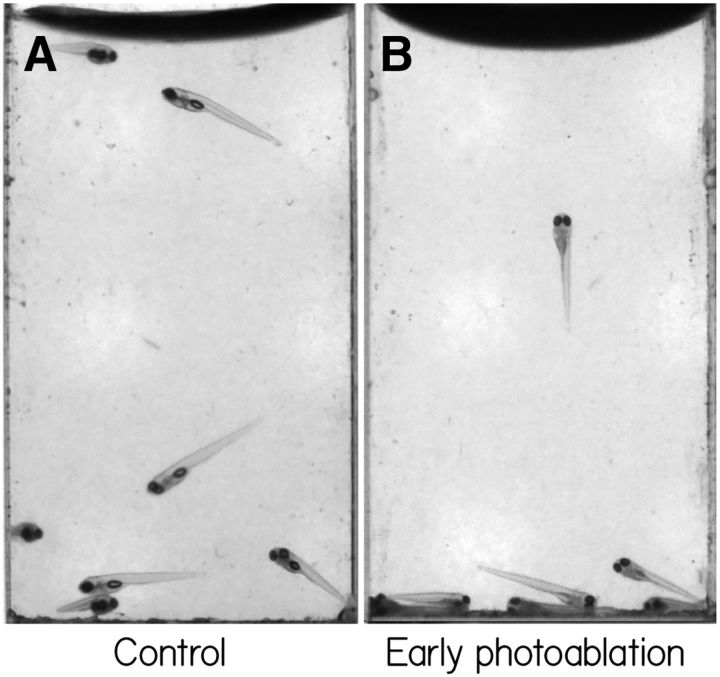
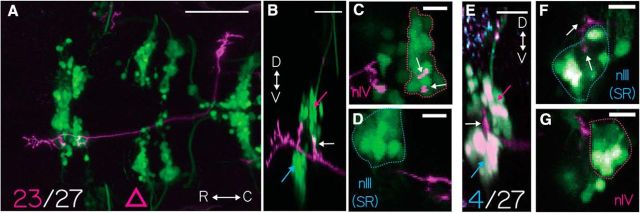
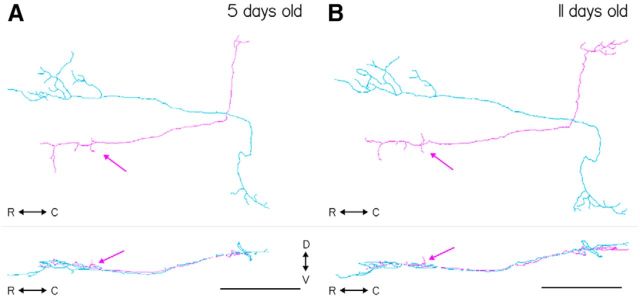
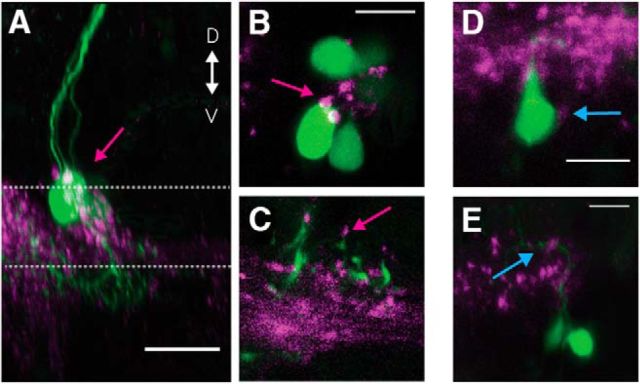
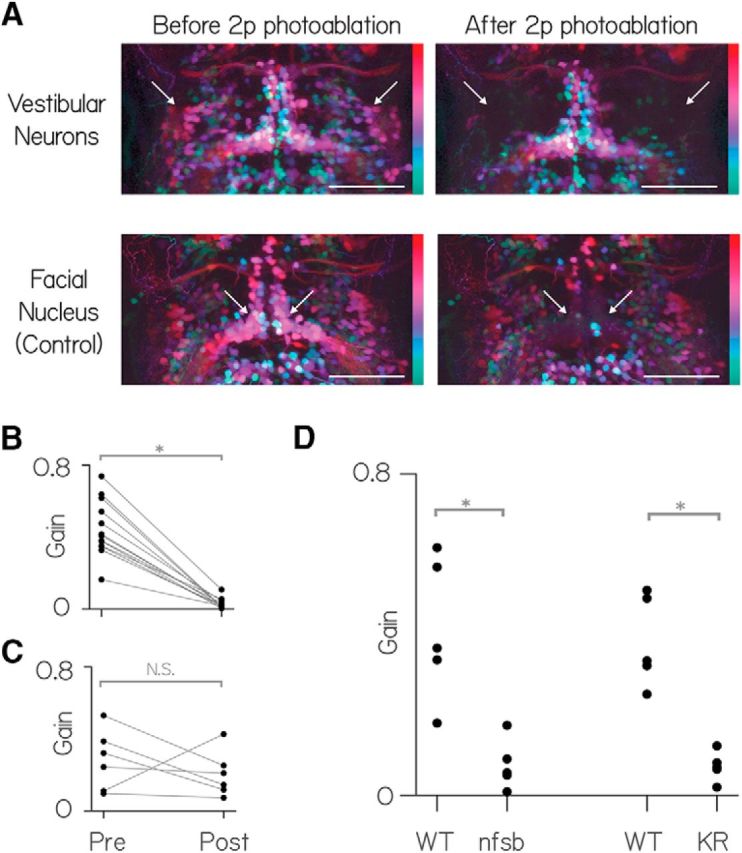
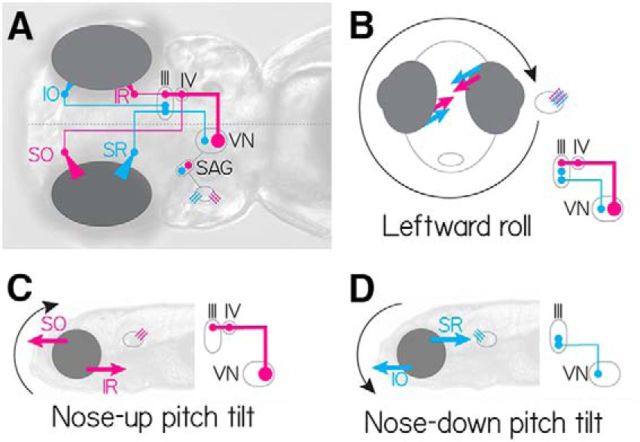
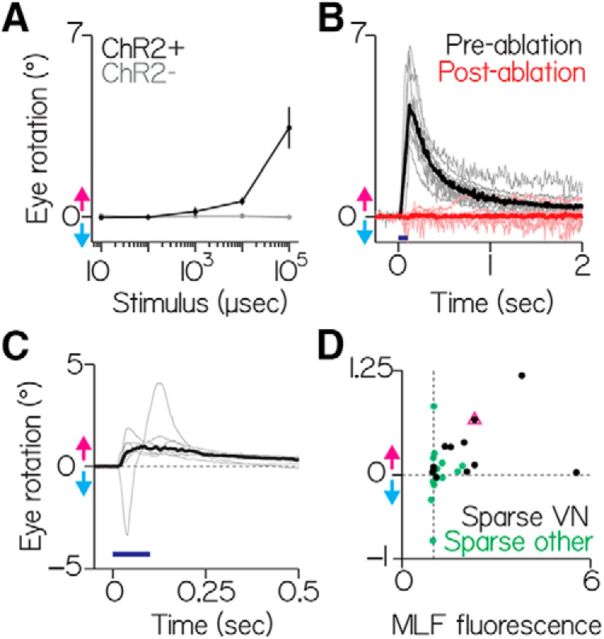
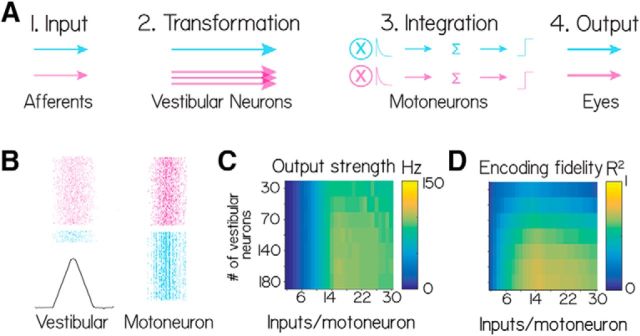
Within reflex circuits, specific anatomical projections allow central neurons to relay sensations to effectors that generate movements. A major challenge is to relate anatomical features of central neural populations, such as asymmetric connectivity, to the computations the populations perform. To address this problem, we mapped the anatomy, modeled the function, and discovered a new behavioral role for a genetically defined population of central vestibular neurons in rhombomeres 5-7 of larval zebrafish. First, we found that neurons within this central population project preferentially to motoneurons that move the eyes downward. Concordantly, when the entire population of asymmetrically projecting neurons was stimulated collectively, only downward eye rotations were observed, demonstrating a functional correlate of the anatomical bias. When these neurons are ablated, fish failed to rotate their eyes following either nose-up or nose-down body tilts. This asymmetrically projecting central population thus participates in both upward and downward gaze stabilization. In addition to projecting to motoneurons, central vestibular neurons also receive direct sensory input from peripheral afferents. To infer whether asymmetric projections can facilitate sensory encoding or motor output, we modeled differentially projecting sets of central vestibular neurons. Whereas motor command strength was independent of projection allocation, asymmetric projections enabled more accurate representation of nose-up stimuli. The model shows how asymmetric connectivity could enhance the representation of imbalance during nose-up postures while preserving gaze stabilization performance. Finally, we found that central vestibular neurons were necessary for a vital behavior requiring maintenance of a nose-up posture: swim bladder inflation. These observations suggest that asymmetric connectivity in the vestibular system facilitates representation of ethologically relevant stimuli without compromising reflexive behavior. Interneuron populations use specific anatomical projections to transform sensations into reflexive actions. Here we examined how the anatomical composition of a genetically defined population of balance interneurons in the larval zebrafish relates to the computations it performs. First, we found that the population of interneurons that stabilize gaze preferentially project to motoneurons that move the eyes downward. Next, we discovered through modeling that such projection patterns can enhance the encoding of nose-up sensations without compromising gaze stabilization. Finally, we found that loss of these interneurons impairs a vital behavior, swim bladder inflation, that relies on maintaining a nose-up posture. These observations suggest that anatomical specialization permits neural circuits to represent relevant features of the environment without compromising behavior.

摘要

在反射回路中,特定的解剖学投射使中枢神经元能够将感觉传递给产生运动的效应器。一个主要挑战是将中枢神经群体的解剖学特征,如不对称连接性,与这些群体执行的计算联系起来。为了解决这个问题,我们绘制了解剖结构,对功能进行建模,并发现了斑马鱼幼体菱脑节5 - 7中一组基因定义的中枢前庭神经元的新行为作用。首先,我们发现这个中枢群体中的神经元优先投射到使眼睛向下移动的运动神经元。相应地,当集体刺激整个不对称投射神经元群体时,只观察到眼睛向下旋转,这证明了解剖学偏向的功能相关性。当这些神经元被切除时,斑马鱼在身体向上或向下倾斜后无法转动眼睛。因此,这个不对称投射的中枢群体参与了向上和向下的注视稳定。除了投射到运动神经元外,中枢前庭神经元还直接接收来自外周传入神经的感觉输入。为了推断不对称投射是否能促进感觉编码或运动输出,我们对中枢前庭神经元的不同投射组进行了建模。虽然运动指令强度与投射分配无关,但不对称投射能够更准确地表示向上倾斜的刺激。该模型展示了不对称连接性如何在保持注视稳定性能的同时,增强向上倾斜姿势期间不平衡的表示。最后,我们发现中枢前庭神经元对于一种需要保持向上倾斜姿势的重要行为——鱼鳔充气是必需的。这些观察结果表明,前庭系统中的不对称连接性有助于在不影响反射行为的情况下表示与行为学相关的刺激。中间神经元群体利用特定的解剖学投射将感觉转化为反射动作。在这里,我们研究了斑马鱼幼体中一组基因定义的平衡中间神经元的解剖学组成与其执行的计算之间的关系。首先,我们发现稳定注视的中间神经元群体优先投射到使眼睛向下移动的运动神经元。接下来,我们通过建模发现,这种投射模式可以在不影响注视稳定的情况下增强对向上倾斜感觉的编码。最后,我们发现这些中间神经元的缺失会损害一种依赖于保持向上倾斜姿势的重要行为——鱼鳔充气。这些观察结果表明,解剖学特化允许神经回路在不影响行为的情况下表示环境的相关特征。
https://cdn.ncbi.nlm.nih.gov/pmc/blobs/dd4b/5700419/aeea435dc1a3/zns9991702210009.jpg
https://cdn.ncbi.nlm.nih.gov/pmc/blobs/dd4b/5700419/ac16a3234391/zns9991702210001.jpg
https://cdn.ncbi.nlm.nih.gov/pmc/blobs/dd4b/5700419/dd0e26369a72/zns9991702210002.jpg
https://cdn.ncbi.nlm.nih.gov/pmc/blobs/dd4b/5700419/c7196ee6fbbb/zns9991702210003.jpg
https://cdn.ncbi.nlm.nih.gov/pmc/blobs/dd4b/5700419/ca7620a552a8/zns9991702210004.jpg
https://cdn.ncbi.nlm.nih.gov/pmc/blobs/dd4b/5700419/575ed6c85703/zns9991702210005.jpg
https://cdn.ncbi.nlm.nih.gov/pmc/blobs/dd4b/5700419/7c809d712545/zns9991702210006.jpg
https://cdn.ncbi.nlm.nih.gov/pmc/blobs/dd4b/5700419/d6cc30b85b16/zns9991702210007.jpg
https://cdn.ncbi.nlm.nih.gov/pmc/blobs/dd4b/5700419/b87dfcb7e72f/zns9991702210008.jpg
https://cdn.ncbi.nlm.nih.gov/pmc/blobs/dd4b/5700419/aeea435dc1a3/zns9991702210009.jpg
https://cdn.ncbi.nlm.nih.gov/pmc/blobs/dd4b/5700419/ac16a3234391/zns9991702210001.jpg
https://cdn.ncbi.nlm.nih.gov/pmc/blobs/dd4b/5700419/dd0e26369a72/zns9991702210002.jpg
https://cdn.ncbi.nlm.nih.gov/pmc/blobs/dd4b/5700419/c7196ee6fbbb/zns9991702210003.jpg
https://cdn.ncbi.nlm.nih.gov/pmc/blobs/dd4b/5700419/ca7620a552a8/zns9991702210004.jpg
https://cdn.ncbi.nlm.nih.gov/pmc/blobs/dd4b/5700419/575ed6c85703/zns9991702210005.jpg
https://cdn.ncbi.nlm.nih.gov/pmc/blobs/dd4b/5700419/7c809d712545/zns9991702210006.jpg
https://cdn.ncbi.nlm.nih.gov/pmc/blobs/dd4b/5700419/d6cc30b85b16/zns9991702210007.jpg
https://cdn.ncbi.nlm.nih.gov/pmc/blobs/dd4b/5700419/b87dfcb7e72f/zns9991702210008.jpg
https://cdn.ncbi.nlm.nih.gov/pmc/blobs/dd4b/5700419/aeea435dc1a3/zns9991702210009.jpg

相似文献

1
Gaze-Stabilizing Central Vestibular Neurons Project Asymmetrically to Extraocular Motoneuron Pools.凝视稳定的中枢前庭神经元不对称地投射到眼外运动神经元池。
J Neurosci. 2017 Nov 22;37(47):11353-11365. doi: 10.1523/JNEUROSCI.1711-17.2017. Epub 2017 Sep 29.
2
Physiological and behavioral identification of vestibular nucleus neurons mediating the horizontal vestibuloocular reflex in trained rhesus monkeys.训练恒河猴中介导水平前庭眼反射的前庭核神经元的生理和行为鉴定
J Neurophysiol. 1992 Jul;68(1):244-64. doi: 10.1152/jn.1992.68.1.244.
3
[Central oculomotor circuits].[中枢动眼神经回路]
Rev Neurol (Paris). 1985;141(5):349-70.
4
Brain stem pursuit pathways: dissociating visual, vestibular, and proprioceptive inputs during combined eye-head gaze tracking.脑干追踪通路:在联合眼-头注视追踪过程中分离视觉、前庭和本体感觉输入
J Neurophysiol. 2003 Jul;90(1):271-90. doi: 10.1152/jn.01074.2002.
5
Coordination of gaze shifts in primates: brainstem inputs to neck and extraocular motoneuron pools.灵长类动物注视转移的协调:脑干向颈部和眼外运动神经元池的输入。
J Comp Neurol. 1994 Aug 1;346(1):43-62. doi: 10.1002/cne.903460104.
6
Local Spinal Cord Circuits and Bilateral Mauthner Cell Activity Function Together to Drive Alternative Startle Behaviors.局部脊髓回路和双侧红核巨细胞核活动共同驱动替代惊跳行为。
Curr Biol. 2017 Mar 6;27(5):697-704. doi: 10.1016/j.cub.2017.01.019. Epub 2017 Feb 16.
7
Vestibuloocular reflex of the adult flatfish. III. A species-specific reciprocal pattern of excitation and inhibition.成年比目鱼的前庭眼反射。III. 一种物种特异性的兴奋与抑制的相互模式。
J Neurophysiol. 2001 Sep;86(3):1376-88. doi: 10.1152/jn.2001.86.3.1376.
8
The extraocular motor nuclei: organization and functional neuroanatomy.眼球外肌运动核:组织与功能神经解剖学
Prog Brain Res. 2006;151:95-125. doi: 10.1016/S0079-6123(05)51004-5.
9
Excitatory and inhibitory vestibular pathways to the extraocular motor nuclei in goldfish.金鱼中通往眼外肌运动核的兴奋性和抑制性前庭通路。
J Neurophysiol. 1997 May;77(5):2765-79. doi: 10.1152/jn.1997.77.5.2765.
10
Vestibular motor control.前庭运动控制。
Handb Clin Neurol. 2023;195:31-54. doi: 10.1016/B978-0-323-98818-6.00022-4.

引用本文的文献

1
Cerebellar Purkinje cells control posture in larval zebrafish ().小脑浦肯野细胞控制斑马鱼幼体的姿势。
Elife. 2025 Apr 24;13:RP97614. doi: 10.7554/eLife.97614.
2
Motor neurons are dispensable for the assembly of a sensorimotor circuit for gaze stabilization.运动神经元对于凝视稳定的感觉运动回路的组装是可有可无的。
Elife. 2024 Nov 20;13:RP96893. doi: 10.7554/eLife.96893.
3
Evolutionarily conserved brainstem architecture enables gravity-guided vertical navigation.进化保守的脑干结构使重力导向的垂直导航成为可能。

本文引用的文献

1
Segmental Organization of Vestibular and Reticular Projections to Spinal and Oculomotor Nuclei in the Zebrafish and Goldfish.斑马鱼和金鱼中前庭和网状结构向脊髓和动眼神经核投射的节段性组织
Biol Bull. 1996 Oct;191(2):257-259. doi: 10.1086/BBLv191n2p257.
2
Delayed Otolith Development Does Not Impair Vestibular Circuit Formation in Zebrafish.延迟的耳石发育不会损害斑马鱼的前庭回路形成。
J Assoc Res Otolaryngol. 2017 Jun;18(3):415-425. doi: 10.1007/s10162-017-0617-9. Epub 2017 Mar 22.
3
Control of Movement Initiation Underlies the Development of Balance.
PLoS Biol. 2024 Nov 12;22(11):e3002902. doi: 10.1371/journal.pbio.3002902. eCollection 2024 Nov.
4
The Vestibulospinal Nucleus Is a Locus of Balance Development.前庭脊髓核是平衡发展的一个部位。
J Neurosci. 2024 Jul 24;44(30):e2315232024. doi: 10.1523/JNEUROSCI.2315-23.2024.
5
A brainstem circuit for gravity-guided vertical navigation.一个用于重力引导垂直导航的脑干回路。
bioRxiv. 2024 Mar 13:2024.03.12.584680. doi: 10.1101/2024.03.12.584680.
6
Evolution and development of extraocular motor neurons, nerves and muscles in vertebrates.脊椎动物眼球外运动神经元、神经和肌肉的演化和发育。
Ann Anat. 2024 Apr;253:152225. doi: 10.1016/j.aanat.2024.152225. Epub 2024 Feb 10.
7
Motor neurons are dispensable for the assembly of a sensorimotor circuit for gaze stabilization.运动神经元对于用于凝视稳定的感觉运动回路的组装并非必需。
bioRxiv. 2024 Jan 27:2024.01.25.577261. doi: 10.1101/2024.01.25.577261.
8
Larval zebrafish maintain elevation with multisensory control of posture and locomotion.斑马鱼幼体通过对姿势和运动的多感官控制来保持身体平衡。
bioRxiv. 2024 Dec 20:2024.01.23.576760. doi: 10.1101/2024.01.23.576760.
9
The vestibulospinal nucleus is a locus of balance development.前庭脊髓核是平衡发育的一个位点。
bioRxiv. 2024 Mar 21:2023.12.06.570482. doi: 10.1101/2023.12.06.570482.
10
Multisensory navigational strategies of hatchling fish for dispersal.幼鱼用于扩散的多感觉导航策略。
Curr Biol. 2023 Nov 20;33(22):4917-4925.e4. doi: 10.1016/j.cub.2023.09.070. Epub 2023 Oct 20.
运动起始的控制是平衡发展的基础。
Curr Biol. 2017 Feb 6;27(3):334-344. doi: 10.1016/j.cub.2016.12.003. Epub 2017 Jan 19.
4
Extraocular motoneuron pools develop along a dorsoventral axis in zebrafish, Danio rerio.斑马鱼(Danio rerio)的眼外运动神经元池沿背腹轴发育。
J Comp Neurol. 2017 Jan 1;525(1):65-78. doi: 10.1002/cne.24042. Epub 2016 Jun 1.
5
Whole-brain activity mapping onto a zebrafish brain atlas.全脑活动映射到斑马鱼脑图谱上。
Nat Methods. 2015 Nov;12(11):1039-46. doi: 10.1038/nmeth.3581.
6
A convergent and essential interneuron pathway for Mauthner-cell-mediated escapes.一条用于Mauthner细胞介导逃避反应的汇聚性且必不可少的中间神经元通路。
Curr Biol. 2015 Jun 1;25(11):1526-34. doi: 10.1016/j.cub.2015.04.025. Epub 2015 May 7.
7
Selective responses to tonic descending commands by temporal summation in a spinal motor pool.脊髓运动神经元池通过时间总和对强直下行指令的选择性反应。
Neuron. 2014 Aug 6;83(3):708-21. doi: 10.1016/j.neuron.2014.06.021. Epub 2014 Jul 24.
8
Neural control and modulation of swimming speed in the larval zebrafish.斑马鱼幼体游泳速度的神经控制与调节
Neuron. 2014 Aug 6;83(3):692-707. doi: 10.1016/j.neuron.2014.06.032. Epub 2014 Jul 24.
9
Descending control of swim posture by a midbrain nucleus in zebrafish.斑马鱼中脑核团对游泳姿势的下行控制。
Neuron. 2014 Aug 6;83(3):679-91. doi: 10.1016/j.neuron.2014.04.018. Epub 2014 Jul 24.
10
Statistics of the vestibular input experienced during natural self-motion: implications for neural processing.自然自我运动过程中前庭输入的统计分析:对神经处理的启示
J Neurosci. 2014 Jun 11;34(24):8347-57. doi: 10.1523/JNEUROSCI.0692-14.2014.