Petersen Steffen E, Sanghvi Mihir M, Aung Nay, Cooper Jackie A, Paiva José Miguel, Zemrak Filip, Fung Kenneth, Lukaschuk Elena, Lee Aaron M, Carapella Valentina, Kim Young Jin, Piechnik Stefan K, Neubauer Stefan
William Harvey Research Institute, NIHR Biomedical Research Centre at Barts, Queen Mary University of London, Charterhouse Square, London, United Kingdom.
Division of Cardiovascular Medicine, Radcliffe Department of Medicine, University of Oxford, Oxford, United Kingdom.
PLoS One. 2017 Oct 3;12(10):e0185114. doi: 10.1371/journal.pone.0185114. eCollection 2017.
The UK Biobank is a large-scale population-based study utilising cardiovascular magnetic resonance (CMR) to generate measurements of atrial and ventricular structure and function. This study aimed to quantify the association between modifiable cardiovascular risk factors and cardiac morphology and function in individuals without known cardiovascular disease.
Age, sex, ethnicity (non-modifiable) and systolic blood pressure, diastolic blood pressure, smoking status, exercise, body mass index (BMI), high cholesterol, diabetes, alcohol intake (modifiable) were considered important cardiovascular risk factors. Multivariable regression models were built to ascertain the association of risk factors on left ventricular (LV), right ventricular (RV), left atrial (LA) and right atrial (RA) CMR parameters.
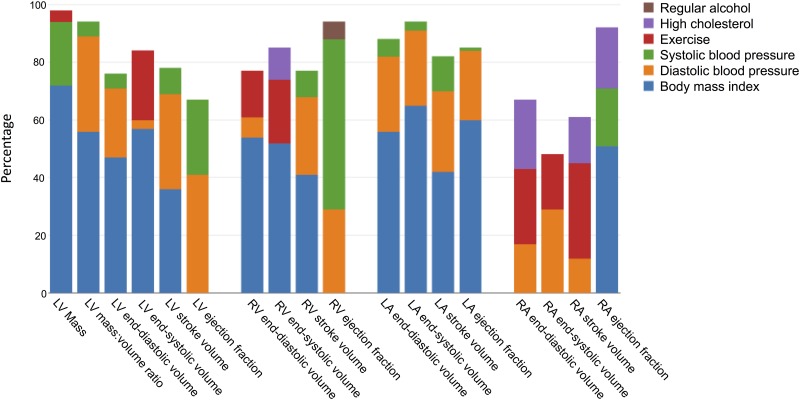
4,651 participants were included in the analysis. All modifiable risk factors had significant effects on differing atrial and ventricular parameters. BMI was the modifiable risk factor most consistently associated with subclinical changes to CMR parameters, particularly in relation to higher LV mass (+8.3% per SD [4.3 kg/m2], 95% CI: 7.6 to 8.9%), LV (EDV: +4.8% per SD, 95% CI: 4.2 to 5.4%); ESV: +4.4% per SD, 95% CI: 3.5 to 5.3%), RV (EDV: +5.3% per SD, 95% CI: 4.7 to 5.9%; ESV: +5.4% per SD, 95% CI: 4.5 to 6.4%) and LA maximal (+8.6% per SD, 95% CI: 7.4 to 9.7%) volumes. Increases in SBP were associated with higher LV mass (+6.8% per SD, 95% CI: 5.9 to 7.7%), LV (EDV: +4.5% per SD, 95% CI: 3.6 to 5.4%; ESV: +2.0% per SD, 95% CI: 0.8 to 3.3%) volumes. The presence of diabetes or high cholesterol resulted in smaller volumes and lower ejection fractions.
Modifiable risk factors are associated with subclinical alterations in structure and function in all four cardiac chambers. BMI and systolic blood pressure are the most important modifiable risk factors affecting CMR parameters known to be linked to adverse outcomes.
英国生物银行是一项基于大规模人群的研究,利用心血管磁共振成像(CMR)对心房和心室的结构与功能进行测量。本研究旨在量化可改变的心血管危险因素与无已知心血管疾病个体的心脏形态和功能之间的关联。
年龄、性别、种族(不可改变因素)以及收缩压、舒张压、吸烟状况、运动、体重指数(BMI)、高胆固醇、糖尿病、酒精摄入量(可改变因素)被视为重要的心血管危险因素。构建多变量回归模型以确定危险因素与左心室(LV)、右心室(RV)、左心房(LA)和右心房(RA)CMR参数之间的关联。
4651名参与者纳入分析。所有可改变的危险因素对不同的心房和心室参数均有显著影响。BMI是与CMR参数亚临床变化最一致相关的可改变危险因素,特别是与较高的左心室质量(每标准差增加8.3%[4.3kg/m²],95%置信区间:7.6%至8.9%)、左心室(舒张末期容积:每标准差增加4.8%,95%置信区间:4.2%至5.4%;收缩末期容积:每标准差增加4.4%,95%置信区间:3.5%至5.3%)、右心室(舒张末期容积:每标准差增加5.3%,95%置信区间:4.7%至5.9%;收缩末期容积:每标准差增加5.4%,95%置信区间:4.5%至6.4%)以及左心房最大容积(每标准差增加8.6%,95%置信区间:7.4%至9.7%)有关。收缩压升高与较高的左心室质量(每标准差增加6.8%,95%置信区间:5.9%至7.7%)、左心室(舒张末期容积:每标准差增加4.5%,95%置信区间:3.6%至5.4%;收缩末期容积:每标准差增加2.0%,95%置信区间:0.8%至3.3%)容积有关。糖尿病或高胆固醇的存在导致容积较小和射血分数较低。
可改变的危险因素与所有四个心腔的结构和功能亚临床改变有关。BMI和收缩压是影响已知与不良结局相关的CMR参数的最重要可改变危险因素。