van de Leur Rutger R, Bos Max N, Taha Karim, Sammani Arjan, Yeung Ming Wai, van Duijvenboden Stefan, Lambiase Pier D, Hassink Rutger J, van der Harst Pim, Doevendans Pieter A, Gupta Deepak K, van Es René
Department of Cardiology, University Medical Center Utrecht, Internal ref E03.511, Heidelberglaan 100, 3584 CX Utrecht, The Netherlands.
Netherlands Heart Institute, Moreelsepark 1, 3511 EP Utrecht, The Netherlands.
Eur Heart J Digit Health. 2022 Jul 25;3(3):390-404. doi: 10.1093/ehjdh/ztac038. eCollection 2022 Sep.
Deep neural networks (DNNs) perform excellently in interpreting electrocardiograms (ECGs), both for conventional ECG interpretation and for novel applications such as detection of reduced ejection fraction (EF). Despite these promising developments, implementation is hampered by the lack of trustworthy techniques to explain the algorithms to clinicians. Especially, currently employed heatmap-based methods have shown to be inaccurate.
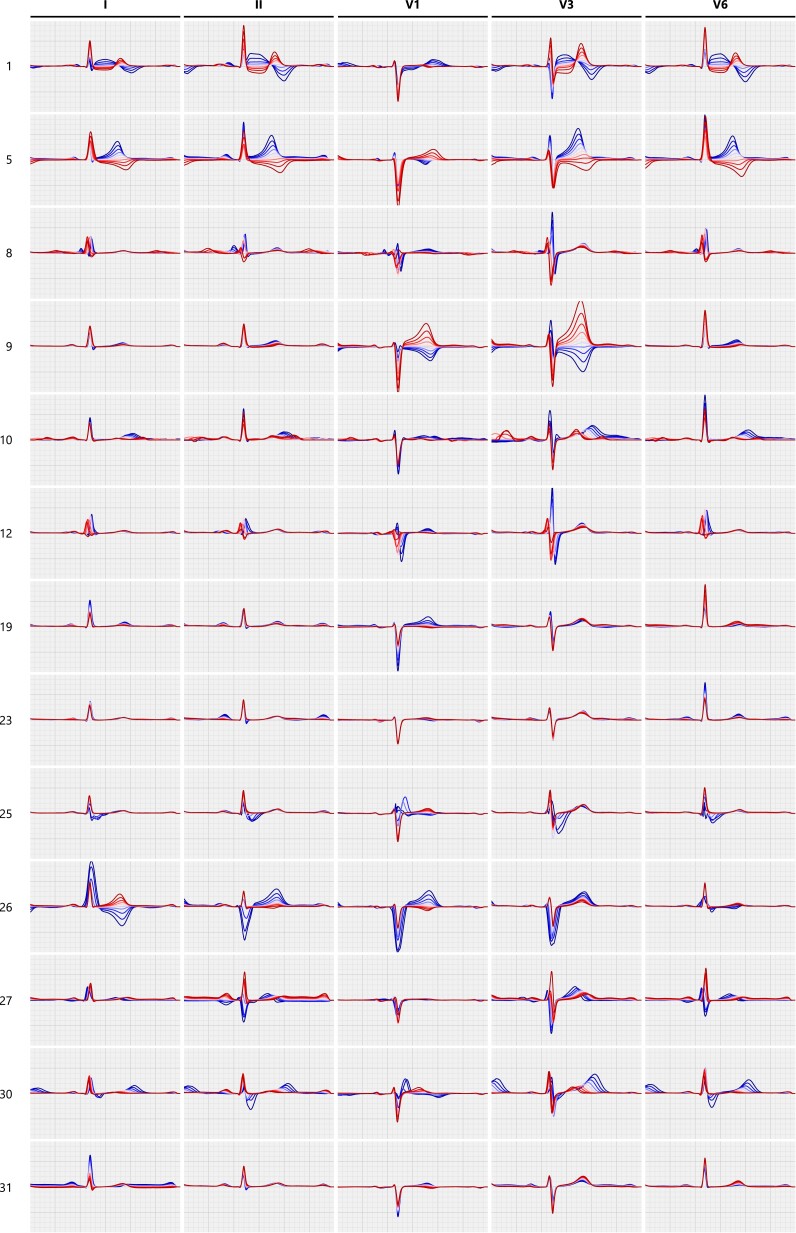
We present a novel pipeline consisting of a variational auto-encoder (VAE) to learn the underlying factors of variation of the median beat ECG morphology (the FactorECG), which are subsequently used in common and interpretable prediction models. As the ECG factors can be made explainable by generating and visualizing ECGs on both the model and individual level, the pipeline provides improved explainability over heatmap-based methods. By training on a database with 1.1 million ECGs, the VAE can compress the ECG into 21 generative ECG factors, most of which are associated with physiologically valid underlying processes. Performance of the explainable pipeline was similar to 'black box' DNNs in conventional ECG interpretation [area under the receiver operating curve (AUROC) 0.94 vs. 0.96], detection of reduced EF (AUROC 0.90 vs. 0.91), and prediction of 1-year mortality (AUROC 0.76 vs. 0.75). Contrary to the 'black box' DNNs, our pipeline provided explainability on which morphological ECG changes were important for prediction. Results were confirmed in a population-based external validation dataset.
Future studies on DNNs for ECGs should employ pipelines that are explainable to facilitate clinical implementation by gaining confidence in artificial intelligence and making it possible to identify biased models.
深度神经网络(DNN)在解读心电图(ECG)方面表现出色,无论是传统的心电图解读,还是诸如检测射血分数(EF)降低等新应用。尽管有这些令人鼓舞的进展,但由于缺乏向临床医生解释算法的可靠技术,其应用受到阻碍。特别是,目前使用的基于热图的方法已被证明不准确。
我们提出了一种新颖的流程,该流程由变分自编码器(VAE)组成,用于学习中位搏动心电图形态的潜在变化因素(即因子心电图),这些因素随后用于常见且可解释的预测模型。由于心电图因子可以通过在模型和个体层面生成并可视化心电图来进行解释,因此该流程比基于热图的方法具有更高的可解释性。通过在包含110万份心电图的数据库上进行训练,VAE可以将心电图压缩为21个生成性心电图因子,其中大多数与生理上有效的潜在过程相关。在传统心电图解读中,可解释流程的性能与“黑箱”DNN相似[受试者操作特征曲线下面积(AUROC)分别为0.94和0.96],在检测EF降低方面(AUROC分别为0.90和0.91),以及在预测1年死亡率方面(AUROC分别为0.76和0.75)。与“黑箱”DNN不同,我们的流程提供了可解释性,即哪些心电图形态变化对预测很重要。结果在基于人群的外部验证数据集中得到了证实。
未来关于心电图DNN的研究应采用可解释的流程,以通过增强对人工智能的信心并识别有偏差的模型来促进临床应用。