Department of Dermatology, Hanyang University Guri Hospital, Guri, Korea.
Department of Dermatology, Seoul St. Mary's Hospital, College of Medicine, The Catholic University of Korea, Seoul, Korea.
Sci Rep. 2017 Oct 3;7(1):12637. doi: 10.1038/s41598-017-13068-x.
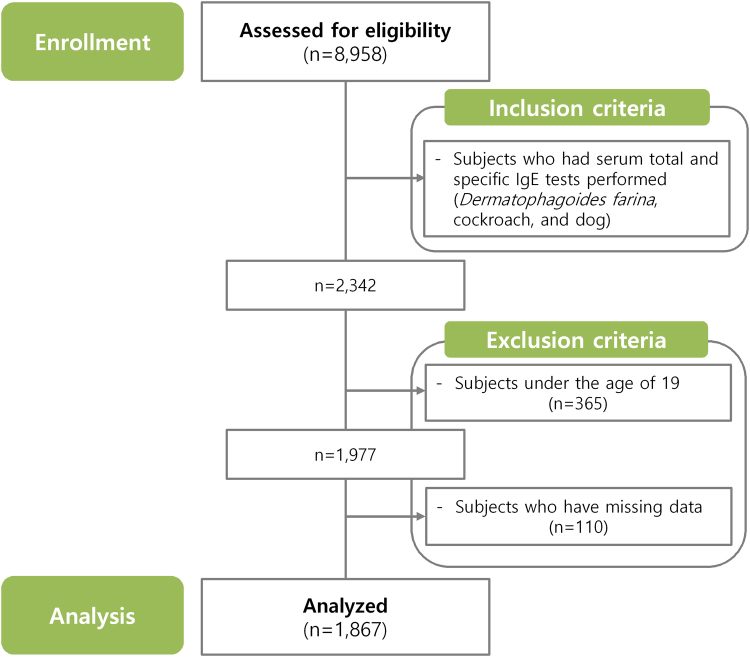
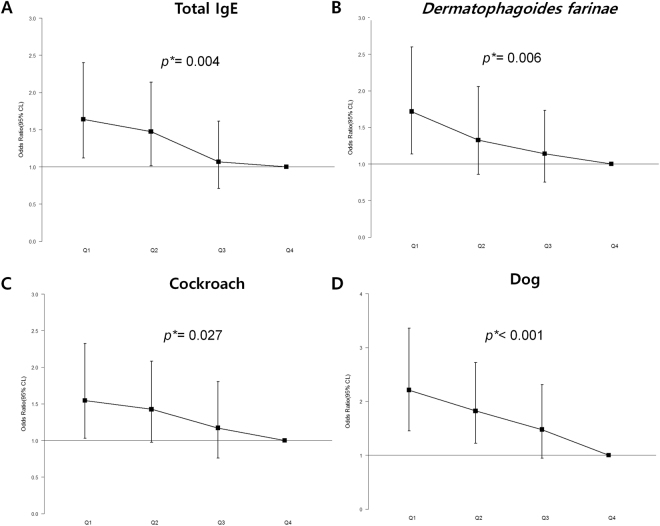
Zinc (Zn) is an essential trace element that plays important roles in the immune system. There is little known about the role of trace elements in allergic diseases, and previous reports have shown conflicting results. The aim of this study was to investigate the relationship between serum Zn levels and total or allergen-specific immunoglobulin E (IgE) levels. The initial candidates for this study were those who participated in the 5 Korean National Health and Nutrition Examination Survey 2010 (n = 8,958), and 1,867 adults who had serum total and allergen specific-IgE levels measured were included. Upon adjusting for covariates, mean total IgE, Dermatophagoides farinae and dog-specific IgE levels increased significantly as the Zn levels decrease from the highest to the lowest quartile (p = 0.009, 0.004, and < 0.001, respectively). The multiple logistic regression analyses showed significant negative linear correlations between serum Zn levels and total, D. farinae-, cockroach-, and dog-specific IgE levels (p-value for linear trend = 0.004, 0.006, 0.027, and < 0.001, respectively). This study demonstrated that total/allergen specific IgE and Zn levels are significantly inversely related.
锌(Zn)是一种必需的微量元素,在免疫系统中发挥重要作用。关于微量元素在过敏性疾病中的作用知之甚少,先前的报告结果也相互矛盾。本研究旨在探讨血清锌水平与总免疫球蛋白 E(IgE)或过敏原特异性 IgE(sIgE)水平之间的关系。本研究的初始候选者是参加了 2010 年韩国全国健康和营养调查 5 期(n=8958)的人群,其中包括了 1867 名血清总 IgE 和过敏原特异性 IgE 水平均被测量的成年人。在调整了混杂因素后,总 IgE、粉尘螨和狗特异性 IgE 水平随着锌水平从最高到最低四分位数的降低而显著升高(p=0.009、0.004 和 <0.001)。多元逻辑回归分析显示,血清锌水平与总 IgE、粉尘螨特异性 IgE、蟑螂特异性 IgE 和狗特异性 IgE 水平之间存在显著的负线性相关(线性趋势 p 值分别为 0.004、0.006、0.027 和 <0.001)。本研究表明,总/过敏原特异性 IgE 与锌水平呈显著负相关。