Torino Claudia, Pizzini Patrizia, Cutrupi Sebastiano, Tripepi Rocco, Tripepi Giovanni, Mallamaci Francesca, Zoccali Carmine
CNR-IFC, Clinical Epidemiology and Physiopathology of Renal Diseases and Hypertension & Nephrology and Renal Transplantation Unit, Reggio Calabria, Italy.
PLoS One. 2017 Oct 4;12(10):e0185449. doi: 10.1371/journal.pone.0185449. eCollection 2017.
Vitamin D associates with the plasma concentration of the endogenous inhibitor of the nitric oxide system asymmetric dimethyl arginine (ADMA) and cross-sectional studies in CKD patients treated with the vitamin D receptor activator paricalcitol show that plasma ADMA is substantially less than in those not receiving this drug.
In the frame of a randomized, double-blind, placebo controlled trial, the Paracalcitol and ENdothelial fuNction in chronic kidneY disease (PENNY), we investigated whether vitamin D receptor activation by paricalcitol (2 μg/day x 12 weeks) affects the plasma concentration of ADMA and symmetric dimethyl arginine (SDMA) in 88 patients with stage 3 to 4 CKD.
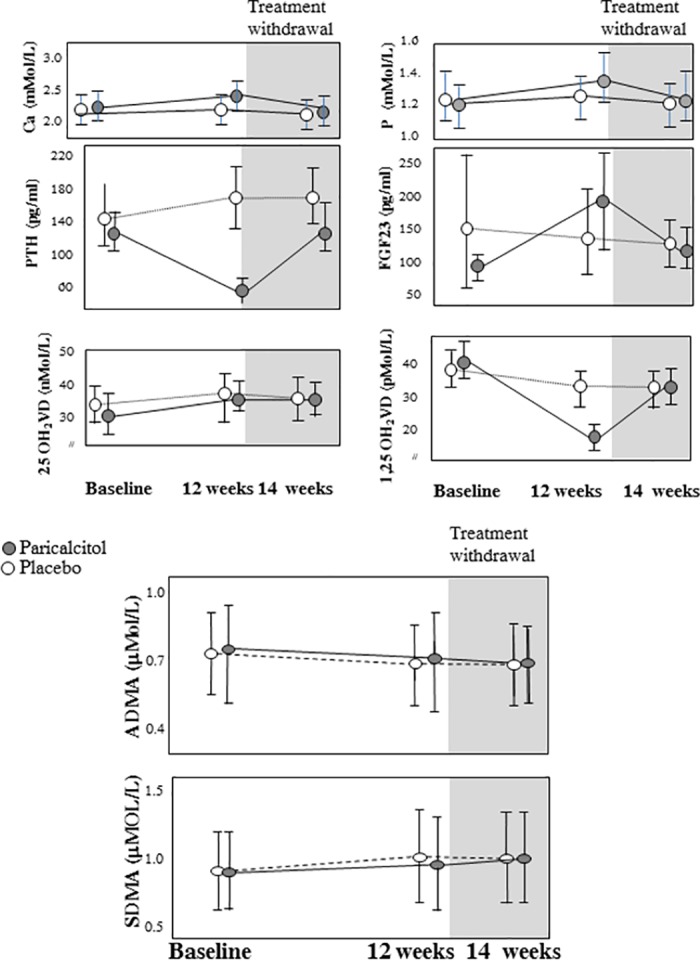
Paricalcitol produced the expected small rise in serum calcium and phosphate and a marked PTH suppression. However, ADMA [Paricalcitol: baseline 0.75 μMol/L (95%CI: 0.70-0.81), 12 week 0.72 μMol/L (95%CI: 0.66-0.78); Placebo: baseline 0.75 μMol/L (95%CI: 0.70-0.90) 12 weeks 0.70 μMol/L (95%CI: 0.66-0.74)] and SDMA [Paricalcitol: baseline 0.91 μMol/L (95%CI: 0.82-1.00), 12 week 0.94 μMol/L (95%CI: 0.82-0.1.06); Placebo: baseline 0.91 μMol/L (95%CI: 0.82-1.06) 12 weeks 0.99 μMol/L (95%CI: 0.88-1.10)] remained unchanged during the trial and 2 weeks after stopping these treatments.
Paricalcitol does not modify plasma ADMA and SDMA in patients with stage 3-4 CKD. The apparent beneficial effects of paricalcitol on ADMA registered in cross-sectional studies is likely attributable to confounding by indication rather than to a true effect of this drug on ADMA metabolism.
维生素D与一氧化氮系统内源性抑制剂不对称二甲基精氨酸(ADMA)的血浆浓度相关,并且对接受维生素D受体激活剂帕立骨化醇治疗的慢性肾脏病(CKD)患者的横断面研究表明,血浆ADMA显著低于未接受该药物治疗的患者。
在一项随机、双盲、安慰剂对照试验——慢性肾脏病中的帕立骨化醇与内皮功能(PENNY)试验框架内,我们调查了帕立骨化醇(2μg/天×12周)激活维生素D受体是否会影响88例3至4期CKD患者的血浆ADMA和对称二甲基精氨酸(SDMA)浓度。
帕立骨化醇使血清钙和磷出现预期的小幅升高,并显著抑制甲状旁腺激素(PTH)。然而,在试验期间以及停止这些治疗2周后,ADMA[帕立骨化醇组:基线0.75μMol/L(95%CI:0.70 - 0.81),12周时0.72μMol/L(95%CI:0.66 - 0.78);安慰剂组:基线0.75μMol/L(95%CI:0.70 - 0.90),12周时0.70μMol/L(95%CI:0.66 - 0.74)]和SDMA[帕立骨化醇组:基线0.91μMol/L(95%CI:0.82 - 1.00),12周时0.94μMol/L(95%CI:0.82 - 0.1.06);安慰剂组:基线0.91μMol/L(95%CI:0.82 - 1.06),12周时0.99μMol/L(95%CI:0.88 - 1.10)]均保持不变。
帕立骨化醇不会改变3 - 4期CKD患者的血浆ADMA和SDMA水平。横断面研究中记录的帕立骨化醇对ADMA的明显有益作用可能归因于适应证的混杂因素,而非该药物对ADMA代谢的真正作用。