Nasir Nazrila Hairin, Mohamad Mohazmi, Lum Lucy Chai See, Ng Chirk Jenn
Department of Primary Care Medicine, Faculty of Medicine, University of Malaya, Kuala Lumpur, Malaysia.
Department of Paediatrics, Faculty of Medicine, University of Malaya, Kuala Lumpur, Malaysia.
PLoS One. 2017 Oct 4;12(10):e0183544. doi: 10.1371/journal.pone.0183544. eCollection 2017.
Dengue infection is the fastest spreading mosquito-borne viral disease in the world. One of the complications of dengue is dehydration which, if not carefully monitored and treated, may lead to shock, particularly in those with dengue haemorrhagic fever. WHO has recommended oral fluid intake of five glasses or more for adults who are suspected to have dengue fever. However, there have been no published studies looking at self-care intervention measures to improve oral fluid intake among patients suspected of dengue fever.
To assess the feasibility and effectiveness of using a fluid chart to improve oral fluid intake in patients with suspected dengue fever in a primary care setting.
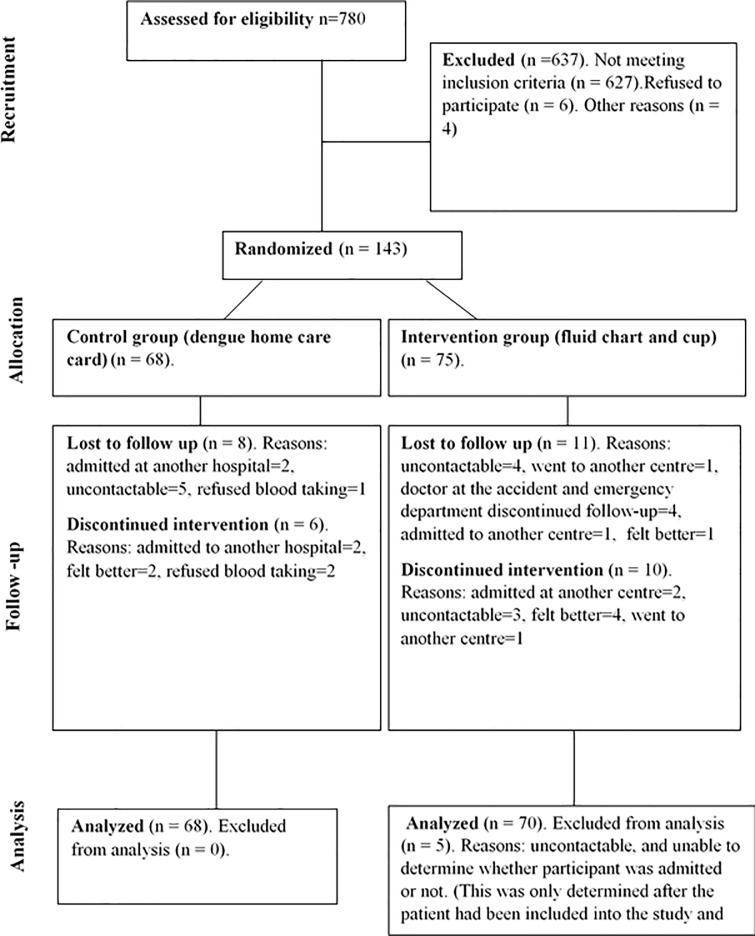
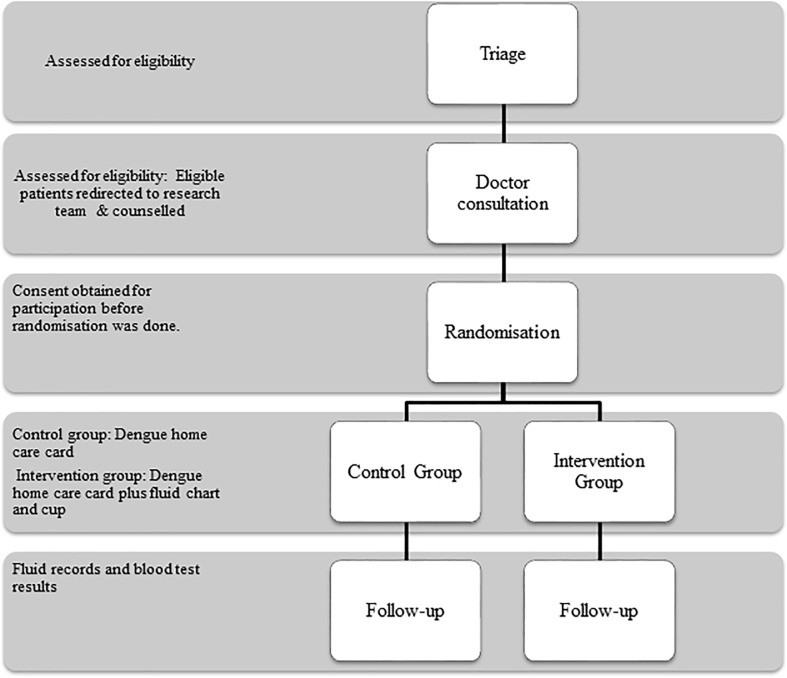
This feasibility study used a randomized controlled study design. The data was collected over two months at a primary care clinic in a teaching hospital. The inclusion criteria were: age > 12 years, patients who were suspected to have dengue fever based on the assessment by the primary healthcare clinician, fever for > three days, and thrombocytopenia (platelets < 150 x 109/L). Both groups received a dengue home care card. The intervention group received the fluid chart and a cup (200ml). Baseline clinical and laboratory data, 24-hour fluid recall (control group), and fluid chart were collected. The main outcomes were: hospitalization rates, intravenous fluid requirement and total oral fluid intake.
Among the 138 participants who were included in the final analysis, there were fewer hospital admissions in the intervention group (n = 7, 10.0%) than the control group (n = 12, 17.6%) (p = 0.192). Similarly, fewer patients (n = 9, 12.9%) in the intervention group required intravenous fluid compared to the control group (n = 15, 22.1%), (p = 0.154). There was an increase in the amount of daily oral fluid intake in the intervention group (about 3,000 ml) compared to the control group (about 2,500 ml, p = 0.521). However, these differences did not reach statistical significance.
This is a feasible and acceptable study to perform in a primary care setting. The fluid chart is a simple, inexpensive tool that may reduce hospitalization and intravenous fluid requirement in suspected dengue patients. A randomized controlled trial with larger sample size is needed to determine this conclusively.
International Standard Randomized Controlled Trial Number (ISRCTN) Registry ISRCTN25394628 http://www.isrctn.com/ISRCTN25394628.
登革热感染是全球传播速度最快的蚊媒病毒性疾病。登革热的并发症之一是脱水,如果不仔细监测和治疗,可能会导致休克,尤其是在登革出血热患者中。世界卫生组织建议,疑似登革热的成年人应口服五杯或更多液体。然而,尚未有已发表的研究探讨自我护理干预措施对提高疑似登革热患者口服液体摄入量的作用。
评估在基层医疗环境中使用液体摄入量图表来提高疑似登革热患者口服液体摄入量的可行性和有效性。
本可行性研究采用随机对照研究设计。在一家教学医院的基层医疗诊所进行了为期两个月的数据收集。纳入标准为:年龄>12岁,根据基层医疗临床医生的评估疑似患有登革热,发热超过三天,以及血小板减少(血小板<150×10⁹/L)。两组均收到一张登革热家庭护理卡。干预组收到液体摄入量图表和一个杯子(200毫升)。收集了基线临床和实验室数据、24小时液体摄入量回忆(对照组)以及液体摄入量图表。主要结局指标为:住院率、静脉补液需求和口服液体总摄入量。
在最终分析纳入的138名参与者中,干预组的住院人数(n = 7,10.0%)少于对照组(n = 12,17.6%)(p = 0.192)。同样,干预组需要静脉补液的患者(n = 9,12.9%)少于对照组(n = 15,22.1%)(p = 0.154)。与对照组(约2500毫升,p = 0.521)相比,干预组的每日口服液体摄入量有所增加(约3000毫升)。然而,这些差异未达到统计学意义。
这是一项在基层医疗环境中可行且可接受的研究。液体摄入量图表是一种简单、廉价的工具,可能会减少疑似登革热患者的住院率和静脉补液需求。需要进行一项样本量更大的随机对照试验来最终确定这一点。
国际标准随机对照试验编号(ISRCTN)注册库ISRCTN25394628 http://www.isrctn.com/ISRCTN25394628 。