Enokida Tomohiro, Fujii Satoshi, Takahashi Mari, Higuchi Youichi, Nomura Shogo, Wakasugi Tetsuro, Yamazaki Tomoko, Hayashi Ryuichi, Ohtsu Atsushi, Tahara Makoto
Department of Head and Neck Medical Oncology, National Cancer Center Hospital East, Kashiwa, Chiba 277-8577, Japan.
Advanced Clinical Research of Cancer, Juntendo University Graduate School of Medicine, Bunkyo-Ku, Tokyo 113-8421, Japan.
Oncotarget. 2017 Jun 27;8(37):61786-61799. doi: 10.18632/oncotarget.18692. eCollection 2017 Sep 22.
To establish a prognostic signature for locally advanced tongue squamous cell carcinoma (TSCC) patients treated with surgery.
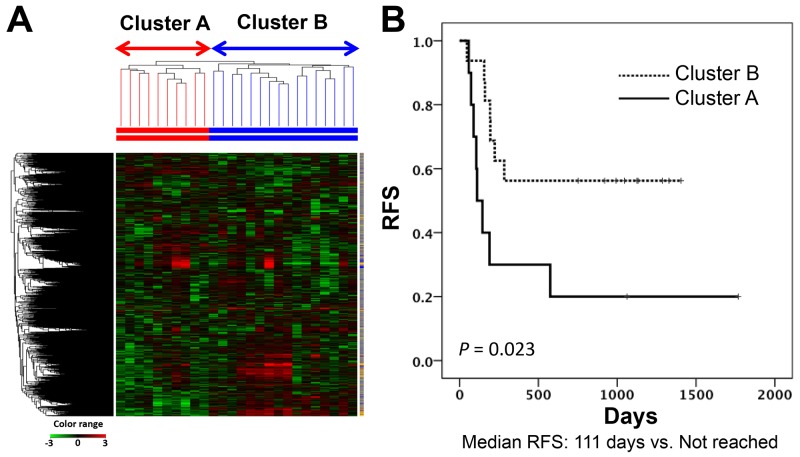
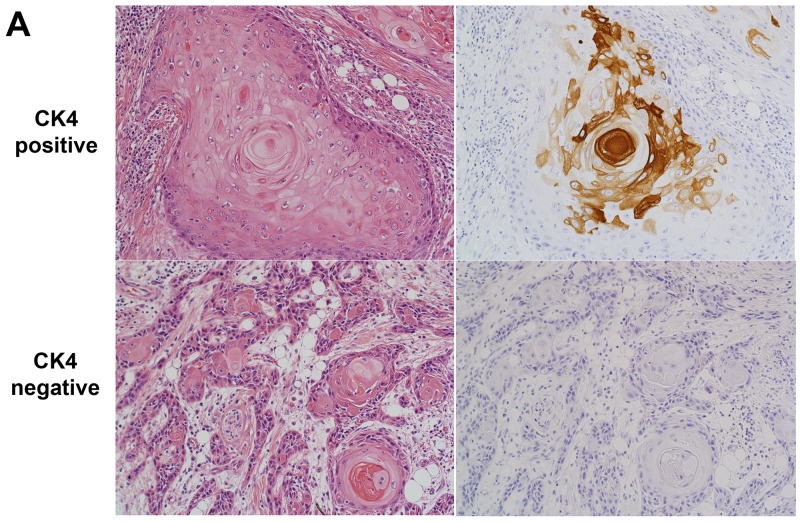
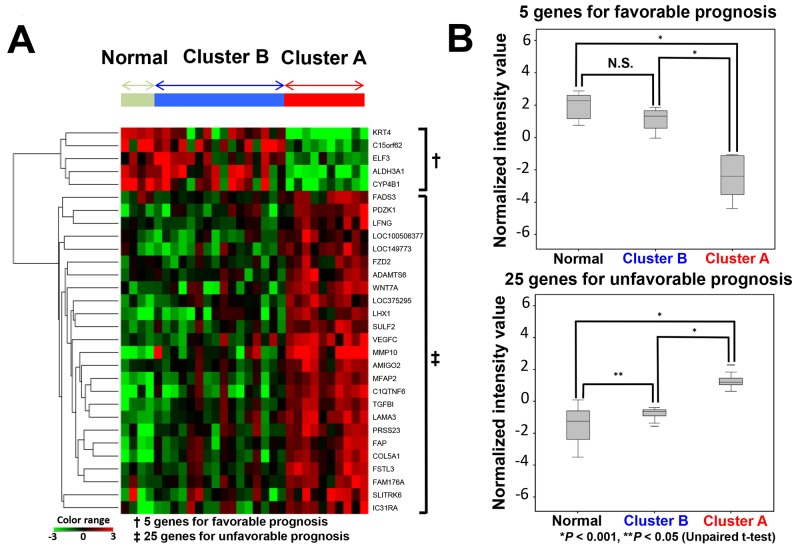
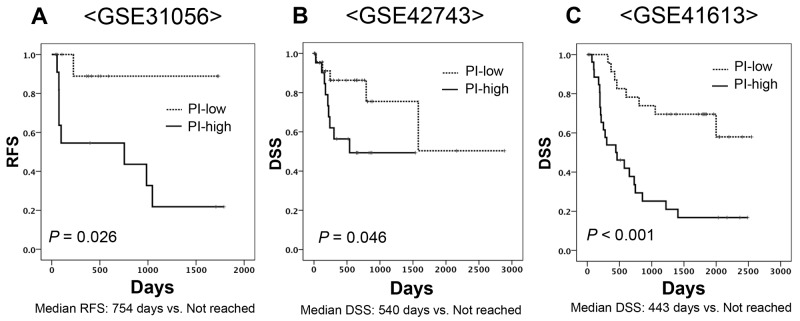
In the discovery study, unsupervised hierarchical clustering analysis identified two clusters which differentiated the Kaplan-Meier curves of RFS [median RFS, 111 days vs. not reached; log-rank test, = 0.023]. The 30 genes identified were combined into a dichotomous PI. In the validation cohort, classification according to the PI was associated with RFS [median RFS, 754 days vs. not reached; log-rank test, = 0.026 in GSE31056] and DSS [median DSS, 540 days vs. not reached; log-rank test, = 0.046 in GSE42743 and 443 days vs. not reached; < 0.001 in GSE41613]. Among genes, positive immunohistochemical staining of cytokeratin 4 was associated with favorable prognostic values for RFS (hazard ratio (HR), 0.591, = 0.045) and DSS (HR, 0.333, = 0.004).
We conducted gene expression profiling of 26 clinicopathologically homogeneous advanced TSCC tissue samples using cDNA microarray as a discovery study. Candidate genes were screened using clustering analysis and univariate Cox regression analysis for relapse-free survival (RFS). These were combined into a prognostic index (PI), which was validated using three public microarray datasets of tongue and oral cancer (123 patients). Some genes identified in discovery were immunohistochemically examined for protein expression in another 127 TSCC patients.
We identified robust molecular markers that showed significant associations with prognosis in TSCC patients. Gene expression profiling data were successfully converted to protein expression profiling data.
为接受手术治疗的局部晚期舌鳞状细胞癌(TSCC)患者建立一个预后特征。
在探索性研究中,无监督层次聚类分析识别出两个聚类,它们区分了无复发生存期(RFS)的Kaplan-Meier曲线[RFS中位数,111天对未达到;对数秩检验,P = 0.023]。所识别出的30个基因被组合成一个二分的预后指数(PI)。在验证队列中,根据PI进行的分类与RFS相关[RFS中位数,754天对未达到;对数秩检验,在GSE31056中P = 0.026]以及与疾病特异性生存期(DSS)相关[DSS中位数,540天对未达到;对数秩检验,在GSE42743中P = 0.046以及443天对未达到;在GSE41613中P < 0.001]。在这些基因中,细胞角蛋白4的阳性免疫组化染色与RFS(风险比(HR),0.591,P = 0.045)和DSS(HR,0.333,P = 0.004)的良好预后值相关。
我们使用cDNA微阵列对26个临床病理特征均一的晚期TSCC组织样本进行基因表达谱分析作为探索性研究。使用聚类分析和单变量Cox回归分析筛选无复发生存期(RFS)的候选基因。这些基因被组合成一个预后指数(PI),并使用三个舌癌和口腔癌的公共微阵列数据集(123例患者)进行验证。在另外127例TSCC患者中对在探索性研究中识别出的一些基因进行免疫组化检测其蛋白表达。
我们识别出了与TSCC患者预后显著相关的可靠分子标志物。基因表达谱数据成功转化为蛋白表达谱数据。