Aya-Bonilla Carlos A, Marsavela Gabriela, Freeman James B, Lomma Chris, Frank Markus H, Khattak Muhammad A, Meniawy Tarek M, Millward Michael, Warkiani Majid E, Gray Elin S, Ziman Mel
School of Medical and Health Sciences, Edith Cowan University, Perth, Western Australia, Australia.
Department of Health, Perth, Western Australia, Australia.
Oncotarget. 2017 Jun 27;8(40):67355-67368. doi: 10.18632/oncotarget.18641. eCollection 2017 Sep 15.
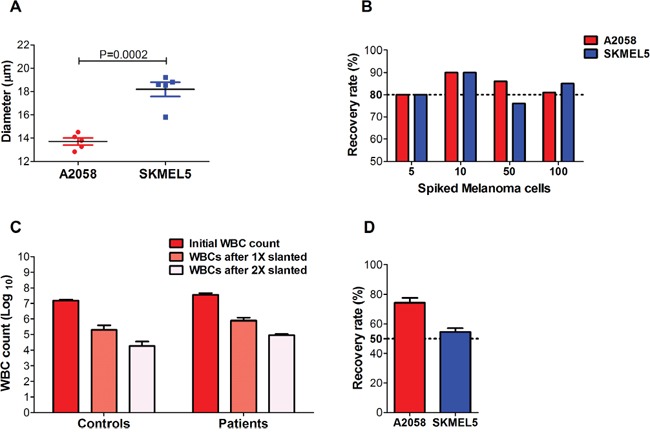
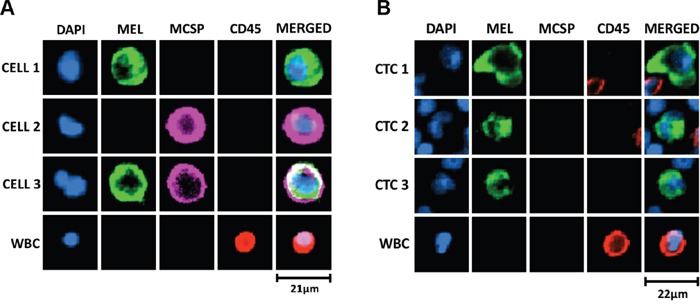
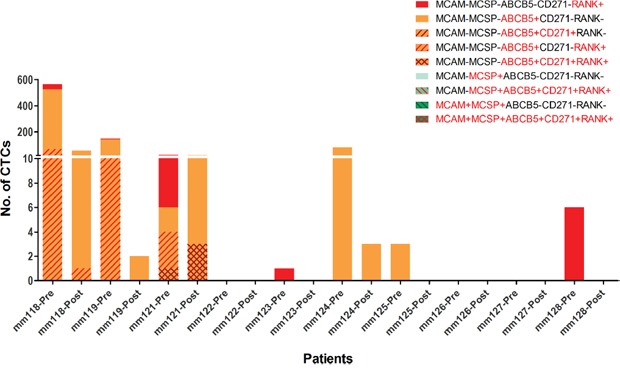
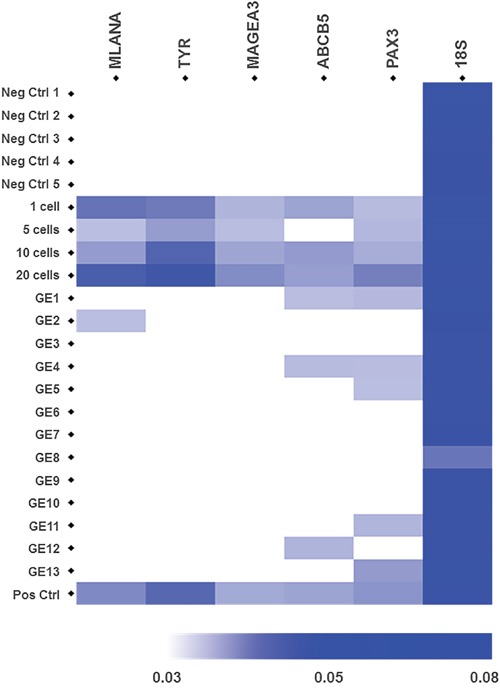
Circulating Tumour Cells (CTCs) are promising cancer biomarkers. Several methods have been developed to isolate CTCs from blood samples. However, the isolation of melanoma CTCs is very challenging as a result of their extraordinary heterogeneity, which has hindered their biological and clinical study. Thus, methods that isolate CTCs based on their physical properties, rather than surface marker expression, such as microfluidic devices, are greatly needed in melanoma. Here, we assessed the ability of the slanted spiral microfluidic device to isolate melanoma CTCs via label-free enrichment. We demonstrated that this device yields recovery rates of spiked melanoma cells of over 80% and 55%, after one or two rounds of enrichment, respectively. Concurrently, a two to three log reduction of white blood cells was achieved with one or two rounds of enrichment, respectively. We characterised the isolated CTCs using multimarker flow cytometry, immunocytochemistry and gene expression. The results demonstrated that CTCs from metastatic melanoma patients were highly heterogeneous and commonly expressed stem-like markers such as PAX3 and ABCB5. The implementation of the slanted microfluidic device for melanoma CTC isolation enables further understanding of the biology of melanoma metastasis for biomarker development and to inform future treatment approaches.
循环肿瘤细胞(CTCs)是很有前景的癌症生物标志物。已经开发了几种从血液样本中分离CTCs的方法。然而,黑色素瘤CTCs的分离极具挑战性,因为它们具有非凡的异质性,这阻碍了它们的生物学和临床研究。因此,黑色素瘤非常需要基于其物理特性而非表面标志物表达来分离CTCs的方法,如微流控装置。在此,我们评估了倾斜螺旋微流控装置通过无标记富集来分离黑色素瘤CTCs的能力。我们证明,经过一轮或两轮富集后,该装置对添加的黑色素瘤细胞的回收率分别超过80%和55%。同时,经过一轮或两轮富集后,白细胞数量分别减少了两到三个对数级。我们使用多标记流式细胞术、免疫细胞化学和基因表达对分离出的CTCs进行了表征。结果表明,转移性黑色素瘤患者的CTCs高度异质,且通常表达PAX3和ABCB5等干细胞样标志物。采用倾斜微流控装置分离黑色素瘤CTCs能够进一步了解黑色素瘤转移的生物学特性,以开发生物标志物并为未来的治疗方法提供依据。