Costa Ricardo, Costa Rubens B, Talamantes Sarah M, Helenoswki Irene, Carneiro Benedito A, Chae Young Kwang, Gradishar William J, Kurzrock Razelle, Giles Francis J
Division of Hematology Oncology, Northwestern University Feinberg School of Medicine, Chicago, Illinois, USA.
Northwestern University Feinberg School of Medicine, Chicago, Illinois, USA.
Oncotarget. 2017 Jun 29;8(40):67782-67789. doi: 10.18632/oncotarget.18847. eCollection 2017 Sep 15.
Anti-PD1 and PD-L1 antibodies are associated with immune-related adverse effects (irAEs). This analysis aims to assess the discrepancies between frequencies of irAEs observed in phase 1 trials with those seen in late-phase trials and to evolve the field of drug development.
PubMed search was conducted for articles published until December of 2016. Trials needed to have at least one of the study arms consisting of nivolumab, pembrolizumab or atezolizumab monotherapy. Trials were matched based on compound used and similarity of populations. All toxicities were reported as frequencies and percentages. -values to assess differences between matches and non-matches of phase 1 and late-phase trials and between early and late-phase trials themselves were obtained via Fisher's exact test. Odds ratios were obtained via logistic regression.
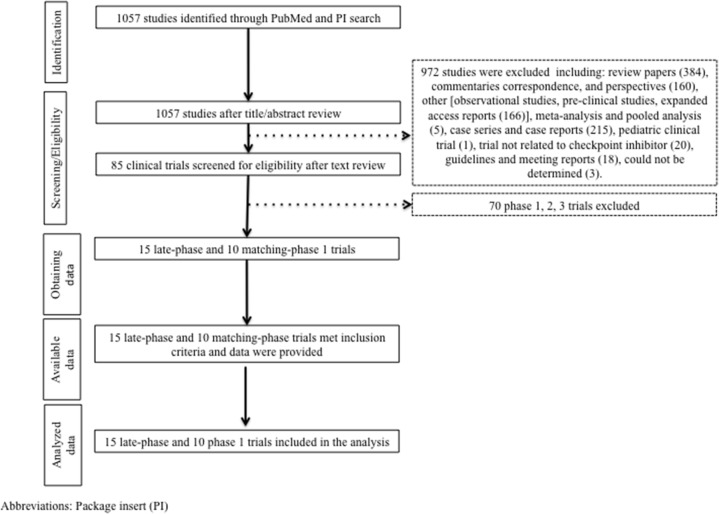
Our search yielded 15 late-phase and 10 matching phase 1 trials; = 4823 and = 1650, respectively. The most common AEs seen in phase 1 trials were also observed in late-phase trials except for phase 1 trials (median = 118) with < 118 patients ( = 0.048). Rash, pruritus, and diarrhea were the most frequently irAEs reported. Only colitis was more frequent in late-phase studies ( = 0.045).
Toxicities of anti-PD-1 and PD-L1 observed in phase 1 trials and late-phase trials are similar. There is positive correlation between phase 1 trial sample size and concordance of toxicity frequencies seen in late-phase studies. In conclusion, current immunotherapy phase 1 trials are appropriate in assessing safety profile of anti-PD-1 and PD-L1 antibodies.
抗程序性死亡蛋白1(PD1)和程序性死亡配体1(PD-L1)抗体与免疫相关不良反应(irAE)有关。本分析旨在评估1期试验中观察到的irAE频率与后期试验中观察到的频率之间的差异,并推动药物开发领域的发展。
对截至2016年12月发表的文章进行PubMed检索。试验需要至少有一个研究组由纳武单抗、帕博利珠单抗或阿特珠单抗单药治疗组成。根据使用的化合物和人群的相似性对试验进行匹配。所有毒性均以频率和百分比报告。通过Fisher精确检验获得评估1期和后期试验匹配与不匹配之间以及早期和后期试验本身之间差异的P值。通过逻辑回归获得优势比。
我们的检索产生了15项后期试验和10项匹配的1期试验;分别有n = 4823和n = 1650。1期试验中最常见的不良事件在后期试验中也有观察到,但1期试验(中位数n = 118)中患者数<118例的试验除外(P = 0.048)。皮疹、瘙痒和腹泻是报告最频繁的irAE。只有结肠炎在后期研究中更常见(P = 0.04)。
1期试验和后期试验中观察到的抗PD-1和PD-L1的毒性相似。1期试验样本量与后期研究中观察到的毒性频率一致性之间存在正相关。总之,目前的免疫治疗1期试验适用于评估抗PD-1和PD-L1抗体的安全性。