Department of Medicine, Division of Geriatric Medicine, University of Cape Town, South Africa.
Department of Medicine, Clinical Research Centre, University of Cape Town, South Africa.
J Alzheimers Dis. 2017;60(3):1087-1096. doi: 10.3233/JAD-170325.
Dementia is a growing concern for low- and middle-income countries where longevity is increasing and service provision is poor. Global prevalence estimates vary from 2% to 8.5% for those aged 60 years and older. There have been few dementia studies in sub-Saharan Africa, and prevalence data are lacking for South Africa.
To conduct a large dementia prevalence study in a low income rural population in South Africa.
1,394 Xhosa-speaking community dwellers, aged ≥60 y (mean age±sd 71.3±8.3 y), in three clinic catchment areas, were screened at home. Trained community health workers administered the brief Community Screening Instrument for Dementia (CSID) to participants and informants to assess cognitive and functional capacity. Depressive symptoms were assessed with three questions from the EURO-D.
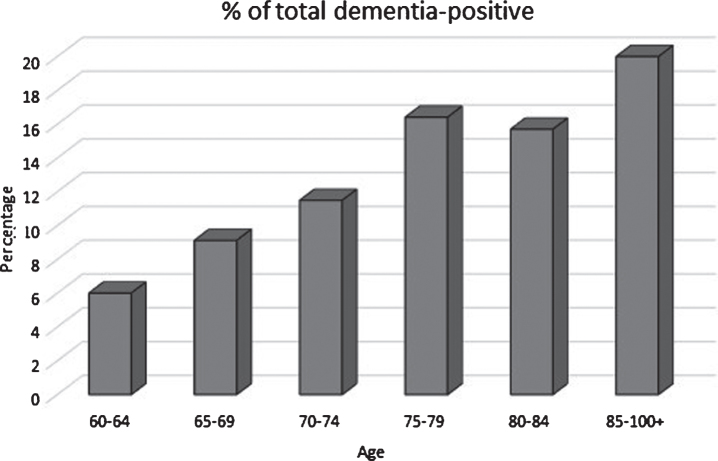
The prevalence estimate using published CSID sensitivity/specificity values was 0.8 (95% CI: 0.06-0.09). Using CSID cut-off scores the estimated prevalence was 0.12 (95% CI: 0.10-0.13), with 161 screen-positives. Both methods gave a rate of 0.11 (95% CI: 0.09-0.13) for those over 65 years (n = 1051). 68.6% of participants were female and 69.8% had less than 7 years of education. Dementia risk was associated with older age and symptoms of depression, but not with sex. The association with education was not significant when controlled for by age.
Dementia prevalence estimates were higher than expected for this low-income rural community. There is a need for increased dementia awareness and feasible support interventions. We also need further studies of regional prevalences, dementia subtypes, and modifiable risk factors in South Africa.
痴呆症是中低收入国家日益关注的问题,这些国家的人口寿命延长,但服务提供却很差。全球 60 岁及以上人群的患病率估计值在 2%至 8.5%之间。撒哈拉以南非洲地区的痴呆症研究很少,南非也缺乏患病率数据。
在南非一个低收入农村地区进行大规模的痴呆症患病率研究。
在三个诊所的服务区内,对 1394 名年龄在 60 岁及以上的科萨族社区居民(平均年龄±标准差为 71.3±8.3 岁)进行了家庭筛查。经过培训的社区卫生工作者对参与者和知情人使用简短的社区痴呆症筛查工具(CSID)进行认知和功能能力评估。使用 EURO-D 的三个问题评估抑郁症状。
使用已发表的 CSID 敏感性/特异性值的患病率估计值为 0.8(95%置信区间:0.06-0.09)。使用 CSID 截断分数,估计的患病率为 0.12(95%置信区间:0.10-0.13),有 161 例筛查阳性。两种方法在 65 岁以上人群中的发病率均为 0.11(95%置信区间:0.09-0.13)(n=1051)。参与者中 68.6%为女性,69.8%的人受教育程度不足 7 年。痴呆症风险与年龄较大和抑郁症状有关,但与性别无关。在控制年龄后,与教育程度的关联并不显著。
对于这个低收入农村社区,痴呆症的患病率估计值高于预期。需要提高对痴呆症的认识,并提供可行的支持干预措施。我们还需要进一步研究南非的区域性患病率、痴呆症亚型和可改变的风险因素。