Tanaka Mari, Tsujimoto Hiraku, Yamamoto Kojiro, Shimoda Saeko, Oka Kazumasa, Takeoka Hiroya
Department of Nephrology and Dialysis, Hyogo Prefectural Amagasaki General Medical Center Department of Pathology, Hyogo Prefectural Nishinomiya Hospital, Hyogo, Japan.
Medicine (Baltimore). 2017 Oct;96(40):e8216. doi: 10.1097/MD.0000000000008216.
TAFRO syndrome is a systemic inflammatory disease characterized by a constellation of symptoms: Thrombocytopenia, Anasarca, MyeloFibrosis, Renal dysfunction, and Organomegaly. Progressive renal insufficiency is a predominant symptom; however, the mechanism of acute kidney injury (AKI) remains unclear, probably because severe thrombocytopenia prevents kidney biopsy. We report a rare case of TAFRO syndrome with histologically confirmed renal involvement.
A 70-year-old man developed fever, anasarca, AKI, thrombocytopenia, and hepatosplenomegaly.
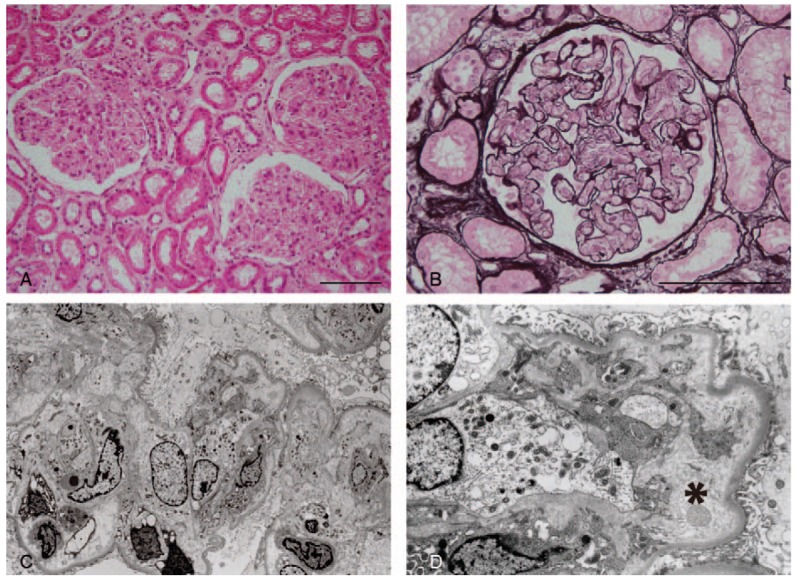
Plasma vascular endothelial growth factor and serum interleukin-6 levels were significantly elevated. The diagnosis of TAFRO syndrome was made based on his clinical and laboratory findings. Kidney biopsy was performed for the evaluation of AKI and provided a diagnosis of membranoproliferative glomerulonephritis-like lesions due to endothelial injury. Glomerular capillary lumens were extremely narrowed or occluded by endothelial swelling, and marked widening of the subendothelial space by electron-lucent material resulted in mesangiolysis and a double-contoured glomerular basement membrane with no immune complex deposits.
The patient required temporary hemodialysis due to oliguric AKI, but steroid therapy rapidly improved renal function.
Typically, patients with progressive renal involvement in TAFRO syndrome rapidly develop oliguric or anuric AKI. This report suggests that the reduction of glomerular perfusion by glomerular endothelial injury might be a primary factor in the progressive AKI of TAFRO syndrome. Our case and the literature review indicate that steroid and/or biological therapies result in highly favorable renal outcomes in patients with progressive AKI in TAFRO syndrome.
TAFRO综合征是一种全身性炎症性疾病,其特征为一系列症状:血小板减少、全身性水肿、骨髓纤维化、肾功能不全和器官肿大。进行性肾功能不全是主要症状;然而,急性肾损伤(AKI)的机制仍不清楚,可能是因为严重血小板减少妨碍了肾脏活检。我们报告一例罕见的TAFRO综合征病例,其肾脏受累经组织学证实。
一名70岁男性出现发热、全身性水肿、急性肾损伤、血小板减少和肝脾肿大。
血浆血管内皮生长因子和血清白细胞介素-6水平显著升高。根据其临床和实验室检查结果诊断为TAFRO综合征。为评估急性肾损伤进行了肾脏活检,诊断为内皮损伤导致的膜增生性肾小球肾炎样病变。肾小球毛细血管腔因内皮肿胀极度狭窄或闭塞,电子透明物质使内皮下间隙明显增宽,导致系膜溶解和肾小球基底膜双轨征,无免疫复合物沉积。
患者因少尿性急性肾损伤需要临时血液透析,但类固醇治疗迅速改善了肾功能。
通常,TAFRO综合征中进行性肾脏受累的患者会迅速发展为少尿性或无尿性急性肾损伤。本报告表明,肾小球内皮损伤导致的肾小球灌注减少可能是TAFRO综合征进行性急性肾损伤的主要因素。我们的病例及文献综述表明,类固醇和/或生物疗法可使TAFRO综合征中进行性急性肾损伤患者的肾脏预后非常良好。