Division of Allergy, Immunology, and Rheumatology, Department of Internal Medicine, Chang Gung Memorial Hospital, Chang Gung University, Tao-Yuan 33305, Taiwan.
Graduate Institute of Medical Science, National Defense Medical Center, Taipei 11490, Taiwan.
Int J Mol Sci. 2017 Oct 8;18(10):2108. doi: 10.3390/ijms18102108.
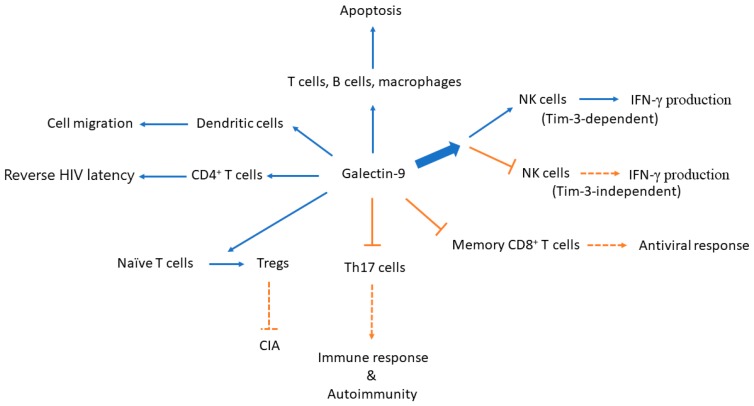
The interaction between galectin-9 and its receptor, Tim-3, triggers a series of signaling events that regulate immune responses. The expression of galectin-9 has been shown to be increased in a variety of target cells of many different viruses, such as hepatitis C virus (HCV), hepatitis B virus (HBV), herpes simplex virus (HSV), influenza virus, dengue virus (DENV), and human immunodeficiency virus (HIV). This enhanced expression of galectin-9 following viral infection promotes significant changes in the behaviors of the virus-infected cells, and the resulting events tightly correlate with the immunopathogenesis of the viral disease. Because the human immune response to different viral infections can vary, and the lack of appropriate treatment can have potentially fatal consequences, understanding the implications of galectin-9 is crucial for developing better methods for monitoring and treating viral infections. This review seeks to address how we can apply the current understanding of galectin-9 function to better understand the pathogenesis of viral infection and better treat viral diseases.
半乳糖凝集素-9 与其受体 Tim-3 的相互作用会触发一系列信号事件,从而调节免疫反应。已证实,多种不同病毒的许多靶细胞中的半乳糖凝集素-9 的表达增加,例如丙型肝炎病毒(HCV)、乙型肝炎病毒(HBV)、单纯疱疹病毒(HSV)、流感病毒、登革热病毒(DENV)和人类免疫缺陷病毒(HIV)。病毒感染后半乳糖凝集素-9 的这种增强表达促进了受感染细胞行为的显著变化,而由此产生的事件与病毒疾病的免疫发病机制密切相关。由于人类对不同病毒感染的免疫反应可能会有所不同,并且缺乏适当的治疗可能会产生潜在的致命后果,因此了解半乳糖凝集素-9 的意义对于开发更好的病毒感染监测和治疗方法至关重要。本综述旨在探讨如何将对半乳糖凝集素-9 功能的现有认识应用于更好地理解病毒感染的发病机制,并更好地治疗病毒疾病。