Tropical Conservation Biology and Environmental Science, University of Hawai'i at Hilo, Hilo, HI.
Department of Tropical Plant and Soil Sciences, University of Hawai'i at Manoa, Honolulu, HI.
J Hered. 2018 Mar 16;109(3):272-282. doi: 10.1093/jhered/esx070.
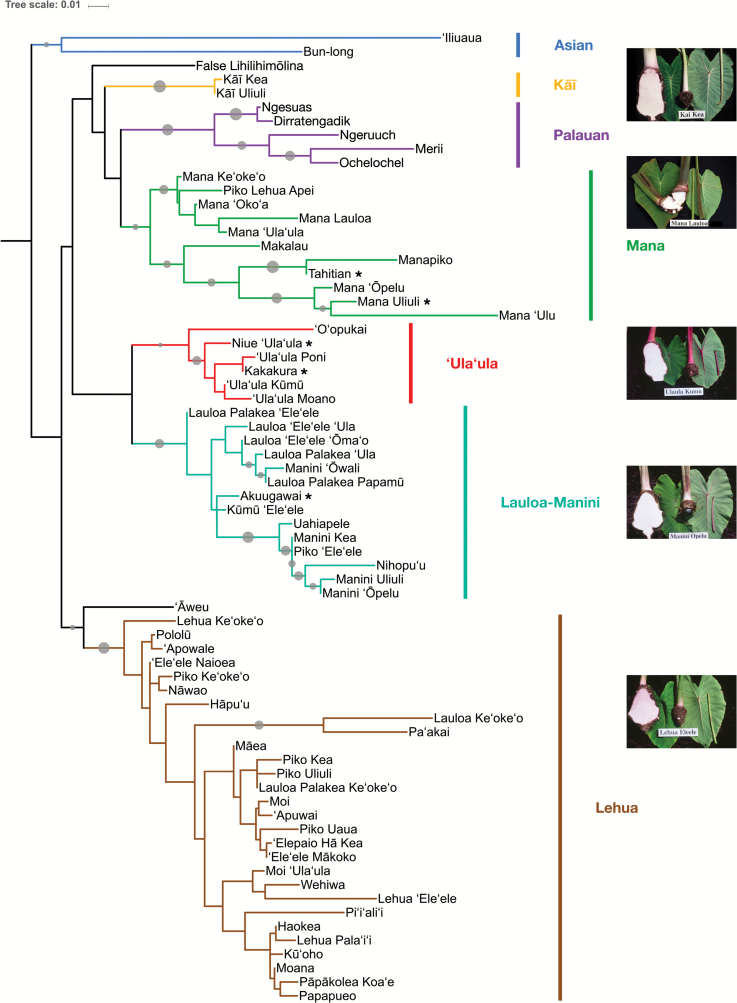
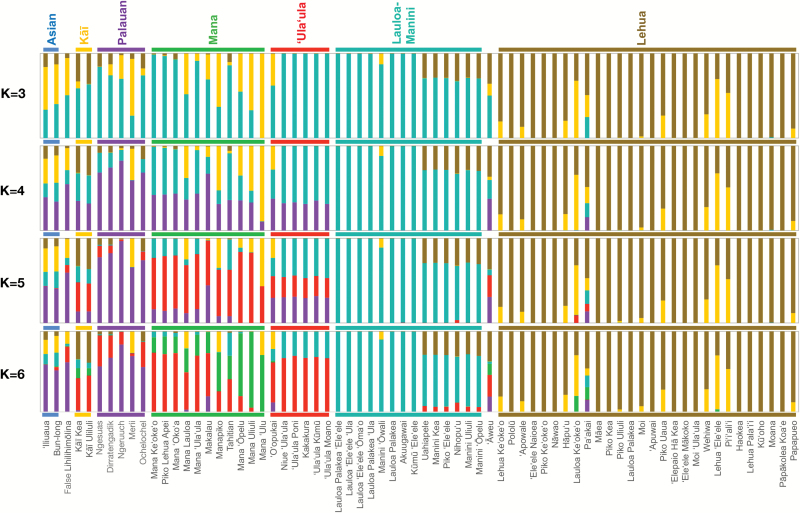
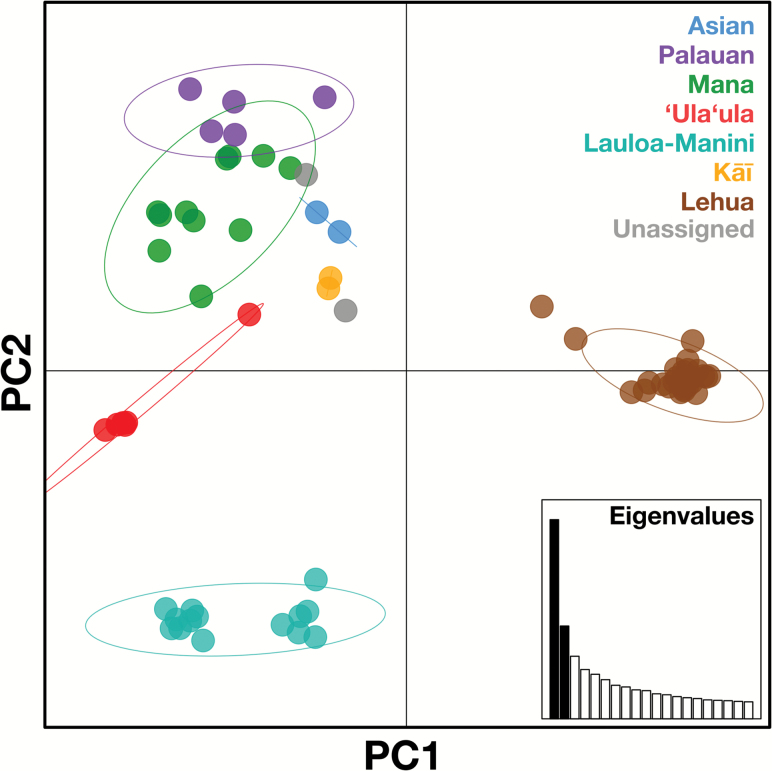
Taro, Colocasia esculenta, is one of the world's oldest root crops and is of particular economic and cultural significance in Hawai'i, where historically more than 150 different landraces were grown. We developed a genome-wide set of more than 2400 high-quality single nucleotide polymorphism (SNP) markers from 70 taro accessions of Hawaiian, South Pacific, Palauan, and mainland Asian origins, with several objectives: 1) uncover the phylogenetic relationships between Hawaiian and other Pacific landraces, 2) shed light on the history of taro cultivation in Hawai'i, and 3) develop a tool to discriminate among Hawaiian and other taros. We found that almost all existing Hawaiian landraces fall into 5 monophyletic groups that are largely consistent with the traditional Hawaiian classification based on morphological characters, for example, leaf shape and petiole color. Genetic diversity was low within these clades but considerably higher between them. Population structure analyses further indicated that the diversification of taro in Hawai'i most likely occurred by a combination of frequent somatic mutation and occasional hybridization. Unexpectedly, the South Pacific accessions were found nested within the clades mainly composed of Hawaiian accessions, rather than paraphyletic to them. This suggests that the origin of clades identified here preceded the colonization of Hawai'i and that early Polynesian settlers brought taro landraces from different clades with them. In the absence of a sequenced genome, this marker set provides a valuable resource towards obtaining a genetic linkage map and to study the genetic basis of phenotypic traits of interest to taro breeding such as disease resistance.
芋头,又称芋艿,是世界上最古老的根茎作物之一,在夏威夷具有特殊的经济和文化意义,历史上曾种植过 150 多种不同的地方品种。我们从 70 份来自夏威夷、南太平洋、帕劳和亚洲大陆的芋头地方品种中,开发了一套超过 2400 个高质量的单核苷酸多态性(SNP)标记,以实现以下目标:1)揭示夏威夷地方品种与其他太平洋地方品种之间的系统发育关系,2)阐明芋头在夏威夷的种植历史,3)开发一种工具来区分夏威夷芋头和其他芋头。我们发现,几乎所有现有的夏威夷地方品种都属于 5 个单系群,这些单系群在很大程度上与基于形态特征的传统夏威夷分类一致,例如叶片形状和叶柄颜色。这些分支内的遗传多样性较低,但它们之间的遗传多样性相当高。种群结构分析进一步表明,芋头在夏威夷的多样化可能是由频繁的体细胞突变和偶尔的杂交相结合造成的。出乎意料的是,南太平洋品种被发现嵌套在主要由夏威夷品种组成的分支内,而不是与它们并系。这表明这里确定的分支起源于夏威夷殖民化之前,早期的波利尼西亚定居者带来了来自不同分支的芋头地方品种。在没有测序基因组的情况下,这个标记集为获得遗传连锁图谱和研究芋头育种中感兴趣的表型性状(如抗病性)的遗传基础提供了宝贵的资源。