Whelan Maxine E, Kingsnorth Andrew P, Orme Mark W, Sherar Lauren B, Esliger Dale W
National Centre for Sport and Exercise Medicine, Loughborough University, Loughborough, Leicestershire, UK.
School of Sport, Exercise and Health Sciences, Loughborough University, Loughborough, Leicestershire, UK.
BMJ Open. 2017 Oct 8;7(10):e018282. doi: 10.1136/bmjopen-2017-018282.
Increasing physical activity (PA) reduces the risk of developing diabetes, highlighting the role of preventive medicine approaches. Changing lifestyle behaviours is difficult and is often predicated on the assumption that individuals are willing to change their lifestyles today to reduce the risk of developing disease years or even decades later. The self-monitoring technologies tested in this study will present PA feedback in real time, parallel with acute physiological data. Presenting the immediate health benefits of being more physically active may help enact change by observing the immediate consequences of that behaviour. The present study aims to assess user engagement with the self-monitoring technologies in individuals at moderate-to-high risk of developing type 2 diabetes.
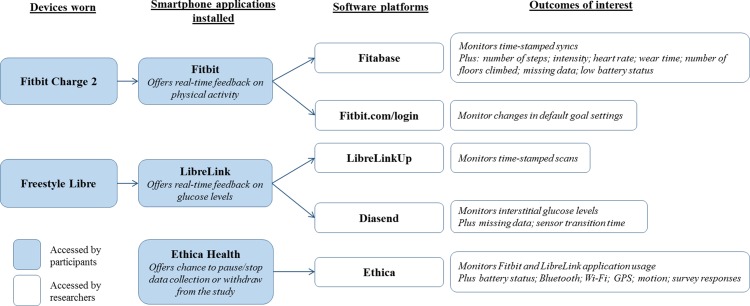
45 individuals with a moderate-to-high risk, aged ≥40 years old and using a compatible smartphone, will be invited to take part in a 7-week protocol. Following 1 week of baseline measurements, participants will be randomised into one of three groups: group 1- glucose feedback followed by biobehavioural feedback (glucose plus PA); group 2-PA feedback followed by biobehavioural feedback; group 3-biobehavioural feedback. A PA monitor and a flash glucose monitor will be deployed during the intervention. Participants will wear both devices throughout the intervention but blinded to feedback depending on group allocation. The primary outcome is the level of participant engagement and will be assessed by device use and smartphone usage. Feasibility will be assessed by the practicality of the technology and screening for diabetes risk. Semistructured interviews will be conducted to explore participant experiences using the technologies.
ISRCTN17545949. Registered on 15/05/2017.
增加身体活动(PA)可降低患糖尿病的风险,凸显了预防医学方法的作用。改变生活方式行为具有挑战性,且通常基于这样一种假设,即个体愿意当下改变生活方式,以降低数年甚至数十年后患病的风险。本研究中测试的自我监测技术将实时呈现身体活动反馈,并与即时生理数据同步。展示更多身体活动带来的即时健康益处,可能通过观察该行为的即时后果来促使改变的发生。本研究旨在评估2型糖尿病中高风险个体对自我监测技术的用户参与度。
将邀请45名年龄≥40岁、中高风险且使用兼容智能手机的个体参与一项为期7周的方案。在进行1周的基线测量后,参与者将被随机分为三组之一:第1组——血糖反馈后接生物行为反馈(血糖加身体活动);第2组——身体活动反馈后接生物行为反馈;第3组——生物行为反馈。在干预期间将部署一个身体活动监测器和一个动态血糖监测仪。参与者在整个干预过程中佩戴这两种设备,但根据分组情况对反馈信息不知情。主要结局是参与者的参与程度,将通过设备使用情况和智能手机使用情况进行评估。将通过技术的实用性和糖尿病风险筛查来评估可行性。将进行半结构化访谈,以探索参与者使用这些技术的体验。
ISRCTN17545949。于2017年5月15日注册。