Nuffield Department of Primary Care Health Sciences, University of Oxford, Oxford, United Kingdom.
National Centre for Sport and Exercise Medicine, Loughborough University, Loughborough, United Kingdom.
JMIR Mhealth Uhealth. 2019 Oct 28;7(10):e14195. doi: 10.2196/14195.
Self-monitoring of behavior (namely, diet and physical activity) and physiology (namely, glucose) has been shown to be effective in type 2 diabetes (T2D) and prediabetes prevention. By combining self-monitoring technologies, the acute physiological consequences of behaviors could be shown, prompting greater consideration to physical activity levels today, which impact the risk of developing diabetes years or decades later. However, until recently, commercially available technologies have not been able to show individuals the health benefits of being physically active.
The objective of this study was to examine the usage, feasibility, and acceptability of behavioral and physiological self-monitoring technologies in individuals at risk of developing T2D.
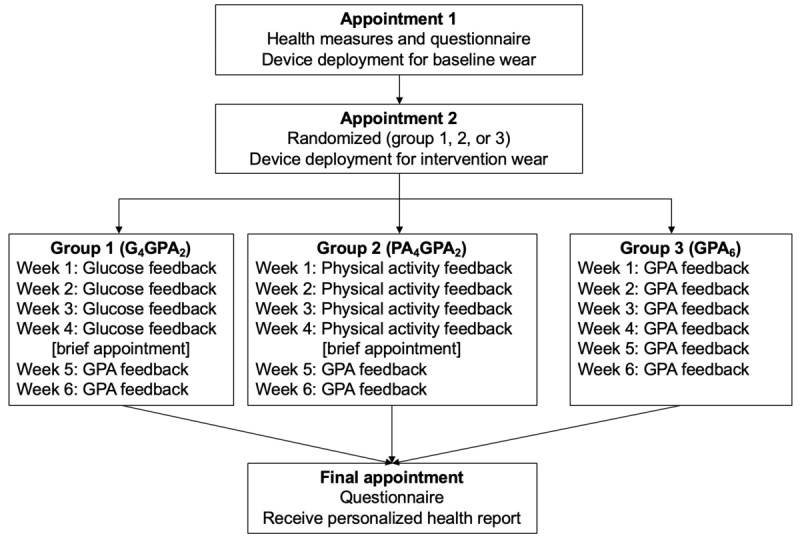
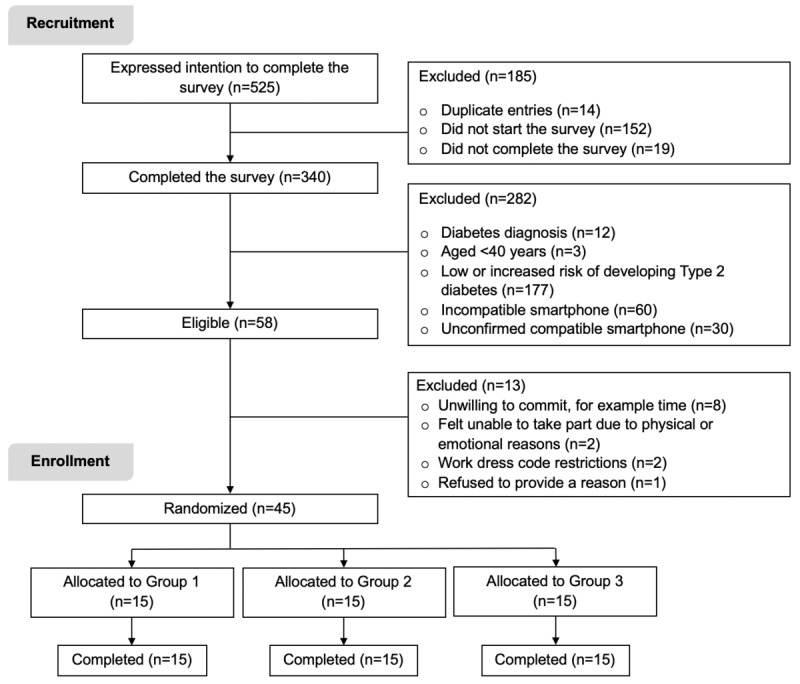
A total of 45 adults aged ≥40 years and at moderate to high risk of T2D were recruited to take part in a 3-arm feasibility trial. Each participant was provided with a behavioral (Fitbit Charge 2) and physiological (FreeStyle Libre flash glucose monitor) monitor for 6 weeks, masked according to group allocation. Participants were allocated to glucose feedback (4 weeks) followed by glucose and physical activity (biobehavioral) feedback (2 weeks; group 1), physical activity feedback (4 weeks) followed by biobehavioral feedback (2 weeks; group 2), or biobehavioral feedback (6 weeks; group 3). Participant usage (including time spent on the apps and number of glucose scans) was the primary outcome. Secondary outcomes were the feasibility (including recruitment and number of sensor displacements) and acceptability (including monitor wear time) of the intervention. Semistructured qualitative interviews were conducted at the 6-week follow-up appointment.
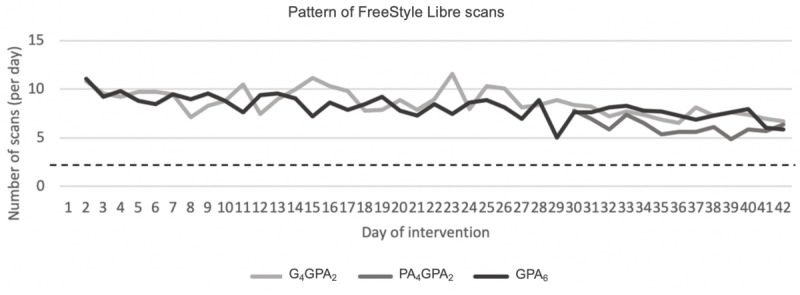
For usage, time spent on the Fitbit and FreeStyle Libre apps declined over the 6 weeks for all groups. Of the FreeStyle Libre sensor scans conducted by participants, 17% (1798/10,582) recorded rising or falling trends in glucose, and 24% (13/45) of participants changed ≥1 of the physical activity goals. For feasibility, 49% (22/45) of participants completed the study using the minimum number of FreeStyle Libre sensors, and a total of 41 sensors were declared faulty or displaced. For acceptability, participants wore the Fitbit for 40.1 (SD 3.2) days, and 20% (9/45) of participants and 53% (24/45) of participants were prompted by email to charge or sync the Fitbit, respectively. Interviews unearthed participant perceptions on the study design by suggesting refinements to the eligibility criteria and highlighting important issues about the usability, wearability, and features of the technologies.
Individuals at risk of developing T2D engaged with wearable digital health technologies providing behavioral and physiological feedback. Modifications are required to both the study and to commercially available technologies to maximize the chances of sustained usage and behavior change. The study and intervention were feasible to conduct and acceptable to most participants.
International Standard Randomized Controlled Trial Number (ISRCTN) 17545949; isrctn.com/ISRCTN17545949.
自我监测行为(即饮食和体育活动)和生理机能(即血糖)已被证明在 2 型糖尿病(T2D)和糖尿病前期预防中有效。通过结合自我监测技术,可以显示行为的急性生理后果,促使人们更多地考虑今天的体育活动水平,因为这会影响未来数年或数十年患糖尿病的风险。然而,直到最近,商业上可用的技术还无法向个人展示进行体育活动的健康益处。
本研究旨在检查行为和生理自我监测技术在有患 T2D 风险的个体中的使用情况、可行性和可接受性。
共招募了 45 名年龄≥40 岁且处于 T2D 中高度风险的成年人参加一项 3 臂可行性试验。每位参与者均被提供了一款行为(Fitbit Charge 2)和生理(FreeStyle Libre 闪光葡萄糖监测器)监测器,使用时间为 6 周,根据分组进行了掩蔽。参与者被分配到葡萄糖反馈(4 周),然后是葡萄糖和身体活动(生物行为)反馈(2 周;第 1 组)、身体活动反馈(4 周),然后是生物行为反馈(2 周;第 2 组)或生物行为反馈(6 周;第 3 组)。参与者的使用情况(包括在应用程序上花费的时间和葡萄糖扫描次数)是主要结局。次要结局是干预措施的可行性(包括招募和传感器位移次数)和可接受性(包括监测器佩戴时间)。在 6 周随访时进行了半结构化定性访谈。
在 6 周的时间里,所有组的 Fitbit 和 FreeStyle Libre 应用程序上的使用时间都减少了。参与者进行的 FreeStyle Libre 传感器扫描中,有 17%(1798/10582)记录了血糖的上升或下降趋势,24%(13/45)的参与者改变了≥1 个身体活动目标。在可行性方面,49%(22/45)的参与者使用最少数量的 FreeStyle Libre 传感器完成了研究,共有 41 个传感器被宣布出现故障或位移。在可接受性方面,参与者佩戴 Fitbit 的时间为 40.1(SD 3.2)天,有 20%(9/45)的参与者和 53%(24/45)的参与者收到了有关为 Fitbit 充电或同步的电子邮件提示。访谈揭示了参与者对研究设计的看法,建议对资格标准进行修改,并强调了技术可用性、可佩戴性和功能方面的重要问题。
有患 T2D 风险的个体参与了提供行为和生理反馈的可穿戴数字健康技术。需要对研究和商业上可用的技术进行修改,以最大限度地提高持续使用和行为改变的机会。该研究和干预措施在实施和接受方面是可行的,大多数参与者都能接受。
国际标准随机对照试验编号(ISRCTN)17545949;isrctn.com/ISRCTN17545949。