Sundermann Alexandra C, Velez Edwards Digna R, Bray Michael J, Jones Sarah H, Latham Sanura M, Hartmann Katherine E
Vanderbilt Epidemiology Center, Institute of Medicine and Public Health, the Vanderbilt Genetics Institute, the Evidence-Based Practice Center, and the Department of Obstetrics and Gynecology, Vanderbilt University Medical Center, Nashville, Tennessee.
Obstet Gynecol. 2017 Nov;130(5):1065-1072. doi: 10.1097/AOG.0000000000002313.
To systematically review studies reporting the risk of spontaneous abortion among pregnant women of typical reproductive potential with and without uterine leiomyomas.
We searched PubMed, EMBASE, Web of Science, and ClinicalTrials.gov for publications from January 1970 to December 2016.
We excluded studies that did not use imaging to uniformly document leiomyoma status of all participants, did not have a comparison group without leiomyomas, or primarily included women seeking care for recurrent miscarriage, infertility care, or assisted reproductive technologies.
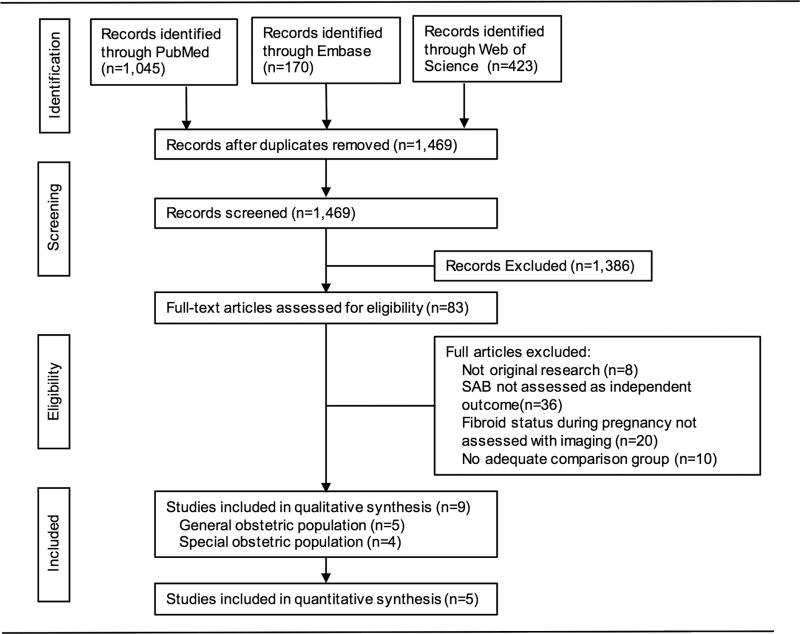
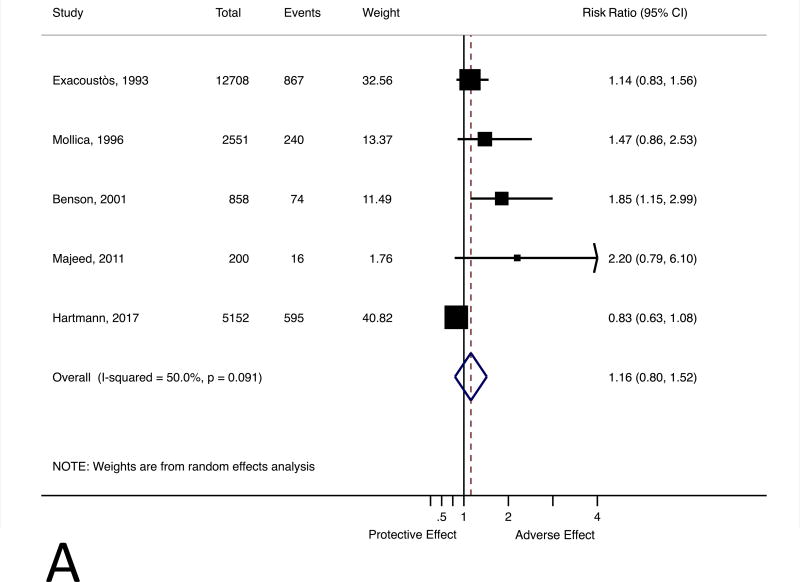
TABULATION, INTEGRATION, AND RESULTS: Two authors independently reviewed eligibility, extracted data, and assigned overall quality ratings based on predetermined criteria. Of 1,469 articles identified, nine were eligible. Five enrolled general obstetric populations and four included women undergoing amniocentesis. In five studies in general obstetric populations that included 21,829 pregnancies (1,394 women with leiomyomas and 20,435 without), only one adjusted for potential confounders. This meta-analysis revealed no increase in risk of spontaneous abortion among those with leiomyomas compared with those without (11.5% compared with 8.0%; risk ratio 1.16, 95% CI 0.80-1.52). When bias from confounding was estimated for nonadjusted studies, the aggregate calculated risk ratio was 0.83 (95% CI 0.68-0.98).
Leiomyoma presence was not associated with increased risk of spontaneous abortion in an analysis of more than 20,000 pregnant women. Failure of prior studies to adjust for confounders may have led to the common clinical belief that leiomyomas are a risk factor for spontaneous abortion.
系统评价报告有或无子宫平滑肌瘤的具有典型生育潜能的孕妇自然流产风险的研究。
我们检索了PubMed、EMBASE、科学网和临床试验.gov,以获取1970年1月至2016年12月期间的出版物。
我们排除了未使用影像学方法统一记录所有参与者平滑肌瘤状态的研究、没有无平滑肌瘤对照组的研究,或主要纳入因反复流产、不孕治疗或辅助生殖技术而寻求治疗的女性的研究。
制表、整合与结果:两位作者独立审查入选资格、提取数据,并根据预定标准分配总体质量评级。在识别出的1469篇文章中,9篇符合要求。5项研究纳入了普通产科人群,4项研究纳入了接受羊膜穿刺术的女性。在纳入21829例妊娠(1394例有平滑肌瘤的女性和20435例无平滑肌瘤的女性)的5项普通产科人群研究中,只有1项对潜在混杂因素进行了调整。这项荟萃分析显示,与无平滑肌瘤者相比,有平滑肌瘤者自然流产风险并未增加(分别为11.5%和8.0%;风险比1.16,95%可信区间0.80 - 1.52)。当对未调整的研究估计混杂偏倚时,汇总计算的风险比为0.83(95%可信区间0.68 - 0.98)。
在对20000多名孕妇的分析中,平滑肌瘤的存在与自然流产风险增加无关。既往研究未对混杂因素进行调整可能导致了临床上普遍认为平滑肌瘤是自然流产的一个危险因素。