Mercer Laina D, Safdar Rana M, Ahmed Jamal, Mahamud Abdirahman, Khan M Muzaffar, Gerber Sue, O'Leary Aiden, Ryan Mike, Salet Frank, Kroiss Steve J, Lyons Hil, Upfill-Brown Alexander, Chabot-Couture Guillaume
Institute for Disease Modeling, 3150 138th Ave SE, Bellevue, WA, 98005, USA.
National Emergency Operations Centre for Polio Eradication, Islamabad, Pakistan.
BMC Med. 2017 Oct 11;15(1):180. doi: 10.1186/s12916-017-0941-2.
Pakistan is one of only three countries where poliovirus circulation remains endemic. For the Pakistan Polio Eradication Program, identifying high risk districts is essential to target interventions and allocate limited resources.
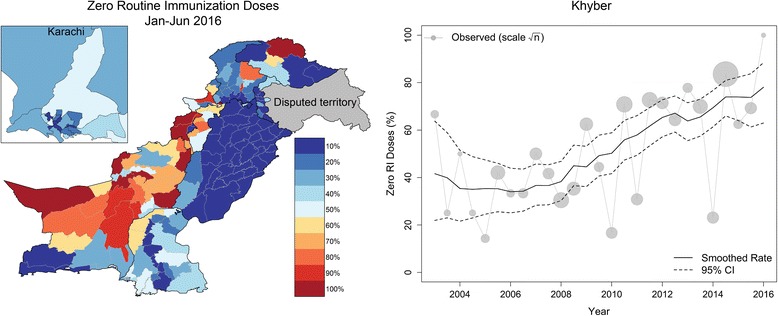
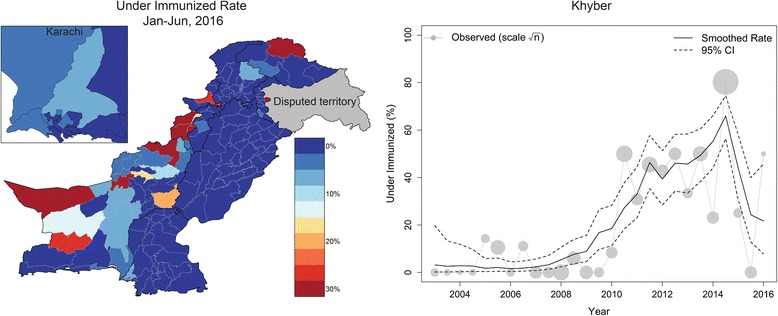
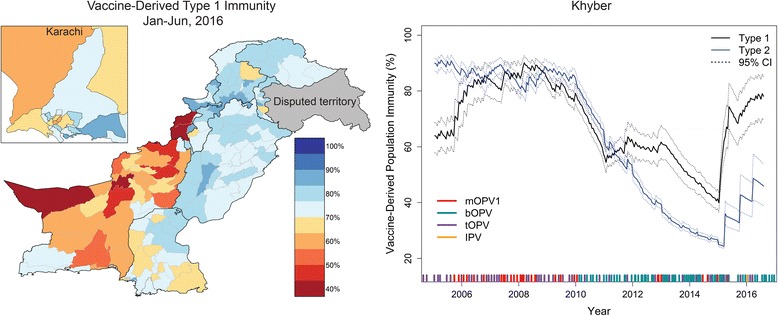
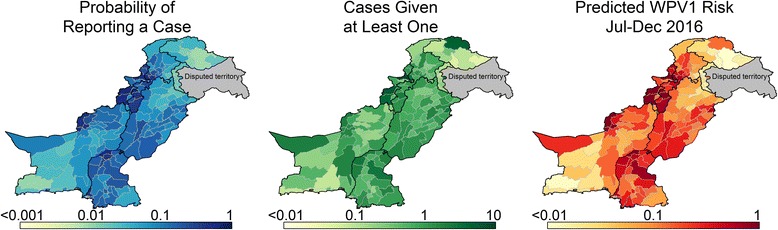
Using a hierarchical Bayesian framework we developed a spatial Poisson hurdle model to jointly model the probability of one or more paralytic polio cases, and the number of cases that would be detected in the event of an outbreak. Rates of underimmunization, routine immunization, and population immunity, as well as seasonality and a history of cases were used to project future risk of cases.
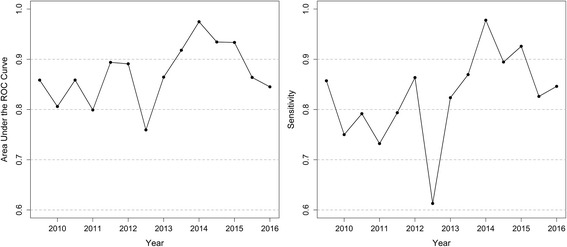
The expected number of cases in each district in a 6-month period was predicted using indicators from the previous 6-months and the estimated coefficients from the model. The model achieves an average of 90% predictive accuracy as measured by area under the receiver operating characteristic (ROC) curve, for the past 3 years of cases.
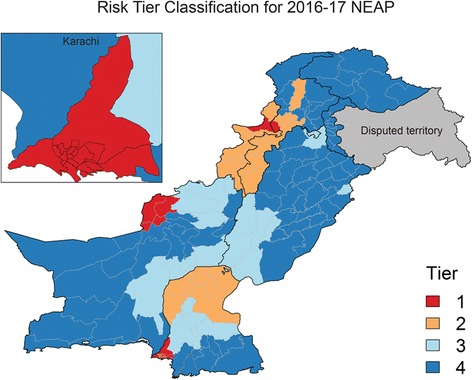
The risk of poliovirus has decreased dramatically in many of the key reservoir areas in Pakistan. The results of this model have been used to prioritize sub-national areas in Pakistan to receive additional immunization activities, additional monitoring, or other special interventions.
巴基斯坦是仅有的三个脊髓灰质炎病毒仍呈地方性流行的国家之一。对于巴基斯坦脊髓灰质炎根除计划而言,确定高风险地区对于针对性干预措施以及分配有限资源至关重要。
我们使用分层贝叶斯框架开发了一种空间泊松障碍模型,以联合模拟出现一例或多例麻痹性脊髓灰质炎病例的概率,以及在疫情暴发时预计会检测到的病例数。未免疫接种率、常规免疫接种率和人群免疫力,以及季节性和病例史被用于预测未来病例风险。
使用前6个月的指标和模型估计系数预测了每个地区6个月内的预期病例数。根据过去3年病例的受试者工作特征(ROC)曲线下面积衡量,该模型平均预测准确率达到90%。
巴基斯坦许多关键疫源地的脊髓灰质炎病毒风险已大幅下降。该模型的结果已被用于确定巴基斯坦国内哪些地区应优先开展额外的免疫活动、加强监测或采取其他特殊干预措施。