Busutil Rafael, Espallardo Olga, Torres Antonio, Martínez-Galdeano Lucía, Zozaya Néboa, Hidalgo-Vega Álvaro
Seminario de Investigación en Economía y Salud, University of Castilla-La Mancha, Toledo, Spain.
Hospital Clínico San Carlos, Madrid, Spain.
Health Qual Life Outcomes. 2017 Oct 10;15(1):197. doi: 10.1186/s12955-017-0773-y.
It is well documented that obesity is strongly associated with mortality and morbidity, but less is known about its impact on functional status and health-related quality of life (HRQOL). The purpose of this study was to calculate the impact of the Body Mass Index (BMI) on the HRQOL of the Spanish adult population, with special emphasis on BMI ≥ 35.
We used the Spanish National Health Survey (SNHS) 2011-2012 to assess the statistical association between HRQOL, measured through the EuroQol-5D-5L questionnaire, and the BMI. We conducted linear regression analysis for the EuroQol-5D-5L Visual Analogue Scale (VAS) and probit regressions for each of the five dimensions of the EuroQol-5D-5L.
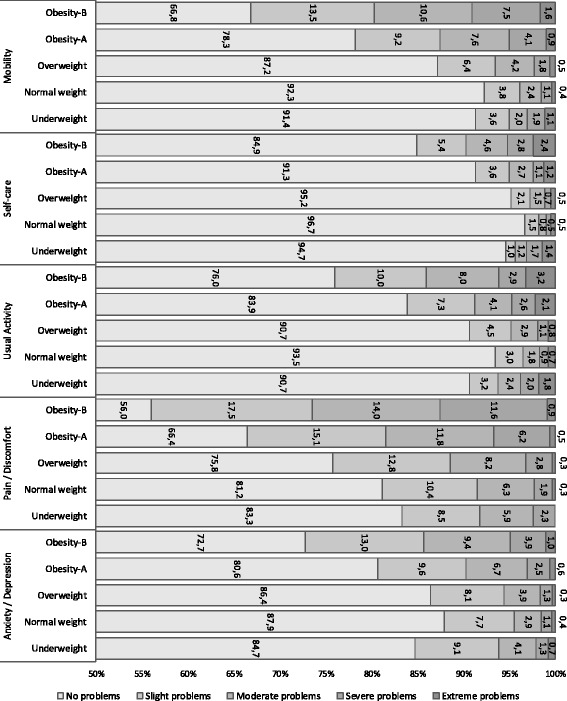
Self-perceived problems in the five dimensions of the EuroQol-5D-5L increased along the BMI, especially in the mobility and pain/discomfort dimensions. Having a BMI ≥ 35 reduced HRQOL even in the absence of chronic diseases. After controlling for comorbidities, severe obesity decreased the VAS score by an average of 1.9 points and increased the probability of reporting any HRQOL problem in mobility (11.8%), self-care (2.2%), usual activities (4.3%) and pain/discomfort (7.4%). No association was found between obesity and mental problems. All the parameters analysed suggest that HRQOL in women and people aged 65 years and over was significantly worse than average.
BMI is an explanatory factor of self-perceived quality of life. Obesity is associated with a worse HRQOL, especially in women and people aged over 64 years. These results may be useful for designing prevention or treatment health policies to target obesity among the Spanish population.
肥胖与死亡率和发病率密切相关,这一点已有充分记录,但关于其对功能状态和健康相关生活质量(HRQOL)的影响,人们了解较少。本研究的目的是计算体重指数(BMI)对西班牙成年人群HRQOL的影响,特别关注BMI≥35的情况。
我们使用2011 - 2012年西班牙国家健康调查(SNHS)来评估通过欧洲五维健康量表(EuroQol - 5D - 5L)问卷测量的HRQOL与BMI之间的统计关联。我们对EuroQol - 5D - 5L视觉模拟量表(VAS)进行线性回归分析,并对EuroQol - 5D - 5L的五个维度分别进行概率回归分析。
EuroQol - 5D - 5L五个维度的自我感知问题随BMI增加而增多,尤其是在活动能力和疼痛/不适维度。即使在没有慢性病的情况下,BMI≥35也会降低HRQOL。在控制合并症后,重度肥胖使VAS评分平均降低了1.9分,并增加了在活动能力(11.8%)、自我护理(2.2%)、日常活动(4.3%)和疼痛/不适(7.4%)方面报告任何HRQOL问题的概率。未发现肥胖与心理问题之间存在关联。所有分析参数表明,女性以及65岁及以上人群的HRQOL明显低于平均水平。
BMI是自我感知生活质量的一个解释因素。肥胖与较差的HRQOL相关联,尤其是在女性和64岁以上人群中。这些结果可能有助于设计针对西班牙人群肥胖问题的预防或治疗健康政策。