Wang Jinping, Shi Jun, Wei Jiawei, Wang Juan, Gao Kuo, Li Xueli, Chen Jianxin, Li Shaojing, Zhao Huihui, Wang Wei
Beijing University of Chinese Medicine, Bei San Huan Dong Lu, Chao Yang District, Beijing, 100029, China.
Department of Physiology, Basic Medical College, Inner Mongolia Medical University, Xinhua Street, Hui Min district, Hohhot, China.
Trials. 2017 Oct 10;18(1):468. doi: 10.1186/s13063-017-2193-z.
Chronic heart failure (CHF), the final stage of various cardiovascular diseases, is a major public health problem resulting in significant hospitalization rates, mortality, and huge health care costs despite advances in the treatment and management of heart failure and heart failure-related risk factors. Qishen granules (QSG), a Chinese herbal formula, is widely used by traditional Chinese medicine (TCM) practitioners to treat CHF. Several animal experimental studies have showed that QSG can significantly relieve the heart failure symptoms in CHF rat models. However, there is as yet no standard clinical trial to confirm this. Thus, the investigators are conducting this study to evaluate the efficacy and safety of QSG in a large, and varied population.
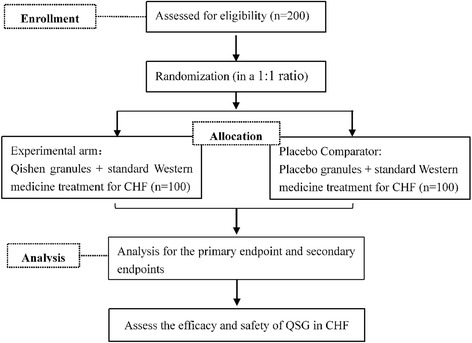
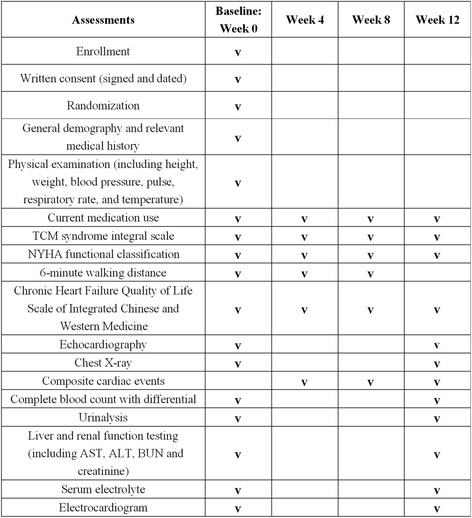
METHODS/DESIGN: This study is designed as a randomized, placebo-controlled, multi-center, double-blind clinical trial with parallel groups. A total of 200 patients with CHF will be recruited and randomly allocated to either the QSG treatment group or the placebo group (in a 1:1 ratio). The patients will receive QSG or placebo granules twice a day for 12 weeks. The primary outcome is the proportion of patients in the QSG group, compared with the placebo group, demonstrating a more than 30% decrease in NT-proBNP level during 12 weeks of treatment. The secondary outcomes consist of composite cardiac events, New York Heart Association functional classification, 6-minute walking distance, left ventricular ejection fraction, patient quality of life, and the TCM syndrome integral scale.
On a background of standard treatment, QSG may further reduce the levels of NT-proBNP. This trial will provide high-quality evidence on the efficacy and safety of QSG in treating CHF, thus providing reference for clinical application of QSG.
Clinical Trials.gov: NCT03027375 . Registered on 16 January 2017.
慢性心力衰竭(CHF)是各种心血管疾病的终末阶段,尽管在心力衰竭及其相关危险因素的治疗和管理方面取得了进展,但它仍是一个重大的公共卫生问题,导致了较高的住院率、死亡率以及巨大的医疗费用。芪参颗粒(QSG)是一种中药配方,被中医从业者广泛用于治疗CHF。多项动物实验研究表明,QSG可显著缓解CHF大鼠模型的心力衰竭症状。然而,目前尚无标准的临床试验来证实这一点。因此,研究人员正在开展这项研究,以评估QSG在大量不同人群中的疗效和安全性。
方法/设计:本研究设计为一项随机、安慰剂对照、多中心、双盲的平行组临床试验。共招募200例CHF患者,并随机分配至QSG治疗组或安慰剂组(比例为1:1)。患者每天服用QSG或安慰剂颗粒两次,持续12周。主要结局是与安慰剂组相比,QSG组患者在12周治疗期间NT-proBNP水平下降超过30%的比例。次要结局包括复合心脏事件、纽约心脏协会功能分级、6分钟步行距离、左心室射血分数、患者生活质量以及中医证候积分量表。
在标准治疗的背景下,QSG可能进一步降低NT-proBNP水平。本试验将为QSG治疗CHF的疗效和安全性提供高质量证据,从而为QSG的临床应用提供参考。
ClinicalTrials.gov:NCT03027375。于2017年1月16日注册。