The Icelandic Institute of Natural History, Urridaholtsstraeti 6-8, 212, Gardabaer, Iceland.
Institute for Experimental Pathology at Keldur, University of Iceland, Keldnavegur 3, 112, Reykjavik, Iceland.
Parasit Vectors. 2017 Oct 10;10(1):466. doi: 10.1186/s13071-017-2375-2.
Ixodes ricinus is a three-host tick, a principal vector of Borrelia burgdorferi (s.l.) and one of the main vectors of tick-borne encephalitis (TBE) virus. Iceland is located in the North Atlantic Ocean with subpolar oceanic climate. During the past 3-4 decades, average temperature has increased, supporting more favourable conditions for ticks. Reports of I. ricinus have increased in recent years. If these ticks were able to establish in a changing climate, Iceland may face new threats posed by tick-borne diseases.
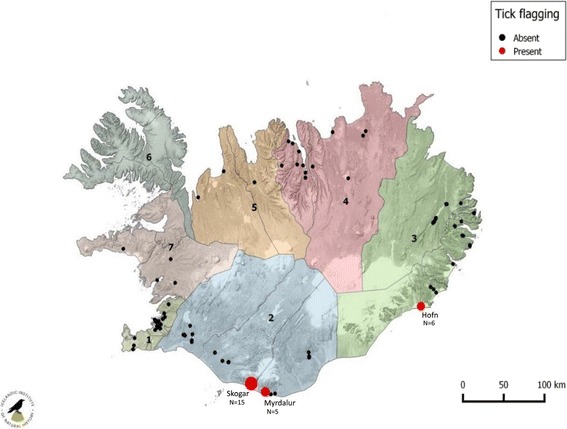
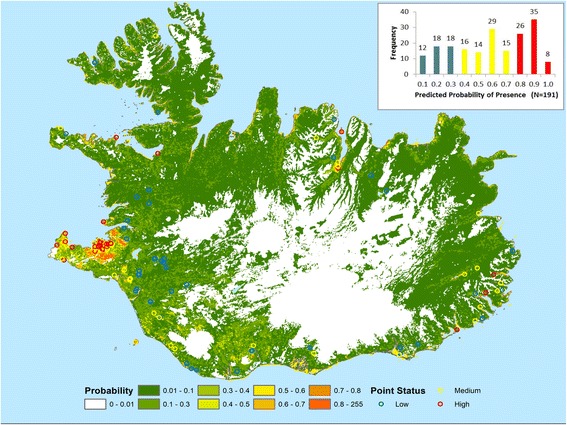
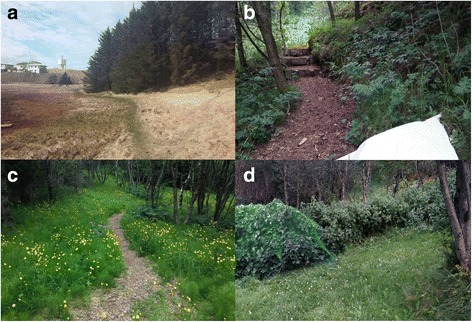
Active field surveillance by tick flagging was conducted at 111 sites around Iceland from August 2015 to September 2016. Longworth mammal traps were used to trap Apodemus sylvaticus in southwestern and southern Iceland. Surveillance on tick importation by migratory birds was conducted in southeastern Iceland, using bird nets and a Heligoland trap. Vulpes lagopus carcasses from all regions of the country were inspected for ticks. In addition, existing and new passive surveillance data from two institutes have been merged and are presented. Continental probability of presence models were produced. Boosted Regression Trees spatial modelling methods and its predictions were assessed against reported presence.
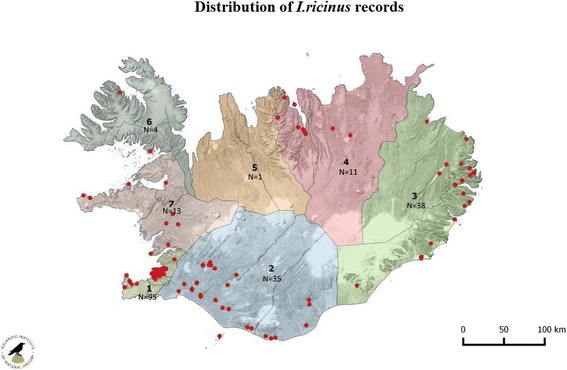
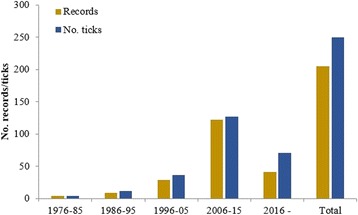
By field sampling 26 questing I. ricinus ticks (7 males, 3 females and 16 nymphs) were collected from vegetation from three locations in southern and southeastern Iceland. Four ticks were found on migratory birds at their arrival in May 2016. A total of 52 A. sylvaticus were live-trapped but no ticks were found nor on 315 V. lagopus carcasses. Passive surveillance data collected since 1976, reports further 214 I. ricinus ticks from 202 records, with an increase of submissions in recent years. The continental probability of presence model correctly predicts approximately 75% of the recorded presences, but fails to predict a fairly specific category of recorded presence in areas where the records are probably opportunistic and not likely to lead to establishment.
To the best of our knowledge, this study represents the first finding of questing I. ricinus ticks in Iceland. The species could possibly be established locally in Iceland in low abundance, although no questing larvae have yet been detected to confirm established populations. Submitted tick records have increased recently, which may reflect an increase in exposure, or in interest in ticks. Furthermore, the amount of records on dogs, cats and humans indicate that ticks were acquired locally, presenting a local biting risk. Tick findings on migratory birds highlight a possible route of importation. Obtaining questing larvae is now a priority to confirm that I. ricinus populations are established in Iceland. Further surveys on wild mammals (e.g. Rangifer tarandus), livestock and migratory birds are recommended to better understand their role as potential hosts for I. ricinus.
硬蜱属(Ixodes)是三宿主蜱,是伯氏疏螺旋体(Borrelia burgdorferi)(s.l.)的主要传播媒介之一,也是蜱传脑炎(Tick-borne encephalitis,TBE)病毒的主要传播媒介之一。冰岛位于北大西洋,属副极地海洋性气候。过去 30-40 年来,平均气温上升,为蜱类提供了更有利的生存条件。近年来,硬蜱属的报告有所增加。如果这些蜱类能够在不断变化的气候中建立种群,冰岛可能会面临蜱传疾病带来的新威胁。
2015 年 8 月至 2016 年 9 月,在冰岛各地的 111 个地点进行了主动实地监测。在冰岛西南部和南部,使用长吻果蝠陷阱捕捉林姬鼠。在冰岛东南部,利用鸟网和 Heligoland 陷阱对候鸟传播的蜱类进行监测。对来自该国所有地区的赤狐尸骸进行了蜱类检查。此外,还合并了两个研究所现有的和新的被动监测数据,并进行了呈现。制作了大陆存在概率模型。评估了增强回归树空间建模方法及其预测结果与报告存在情况的吻合程度。
通过实地采样,从冰岛南部和东南部的三个地点的植被中采集到了 26 只正在觅食的硬蜱(7 只雄性、3 只雌性和 16 只若虫)。在 2016 年 5 月候鸟到达时,在 4 只候鸟身上发现了 4 只蜱。共活捕了 52 只林姬鼠,但在 315 只赤狐尸骸上未发现蜱类,也未在 214 只报告的硬蜱属中发现。自 1976 年以来收集的被动监测数据进一步报告了 214 只硬蜱,来自 202 条记录,近年来提交的记录有所增加。大陆存在概率模型正确预测了大约 75%的记录存在情况,但未能预测在记录可能是偶然的、不太可能导致种群建立的特定区域的记录情况。
据我们所知,这项研究代表了在冰岛首次发现硬蜱属正在觅食的蜱。该物种可能在冰岛以低丰度建立局部种群,尽管尚未检测到正在觅食的幼虫来确认建立的种群。最近提交的蜱类记录有所增加,这可能反映了接触蜱类的增加,或者对蜱类的兴趣增加。此外,狗、猫和人类的蜱类记录表明蜱类是在当地获得的,这表明存在当地的叮咬风险。在候鸟身上发现蜱类突出了其可能作为传播媒介的途径。获得正在觅食的幼虫是确认冰岛硬蜱种群是否建立的当务之急。建议对野生哺乳动物(如驯鹿)、家畜和候鸟进行进一步调查,以更好地了解它们作为硬蜱属潜在宿主的作用。