Goodman Jarid, McIntyre Christa K
School of Behavioral and Brain Sciences, University of Texas at Dallas, RichardsonTX, United States.
Front Pharmacol. 2017 Sep 22;8:663. doi: 10.3389/fphar.2017.00663. eCollection 2017.
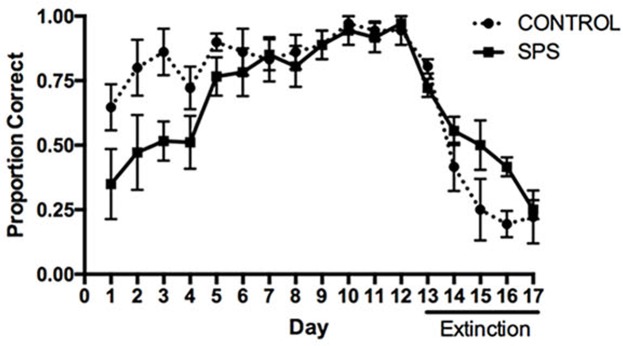
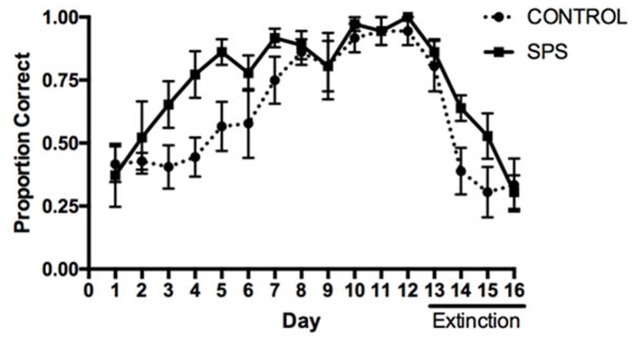
High levels of emotional arousal can impair spatial memory mediated by the hippocampus, and enhance stimulus-response (S-R) habit memory mediated by the dorsolateral striatum (DLS). The present study was conducted to determine whether these memory systems may be similarly affected in an animal model of post-traumatic stress disorder (PTSD). Sprague-Dawley rats were subjected to a "single-prolonged stress" (SPS) procedure and 1 week later received training in one of two distinct versions of the plus-maze: a hippocampus-dependent place learning task or a DLS-dependent response learning task. Results indicated that, relative to non-stressed control rats, SPS rats displayed slower acquisition in the place learning task and faster acquisition in the response learning task. In addition, extinction of place learning and response learning was impaired in rats exposed to SPS, relative to non-stressed controls. The influence of SPS on hippocampal spatial memory and DLS habit memory observed in the present study may be relevant to understanding some common features of PTSD, including hippocampal memory deficits, habit-like avoidance responses to trauma-related stimuli, and greater likelihood of developing drug addiction and alcoholism.
高水平的情绪唤起会损害由海马体介导的空间记忆,并增强由背外侧纹状体(DLS)介导的刺激-反应(S-R)习惯记忆。本研究旨在确定在创伤后应激障碍(PTSD)动物模型中,这些记忆系统是否会受到类似影响。将斯普拉格-道利大鼠进行“单次长时间应激”(SPS)处理,1周后在两种不同版本的十字迷宫中接受训练:一种是依赖海马体的位置学习任务,另一种是依赖DLS的反应学习任务。结果表明,相对于未受应激的对照大鼠,SPS大鼠在位置学习任务中的习得速度较慢,而在反应学习任务中的习得速度较快。此外,相对于未受应激的对照大鼠,暴露于SPS的大鼠在位置学习和反应学习的消退方面受到损害。本研究中观察到SPS对海马体空间记忆和DLS习惯记忆的影响可能与理解PTSD的一些共同特征有关,包括海马体记忆缺陷、对创伤相关刺激的习惯性回避反应,以及发展成药物成瘾和酒精中毒的更大可能性。