Kobal Ronaldo, Pereira Lucas A, Zanetti Vinicius, Ramirez-Campillo Rodrigo, Loturco Irineu
Nucleus of High Performance in Sport (NAR), São Paulo, Brazil.
Red Bull Brazil, Jarinú, Brazil.
Front Physiol. 2017 Sep 26;8:742. doi: 10.3389/fphys.2017.00742. eCollection 2017.
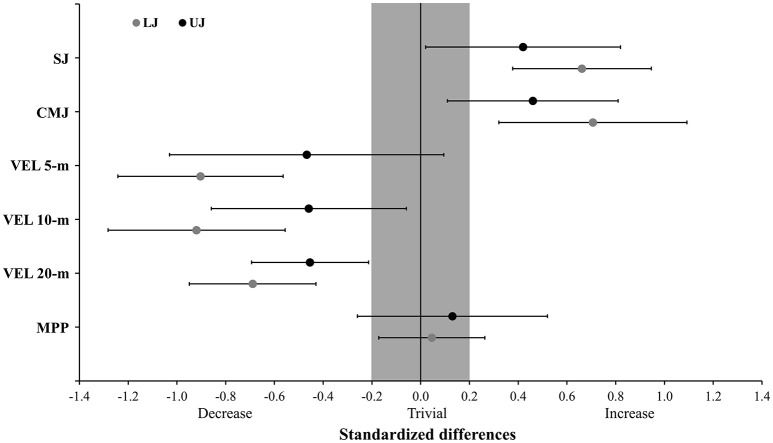
The purpose of this study was to investigate the effects of loaded and unloaded plyometric training strategies on speed and power performance of elite young soccer players. Twenty-three under-17 male soccer players (age: 15.9 ± 1.2 years, height: 178.3 ± 8.1 cm, body-mass (BM): 68.1 ± 9.3 kg) from the same club took part in this study. The athletes were pair-matched in two training groups: loaded vertical and horizontal jumps using an haltere type handheld with a load of 8% of the athletes' body mass (LJ; = 12) and unloaded vertical and horizontal plyometrics (UJ; = 11). Sprinting speeds at 5-, 10-, and 20-m, mean propulsive power (MPP) relative to the players' BM in the jump squat exercise, and performance in the squat jump (SJ) and countermovement jump (CMJ) were assessed pre- and post-training period. During the experimental period, soccer players performed 12 plyometric training sessions across a 6-week preseason period. Magnitude based inferences and standardized differences were used for statistical analysis. A increase in the vertical jumps was observed for the LJ group (99/01/00 and 98/02/00 for SJ and CMJ, respectively). In the UJ group a increase was observed for both vertical jumps (83/16/01 and 90/10/00, for SJ and CMJ, respectively). An decrease in the sprinting velocities along the 20-m course were found in the LJ group (00/00/100 for all split distances tested). Meanwhile, in the UJ to decreases were observed for all sprinting velocities tested (03/18/79, 01/13/86, and 00/04/96, for velocities in 5-, 10-, and 20-m, respectively). No meaningful differences were observed for the MPP in either training group (11/85/04 and 37/55/08 for LJ and UJ, respectively). In summary, under-17 professional soccer players increased jumping ability after a 6-week preseason training program, using loaded or unloaded jumps. Despite these positive adaptations, both plyometric strategies failed to produce worthwhile improvements in maximal speed and power performances, which is possible related to the interference of concurrent training effects. New training strategies should be developed to ensure adequate balance between power and endurance loads throughout short (and high-volume) soccer preseasons.
本研究旨在调查负重和不负重的增强式训练策略对精英青少年足球运动员速度和力量表现的影响。来自同一俱乐部的23名17岁以下男性足球运动员(年龄:15.9±1.2岁,身高:178.3±8.1厘米,体重(BM):68.1±9.3千克)参与了本研究。运动员被配对分为两个训练组:使用哑铃式手持重物进行负重垂直和水平跳跃,重物重量为运动员体重的8%(LJ组;n = 12)以及不负重的垂直和水平增强式训练(UJ组;n = 11)。在训练前后分别评估了5米、10米和20米处的短跑速度、跳蹲练习中相对于运动员体重的平均推进力(MPP)以及深蹲跳(SJ)和反向移动跳(CMJ)的表现。在实验期间,足球运动员在为期6周的季前赛期间进行了12次增强式训练课程。基于量级的推断和标准化差异用于统计分析。LJ组垂直跳跃有增加(SJ和CMJ分别为99/01/00和98/02/00)。UJ组两个垂直跳跃均有增加(SJ和CMJ分别为83/16/01和90/10/00)。LJ组在20米跑道上的短跑速度有所下降(所有测试分段距离均为00/00/100)。同时,UJ组所有测试的短跑速度均出现下降(5米、10米和20米处的速度分别为03/18/79、01/13/86和00/04/96)。两个训练组的MPP均未观察到有意义的差异(LJ组和UJ组分别为11/85/04和37/55/08)。总之,17岁以下职业足球运动员在为期6周的季前训练计划后,无论使用负重还是不负重跳跃,跳跃能力均有所提高。尽管有这些积极的适应性变化,但两种增强式训练策略均未能在最大速度和力量表现上产生有价值的提升,这可能与同时进行的训练效果的干扰有关。应制定新的训练策略,以确保在短时间(且高强度)的足球季前赛中,力量和耐力负荷之间达到适当的平衡。