
使用平均推进速度确定深蹲跳中的最佳功率负荷。
Determining the Optimum Power Load in Jump Squat Using the Mean Propulsive Velocity.
作者信息
Loturco Irineu, Nakamura Fabio Yuzo, Tricoli Valmor, Kobal Ronaldo, Cal Abad Cesar Cavinato, Kitamura Katia, Ugrinowitsch Carlos, Gil Saulo, Pereira Lucas Adriano, González-Badillo Juan José
机构信息
NAR - Nucleus of High Performance in Sport, São Paulo, SP, Brazil; Faculty of Sport, Pablo de Olavide University, Seville, Spain.
NAR - Nucleus of High Performance in Sport, São Paulo, SP, Brazil; State University of Londrina, Londrina, PR, Brazil.
出版信息
PLoS One. 2015 Oct 7;10(10):e0140102. doi: 10.1371/journal.pone.0140102. eCollection 2015.
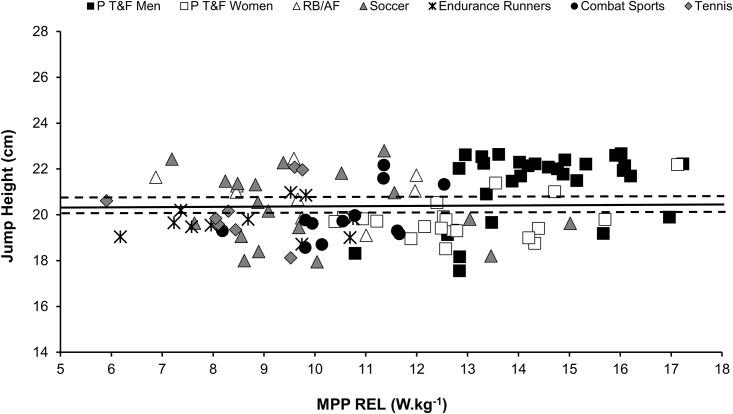
The jump squat is one of the exercises most frequently used to improve lower body power production, which influences sports performance. However, the traditional determination of the specific workload at which power production is maximized (i.e., optimum power load) is time-consuming and requires one-repetition maximum tests. Therefore, the aim of this study was to verify whether elite athletes from different sports would produce maximum mean propulsive power values at a narrow range of mean propulsive velocities, resulting in similar jump heights. One hundred and nine elite athletes from several individual/team sport disciplines underwent repetitions at maximal velocity with progressive loads, starting at 40% of their body mass with increments of 10% to determine the individual optimum power zone. Results indicated that regardless of sport discipline, the athletes' optimum mean propulsive power was achieved at a mean propulsive velocity close to 1.0 m.s(-1) (1.01 ± 0.07 m.s(-1)) and at a jump height close to 20 cm (20.47 ± 1.42 cm). Data were narrowly scattered around these values. Therefore, jump squat optimum power load can be determined simply by means of mean propulsive velocity or jump height determination in training/testing settings, allowing it to be implemented quickly in strength/power training.
深蹲跳是最常用于提高下肢力量输出的训练动作之一,而下肢力量输出会影响运动表现。然而,传统上确定力量输出最大化时的具体负荷(即最佳力量负荷)既耗时又需要进行一次最大重复次数测试。因此,本研究的目的是验证来自不同运动项目的精英运动员是否会在较窄的平均推进速度范围内产生最大平均推进力值,从而获得相似的跳跃高度。109名来自多个个人/团体运动项目的精英运动员以最大速度进行递增负荷重复训练,起始负荷为其体重的40%,每次递增10%,以确定个人最佳力量区域。结果表明,无论运动项目如何,运动员的最佳平均推进力均在平均推进速度接近1.0米/秒(1.01±0.07米/秒)且跳跃高度接近20厘米(20.47±1.42厘米)时实现。数据围绕这些值分布较为集中。因此,在训练/测试环境中,通过测定平均推进速度或跳跃高度即可简单地确定深蹲跳的最佳力量负荷,从而能够在力量/功率训练中快速应用。


 Zotero 插件