Yasmin Farzana, Tun Hein Min, Konya Theodore Brian, Guttman David S, Chari Radha S, Field Catherine J, Becker Allan B, Mandhane Piush J, Turvey Stuart E, Subbarao Padmaja, Sears Malcolm R, Scott James A, Dinu Irina, Kozyrskyj Anita L
Department of Public Health Sciences, University of Alberta, Edmonton, AB, Canada.
Department of Pediatrics, University of Alberta, Edmonton, AB, Canada.
Front Pediatr. 2017 Sep 26;5:200. doi: 10.3389/fped.2017.00200. eCollection 2017.
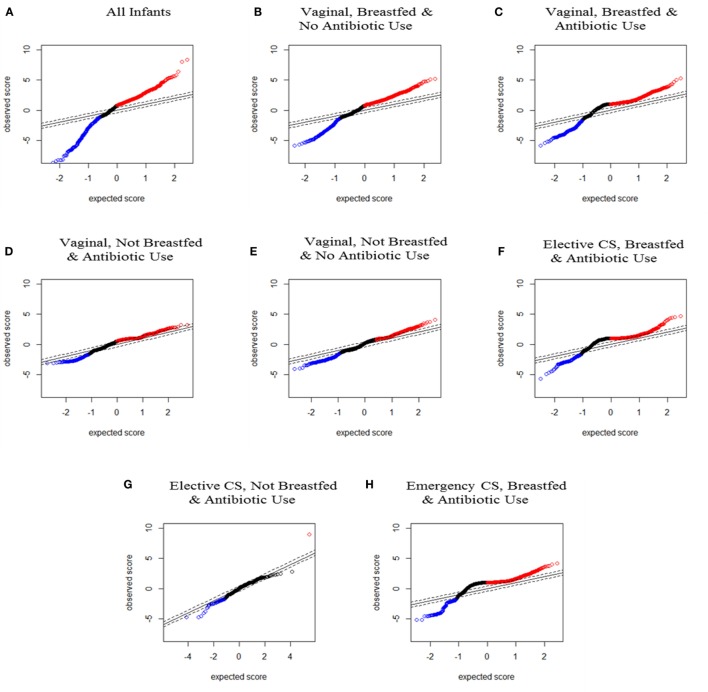
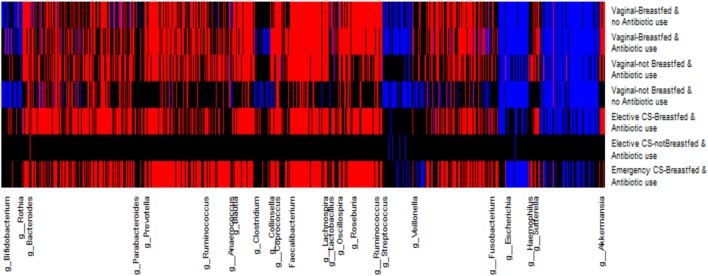
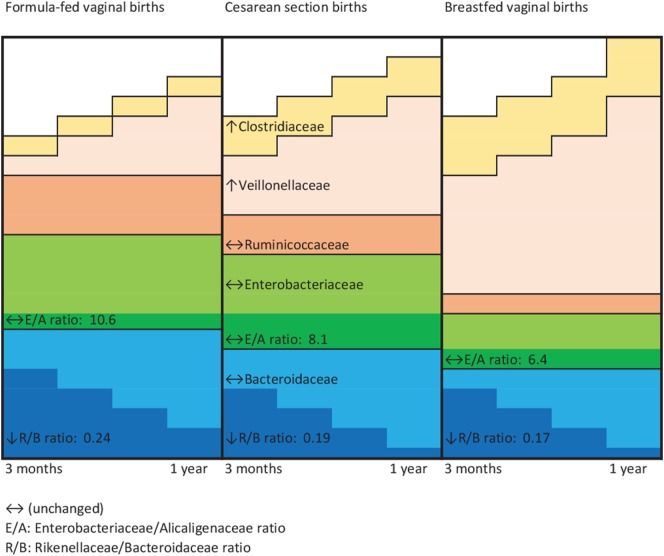
Established during infancy, our complex gut microbial community is shaped by medical interventions and societal preferences, such as cesarean section, formula feeding, and antibiotic use. We undertook this study to apply the significance analysis of microarrays (SAM) method to quantify changes in gut microbial composition during later infancy following the most common birth and postnatal exposures affecting infant gut microbial composition. Gut microbiota of 166 full-term infants in the Canadian Healthy Infant Longitudinal Development birth cohort were profiled using 16S high-throughput gene sequencing. Infants were placed into groups according to mutually exclusive combinations of birth mode (vaginal/cesarean birth), breastfeeding status (yes/no), and antibiotic use (yes/no) by 3 months of age. Based on repeated permutations of data and adjustment for the false discovery rate, the SAM statistic identified statistically significant changes in gut microbial abundance between 3 months and 1 year of age within each infant group. We observed well-known patterns of microbial phyla succession in later infancy (declining Proteobacteria; increasing Firmicutes and Bacteroidetes) following vaginal birth, breastfeeding, and no antibiotic exposure. Genus , and species appeared in the top 10 increases to microbial abundance in these infants. Deviations from this pattern were evident among infants with other perinatal co-exposures; notably, the largest number of microbial species with unchanged abundance was seen in gut microbiota following early cessation of breastfeeding in infants. With and without antibiotic exposure, the absence of a breast milk diet by 3 months of age following vaginal birth yielded a higher proportion of unchanged abundance of and in later infancy, and a higher ratio of unchanged to microbiota. Gut microbiota of infants born vaginally and exclusively formula fed became less enriched with family and , showed unchanging levels of , and exhibited a greater decline in the ratio compared to their breastfed, vaginally delivered counterparts. These changes were also evident in cesarean-delivered infants to a lesser extent. The clinical relevance of these trajectories of microbial change is that they culminate in taxon-specific abundances in the gut microbiota of later infancy, which we and others have observed to be associated with food sensitization.
我们复杂的肠道微生物群落形成于婴儿期,受剖宫产、配方奶喂养和抗生素使用等医疗干预措施及社会偏好的影响。我们开展这项研究,运用微阵列显著性分析(SAM)方法,来量化在婴儿后期,受影响婴儿肠道微生物组成的最常见出生及产后暴露因素作用后,肠道微生物组成的变化。在加拿大健康婴儿纵向发育出生队列中,对166名足月婴儿的肠道微生物群进行了16S高通量基因测序分析。婴儿在3月龄时,根据出生方式(顺产/剖宫产)母乳哺喂情况(是/否)以及抗生素使用情况(是/否)的相互排斥组合进行分组。基于数据的重复排列及错误发现率调整,SAM统计量确定了每个婴儿组在3月龄至1岁之间肠道微生物丰度的统计学显著变化。我们观察到顺产、母乳喂养且未接触抗生素的婴儿在婴儿后期呈现出众所周知的微生物门类演替模式(变形菌门减少;厚壁菌门和拟杆菌门增加)。在这些婴儿中,属、种在微生物丰度增加排名前10位中出现。在有其他围产期共同暴露的婴儿中,明显偏离了这种模式;值得注意的是,在婴儿早期停止母乳喂养后的肠道微生物群中,丰度未改变的微生物种类数量最多。无论是否接触抗生素,顺产婴儿在3月龄时未采用母乳饮食,在婴儿后期和微生物群中丰度未改变的比例更高,且与微生物群的丰度未改变比例更高。顺产且完全采用配方奶喂养的婴儿肠道微生物群中,科和科的富集程度降低,水平不变,与母乳喂养、顺产的婴儿相比,比例下降幅度更大。这些变化在剖宫产婴儿中程度较轻也很明显。这些微生物变化轨迹的临床意义在于,它们最终导致婴儿后期肠道微生物群中特定分类群的丰度,我们和其他人已经观察到这与食物过敏相关。