Lahmann Claas, Gebhardt Maria, Sattel Heribert, Dinkel Andreas, Pieh Christoph, Probst Thomas
Department of Psychosomatic Medicine and Psychotherapy, University Medical Center Freiburg, Faculty of Medicine, University of Freiburg, Freiburg, Germany.
Department of Psychosomatic Medicine and Psychotherapy, Klinikum Rechts der Isar, Technical University of Munich, Munich, Germany.
Front Psychol. 2017 Sep 27;8:1553. doi: 10.3389/fpsyg.2017.01553. eCollection 2017.
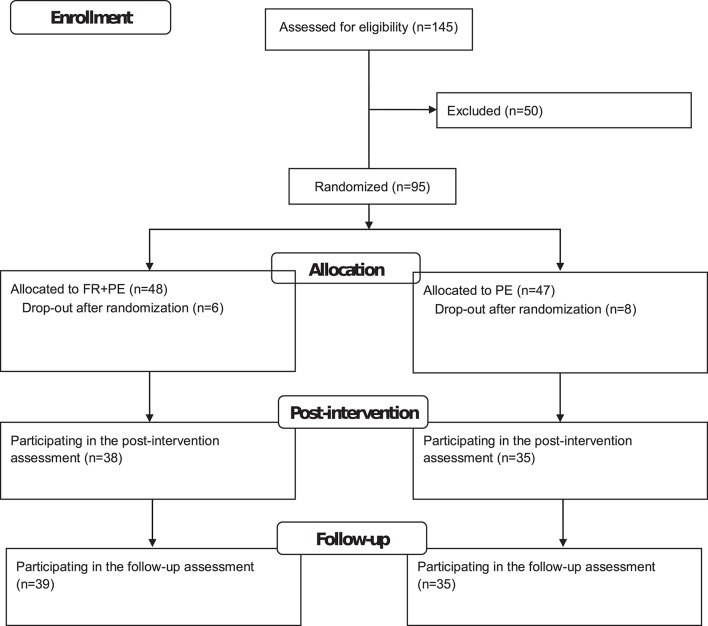
This randomized controlled trial investigated whether adding the psychodynamically based body-oriented psychotherapy "Functional Relaxation" (FR) to psychoeducation (PE) is more effective than PE alone to reduce stress and stress-associated complaints. Eighty-one participants with elevated stress-levels, ≥50 points on the global scale of the Perceived Stress Questionnaire (PSQ), received either 10 sessions of manualized FR + PE ( = 42) or two sessions of manualized PE alone ( = 39) in a group setting. Six FR trainers took part in this study. Stress-level (PSQ) was the primary outcome and secondary outcomes were depression (PHQ-9) and somatization (PHQ-15). Multilevel models for discontinuous change revealed that FR + PE was more helpful to reduce stress-levels than PE from pre-treatment to post-treatment (t0 → t1) as well as from pre-treatment to 6-month follow-up (t0 → t2) (both < 0.05) with effect sizes () being medium for PE ( = 0.57; = 0.67) and large for FR + PE ( = 1.57; = 1.39). Moreover, FR + PE affected depression and somatization more positively than did PE from t0 to t1 as well as from t0 to t2 (all < 0.05). Effect sizes for depression were small to medium for PE ( = 0.52; = 0.37) and large for FR + PE ( = 1.04; = 0.95). Effect sizes for somatization were small for PE ( = 0.18; = 0.19) and medium to large for FR + PE ( = 0.73; = 0.93). In summary, the combination of FR and PE was more effective than PE alone. The results of the present trial provide first evidence of FR as a potent component of stress interventions. Adding FR to such interventions might better help prevent clinically relevant disorders such as depression or somatization.
这项随机对照试验研究了在心理教育(PE)基础上增加基于心理动力学的身体导向心理治疗“功能性放松”(FR)是否比单独使用PE在减轻压力及与压力相关的不适方面更有效。81名压力水平升高(在感知压力问卷(PSQ)全球量表上得分≥50分)的参与者,在小组环境中接受了10节标准化的FR + PE课程(n = 42)或仅2节标准化的PE课程(n = 39)。6名FR培训师参与了这项研究。压力水平(PSQ)是主要结果,次要结果是抑郁(PHQ - 9)和躯体化(PHQ - 15)。用于间断性变化的多层次模型显示,从治疗前到治疗后(t0 → t1)以及从治疗前到6个月随访(t0 → t2),FR + PE在减轻压力水平方面比PE更有帮助(均p < 0.05),效应量(d)对于PE为中等(d = 0.57;d = 0.67),对于FR + PE为大(d = 1.57;d = 1.39)。此外,从t0到t1以及从t0到t2,FR + PE对抑郁和躯体化的影响比PE更积极(均p < 0.05)。PE对抑郁的效应量为小到中等(d = 0.52;d = 0.37),FR + PE为大(d = 1.04;d = 0.95)。PE对躯体化的效应量为小(d = 0.18;d = 0.19),FR + PE为中到高(d = 0.73;d = 0.93)。总之,FR与PE的组合比单独使用PE更有效。本试验结果首次证明FR是压力干预的有效组成部分。在此类干预中加入FR可能更有助于预防如抑郁或躯体化等临床相关疾病。