Durand Benoit, Tran Annelise, Balança Gilles, Chevalier Véronique
University Paris Est, Anses, Laboratory for Animal Health, Epidemiology Unit, Maisons-Alfort, France.
Cirad, UMR TETIS, Montpellier, France.
PLoS One. 2017 Oct 12;12(10):e0185962. doi: 10.1371/journal.pone.0185962. eCollection 2017.
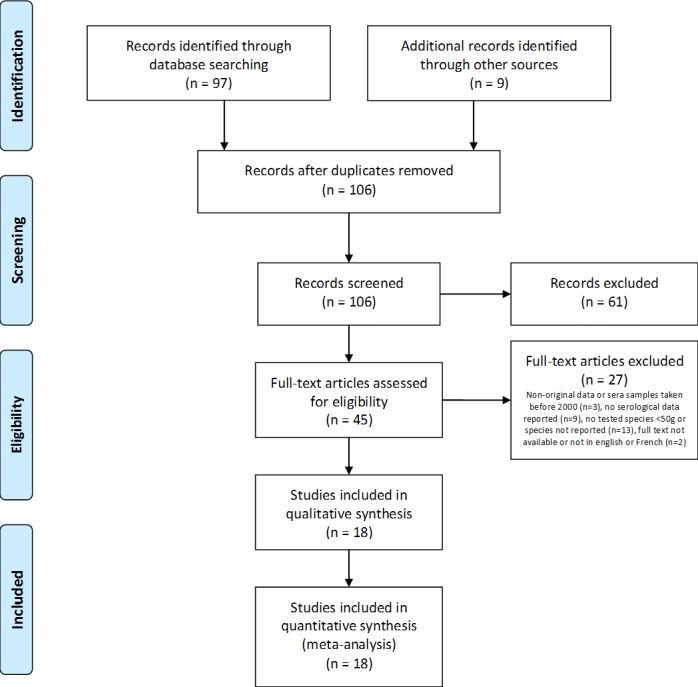
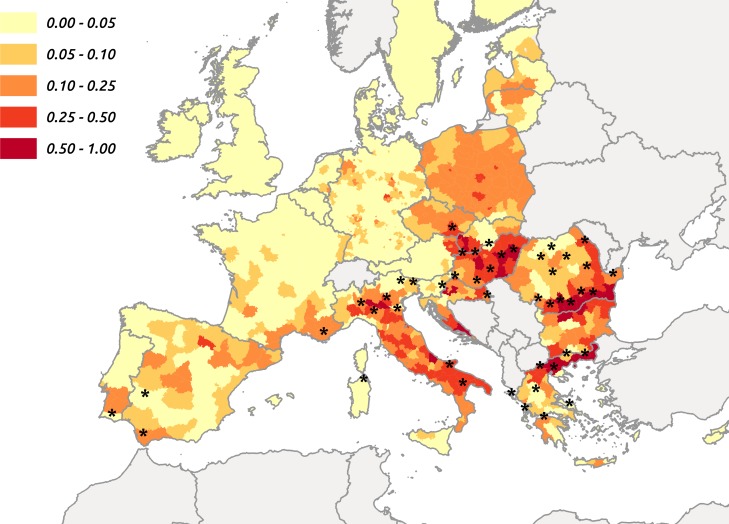
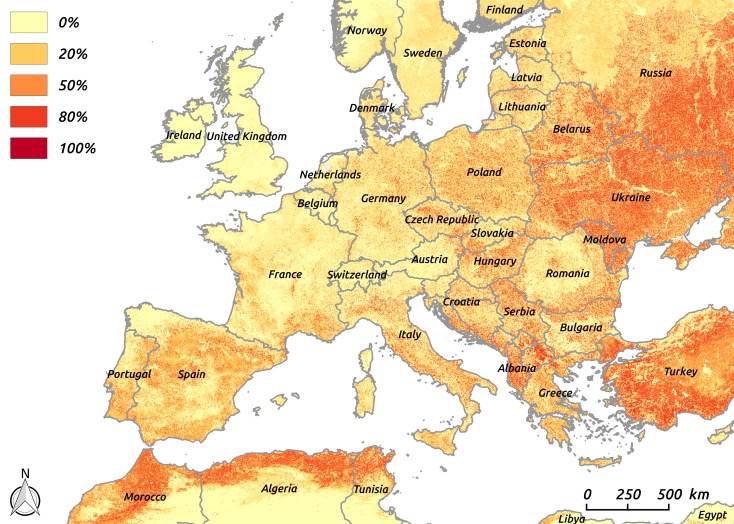
The structural risk of West Nile Disease results from the usual functioning of the socio-ecological system, which may favour the introduction of the pathogen, its circulation and the occurrence of disease cases. Its geographic variations result from the local interactions between three components: (i) reservoir hosts, (ii) vectors, both characterized by their diversity, abundance and competence, (iii) and the socio-economic context that impacts the exposure of human to infectious bites. We developed a model of bird-borne structural risk of West Nile Virus (WNV) circulation in Europe, and analysed the association between the geographic variations of this risk and the occurrence of WND human cases between 2002 and 2014. A meta-analysis of WNV serosurveys conducted in wild bird populations was performed to elaborate a model of WNV seropositivity in European bird species, considered a proxy for bird exposure to WNV. Several eco-ethological traits of bird species were linked to seropositivity and the statistical model adequately fitted species-specific seropositivity data (area under the ROC curve: 0.85). Combined with species distribution maps, this model allowed deriving geographic variations of the bird-borne structural risk of WNV circulation. The association between this risk, and the occurrence of WND human cases across the European Union was assessed. Geographic risk variations of bird-borne structural risk allowed predicting WND case occurrence in administrative districts of the EU with a sensitivity of 86% (95% CI: 0.79-0.92), and a specificity of 68% (95% CI: 0.66-0.71). Disentangling structural and conjectural health risks is important for public health managers as risk mitigation procedures differ according to risk type. The results obtained show promise for the prevention of WND in Europe. Combined with analyses of vector-borne structural risk, they should allow designing efficient and targeted prevention measures.
西尼罗河疾病的结构风险源于社会生态系统的正常运转,这可能有利于病原体的传入、传播以及病例的出现。其地理差异源于三个要素之间的局部相互作用:(i)储存宿主;(ii)媒介,其特点是具有多样性、数量和传播能力;(iii)社会经济环境,它影响人类遭受感染性叮咬的几率。我们建立了一个欧洲西尼罗河病毒(WNV)传播的鸟类传播结构风险模型,并分析了该风险的地理差异与2002年至2014年期间西尼罗河疾病人类病例发生情况之间的关联。对在野生鸟类种群中进行的WNV血清学调查进行了荟萃分析,以构建欧洲鸟类物种WNV血清阳性模型,该模型被视为鸟类接触WNV的替代指标。鸟类物种的若干生态行为特征与血清阳性相关,统计模型充分拟合了物种特异性血清阳性数据(ROC曲线下面积:0.85)。结合物种分布图,该模型可以得出WNV传播的鸟类传播结构风险的地理差异。评估了这种风险与欧盟范围内西尼罗河疾病人类病例发生情况之间的关联。鸟类传播结构风险的地理风险差异能够预测欧盟行政区中西尼罗河疾病病例的发生情况,灵敏度为86%(95%置信区间:0.79 - 0.92),特异度为68%(95%置信区间:0.66 - 0.71)。区分结构健康风险和推测性健康风险对于公共卫生管理人员很重要,因为风险缓解程序因风险类型而异。所获得的结果为欧洲预防西尼罗河疾病带来了希望。结合对媒介传播结构风险的分析,应该能够设计出高效且有针对性的预防措施。