Vendan S Ezhil, Manivannan S, Sunny Anila M, Murugesan R
Food Protectants and Infestation Control Department, CSIR-Central Food Technological Research Institute, Mysore, India.
PLoS One. 2017 Oct 12;12(10):e0186020. doi: 10.1371/journal.pone.0186020. eCollection 2017.
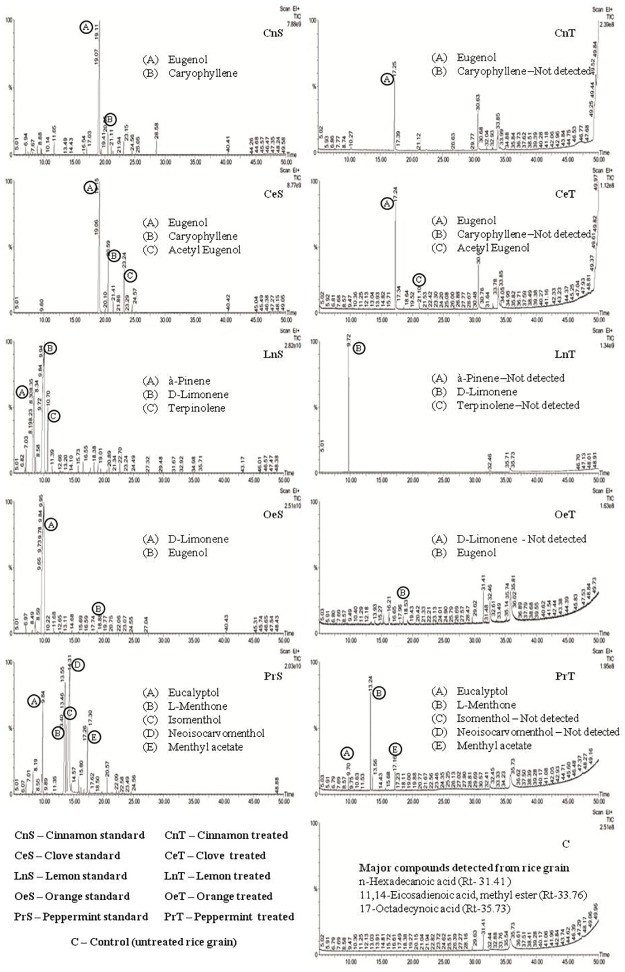
In the present study, we investigated the fumigant potential of five edible essential oils (EOs) against Sitophilus oryzae and their phytochemical residues in treated grains. Among the tested EOs, peppermint oil proved significantly effective (P ≤ 0.05) on S.oryzae at 400 μl/L air concentration, inducing 83 and 100% mortalities in with-food and without-food conditions respectively over 72 h exposure. In addition, it was also observed that the binary mixtures of peppermint + lemon oil (1:1 ratio) produced an equivalent effect to that of peppermint oil alone treatments. The phytochemical residue analysis by GC-MS revealed the presence of six compounds upon 72 h exposure to EOs. Further, the analysis of physico-chemical properties of the compounds indicated a positive correlation between polar surface area (PSA) and its residual nature. The residue levels of eugenol were significantly elevated corresponding to its high PSA value (29) in clove and cinnamon oils. On the other hand, the compounds with zero PSA value imparted very less or no (D-Limonene, caryophyllene, pinene and terpinolene) residues in treated grains. With respect to the most active peppermint oil, L-menthone, menthyl acetate and eucalyptol residues were at 67, 41 and 23% levels respectively. The outcome of the present study indicate the peppermint oil as a potent fumigant against S. oryzae, and although the residues of phytochemicals in treated grains is higher; they belong to the generally recognised as safe (GRAS) status leaving no harmful effect.
在本研究中,我们调查了五种可食用精油对米象的熏蒸潜力及其在处理过的谷物中的植物化学残留。在所测试的精油中,薄荷油在空气浓度为400 μl/L时对米象具有显著效果(P≤0.05),在有食物和无食物条件下暴露72小时后,分别导致83%和100%的死亡率。此外,还观察到薄荷 + 柠檬油(1:1比例)的二元混合物产生了与单独使用薄荷油处理等效的效果。通过气相色谱 - 质谱联用(GC - MS)对植物化学残留的分析显示,暴露于精油72小时后存在六种化合物。此外,对这些化合物的物理化学性质分析表明,极性表面积(PSA)与其残留性质之间存在正相关。丁香和肉桂油中丁香酚的残留水平因其高PSA值(29)而显著升高。另一方面,PSA值为零的化合物(D - 柠檬烯、石竹烯、蒎烯和萜品油烯)在处理过的谷物中残留极少或无残留。就活性最高的薄荷油而言,L - 薄荷酮、乙酸薄荷酯和桉叶油素的残留量分别为67%、41%和23%。本研究结果表明,薄荷油是一种对米象有效的熏蒸剂,尽管处理过的谷物中植物化学物质的残留量较高,但它们属于一般认为安全(GRAS)的类别,不会产生有害影响。