Eibinger Manuel, Sattelkow Jürgen, Ganner Thomas, Plank Harald, Nidetzky Bernd
Institute of Biotechnology and Biochemical Engineering, Graz University of Technology, Petersgasse 10-12/1, 8010, Graz, Austria.
Institute of Electron Microscopy and Nanoanalysis, Graz University of Technology, Steyrergasse 17, 8010, Graz, Austria.
Nat Commun. 2017 Oct 12;8(1):894. doi: 10.1038/s41467-017-01028-y.
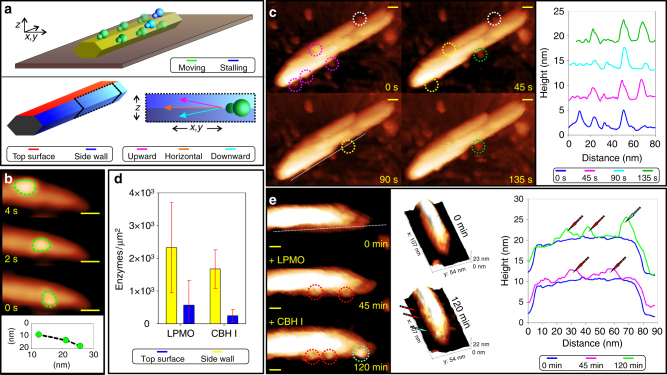
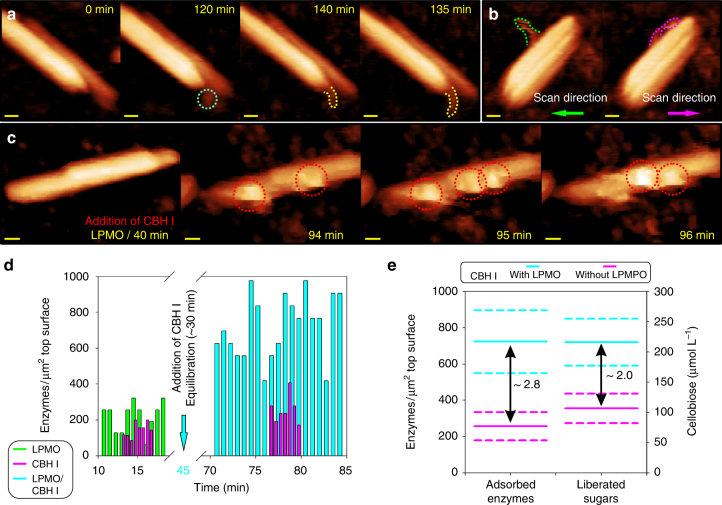
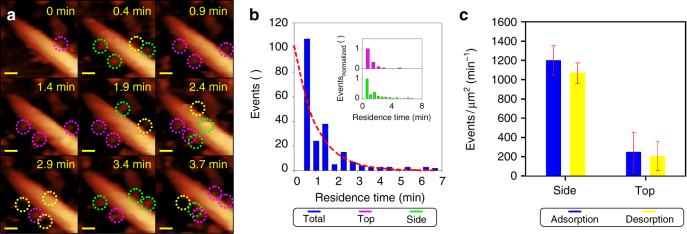
LPMO (lytic polysaccharide monooxygenase) represents a unique paradigm of cellulosic biomass degradation by an oxidative mechanism. Understanding the role of LPMO in deconstructing crystalline cellulose is fundamental to the enzyme's biological function and will help to specify the use of LPMO in biorefinery applications. Here we show with real-time atomic force microscopy that C1 and C4 oxidizing types of LPMO from Neurospora crassa (NcLPMO9F, NcLPMO9C) bind to nanocrystalline cellulose with high preference for the very same substrate surfaces that are also used by a processive cellulase (Trichoderma reesei CBH I) to move along during hydrolytic cellulose degradation. The bound LPMOs, however, are immobile during their adsorbed residence time ( ~ 1.0 min for NcLPMO9F) on cellulose. Treatment with LPMO resulted in fibrillation of crystalline cellulose and strongly ( ≥ 2-fold) enhanced the cellulase adsorption. It also increased enzyme turnover on the cellulose surface, thus boosting the hydrolytic conversion.Understanding the role of enzymes in biomass depolymerization is essential for the development of more efficient biorefineries. Here, the authors show by atomic force microscopy the real-time mechanism of cellulose deconstruction by lytic polysaccharide monooxygenases.
裂解多糖单加氧酶(LPMO)代表了通过氧化机制降解纤维素生物质的独特模式。了解LPMO在解构结晶纤维素中的作用对于该酶的生物学功能至关重要,并且将有助于明确LPMO在生物炼制应用中的用途。在此,我们通过实时原子力显微镜显示,来自粗糙脉孢菌的C1和C4氧化型LPMO(NcLPMO9F、NcLPMO9C)与纳米晶纤维素结合,对在水解纤维素降解过程中一种连续性纤维素酶(里氏木霉CBH I)沿其移动的相同底物表面具有高度偏好性。然而,结合的LPMO在其吸附在纤维素上的停留时间内(NcLPMO9F约为1.0分钟)是不移动的。用LPMO处理导致结晶纤维素形成原纤维,并强烈(≥2倍)增强了纤维素酶的吸附。它还增加了纤维素表面的酶周转率,从而提高了水解转化率。了解酶在生物质解聚中的作用对于开发更高效的生物炼制至关重要。在此,作者通过原子力显微镜展示了裂解多糖单加氧酶解构纤维素的实时机制。