Liu Guodong, Qu Yinbo
State Key Laboratory of Microbial Technology, Shandong University, Qingdao 266237, China.
National Glycoengineering Research Center, Shandong University, Qingdao 266237, China.
Eng Microbiol. 2021 Oct 29;1:100005. doi: 10.1016/j.engmic.2021.100005. eCollection 2021 Dec.
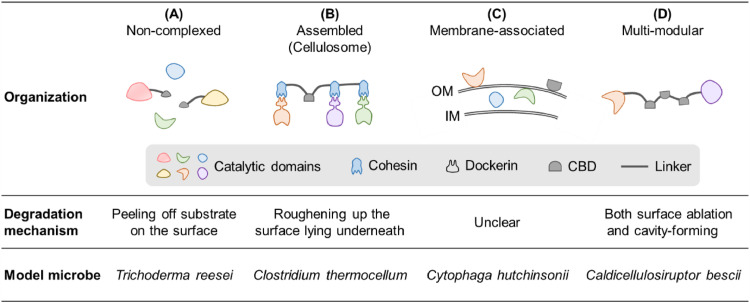
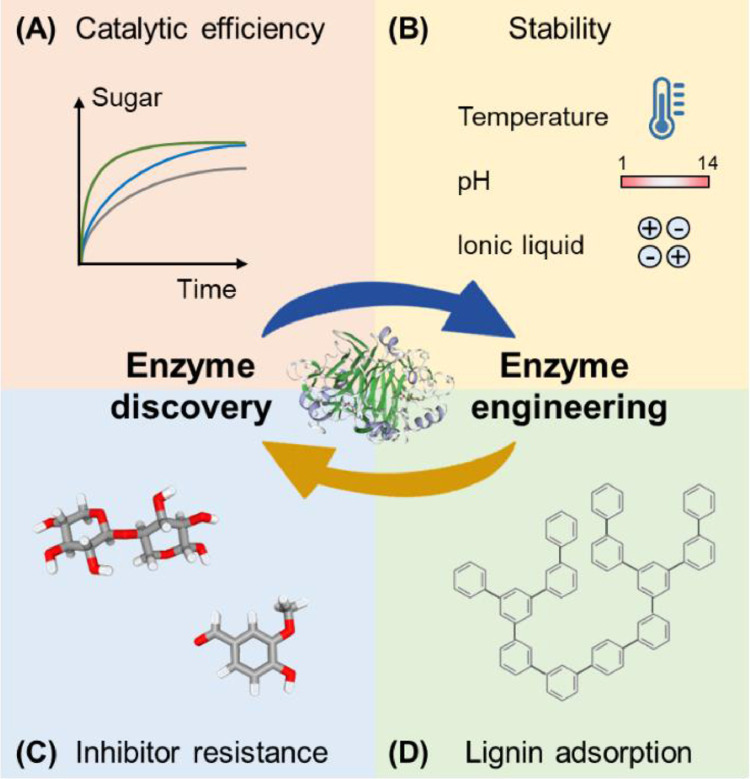
Bioconversion of lignocellulosic biomass to fuels and chemicals represents a new manufacturing paradigm that can help address society's energy, resource, and environmental problems. However, the low efficiency and high cost of lignocellulolytic enzymes currently used hinder their use in the industrial deconstruction of lignocellulose. To overcome these challenges, research efforts have focused on engineering the properties, synergy, and production of lignocellulolytic enzymes. First, lignocellulolytic enzymes' catalytic efficiency, stability, and tolerance to inhibitory compounds have been improved through enzyme mining and engineering. Second, synergistic actions between different enzyme components have been strengthened to construct customized enzyme cocktails for the degradation of specific lignocellulosic substrates. Third, biological processes for protein synthesis and cell morphogenesis in microorganisms have been engineered to achieve a high level and low-cost production of lignocellulolytic enzymes. In this review, the relevant progresses and challenges in these fields are summarized. Integrated engineering is proposed to be essential to achieve cost-effective enzymatic deconstruction of lignocellulose in the future.
将木质纤维素生物质转化为燃料和化学品代表了一种新的制造模式,有助于解决社会的能源、资源和环境问题。然而,目前使用的木质纤维素酶效率低、成本高,阻碍了它们在木质纤维素工业解构中的应用。为了克服这些挑战,研究工作集中在改造木质纤维素酶的性质、协同作用和生产方面。首先,通过酶挖掘和工程改造提高了木质纤维素酶的催化效率、稳定性和对抑制性化合物的耐受性。其次,加强了不同酶组分之间的协同作用,以构建用于降解特定木质纤维素底物的定制酶混合物。第三,对微生物中蛋白质合成和细胞形态发生的生物学过程进行了改造,以实现木质纤维素酶的高水平、低成本生产。在这篇综述中,总结了这些领域的相关进展和挑战。提出综合工程对于未来实现木质纤维素的经济高效酶解至关重要。