Riley Nicholas M, Westphall Michael S, Coon Joshua J
Genome Center of Wisconsin, Madison, WI, USA.
Department of Chemistry, University of Wisconsin-Madison, Madison, WI, 53706, USA.
J Am Soc Mass Spectrom. 2018 Jan;29(1):140-149. doi: 10.1007/s13361-017-1808-7. Epub 2017 Oct 12.
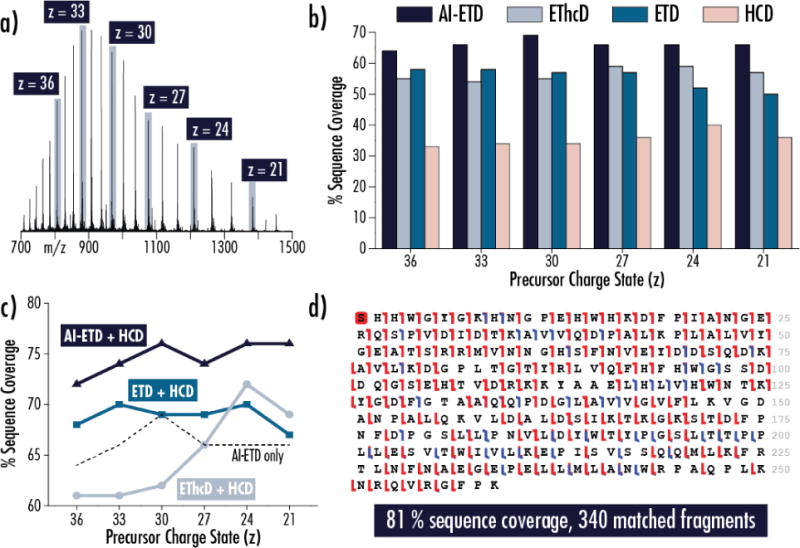
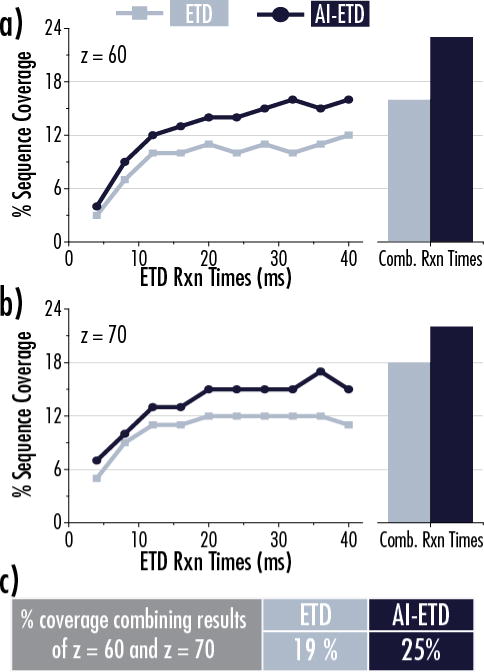
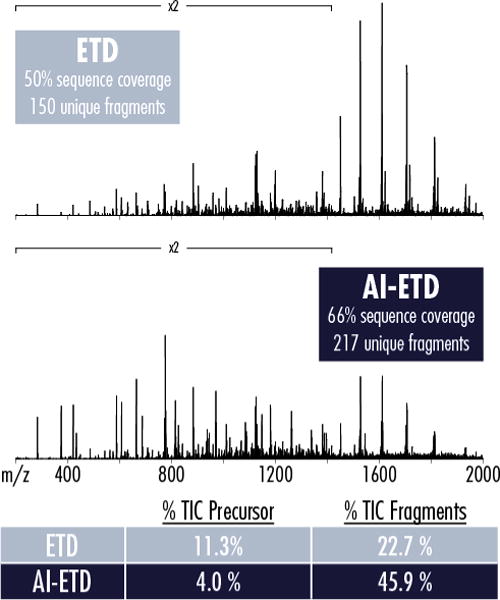
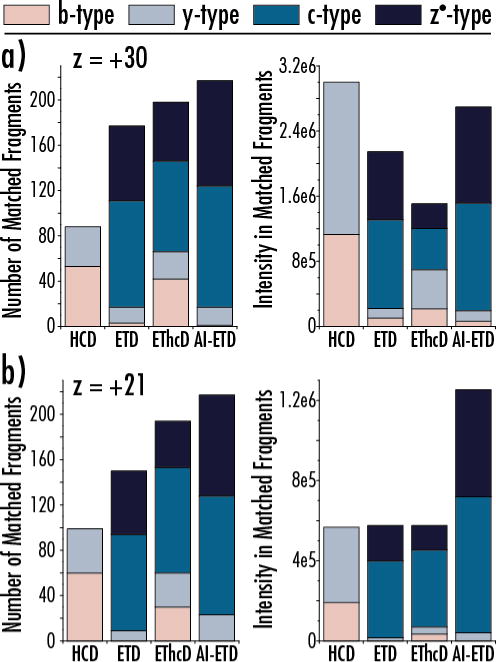
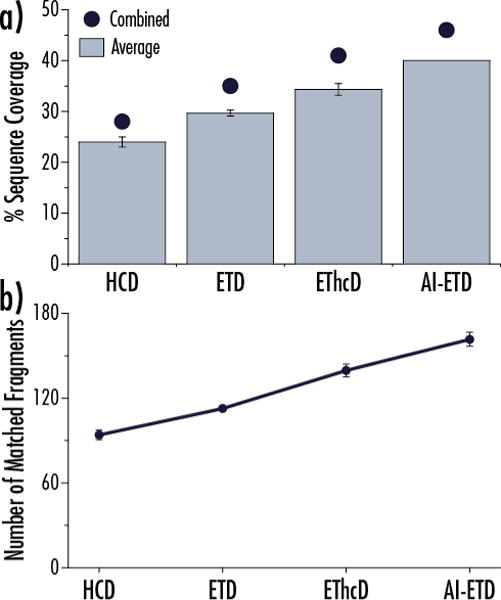
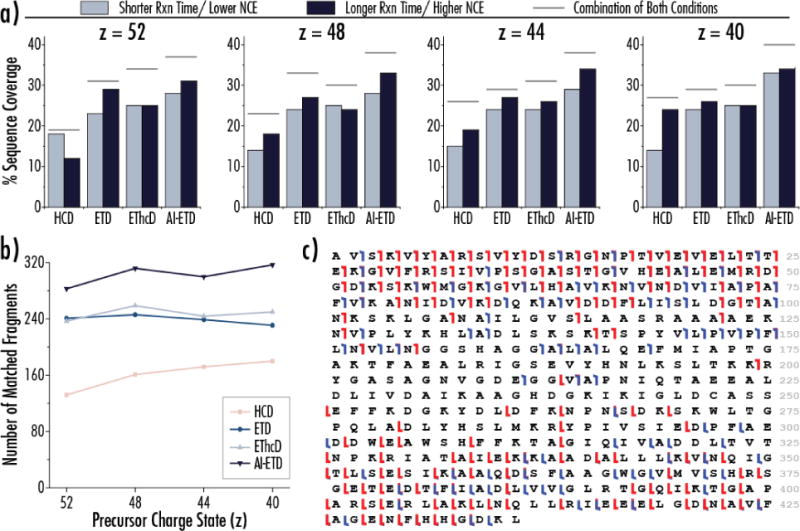
The analysis of intact proteins via mass spectrometry can offer several benefits to proteome characterization, although the majority of top-down experiments focus on proteoforms in a relatively low mass range (<30 kDa). Recent studies have focused on improving the analysis of larger intact proteins (up to ~75 kDa), but they have also highlighted several challenges to be addressed. One major hurdle is the efficient dissociation of larger protein ions, which often to do not yield extensive fragmentation via conventional tandem MS methods. Here we describe the first application of activated ion electron transfer dissociation (AI-ETD) to proteins in the 30-70 kDa range. AI-ETD leverages infrared photo-activation concurrent to ETD reactions to improve sequence-informative product ion generation. This method generates more product ions and greater sequence coverage than conventional ETD, higher-energy collisional dissociation (HCD), and ETD combined with supplemental HCD activation (EThcD). Importantly, AI-ETD provides the most thorough protein characterization for every precursor ion charge state investigated in this study, making it suitable as a universal fragmentation method in top-down experiments. Additionally, we highlight several acquisition strategies that can benefit characterization of larger proteins with AI-ETD, including combination of spectra from multiple ETD reaction times for a given precursor ion, multiple spectral acquisitions of the same precursor ion, and combination of spectra from two different dissociation methods (e.g., AI-ETD and HCD). In all, AI-ETD shows great promise as a method for dissociating larger intact protein ions as top-down proteomics continues to advance into larger mass ranges. Graphical Abstract ᅟ.
通过质谱分析完整蛋白质可为蛋白质组表征带来诸多益处,尽管大多数自上而下的实验聚焦于相对低质量范围(<30 kDa)的蛋白质变体。近期研究致力于改进对更大完整蛋白质(高达约75 kDa)的分析,但也凸显了一些有待解决的挑战。一个主要障碍是更大蛋白质离子的有效解离,通过传统串联质谱方法它们往往不会产生广泛的碎片。在此,我们描述了活化离子电子转移解离(AI-ETD)在30 - 70 kDa范围内蛋白质上的首次应用。AI-ETD利用与电子转移解离(ETD)反应同时发生的红外光活化来改善产生具有序列信息的产物离子。该方法比传统ETD、高能碰撞解离(HCD)以及ETD与补充HCD活化相结合(EThcD)产生更多的产物离子和更大的序列覆盖率。重要的是,对于本研究中所研究的每个前体离子电荷态,AI-ETD都能提供最全面的蛋白质表征,使其适合作为自上而下实验中的通用碎片化方法。此外,我们强调了几种可借助AI-ETD有助于更大蛋白质表征的采集策略,包括针对给定前体离子将多个ETD反应时间的光谱进行组合、对同一前体离子进行多次光谱采集以及将来自两种不同解离方法(例如AI-ETD和HCD)的光谱进行组合。总体而言,随着自上而下的蛋白质组学不断向更大质量范围发展,AI-ETD作为一种解离更大完整蛋白质离子的方法显示出巨大的潜力。图形摘要ᅟ