Genome Center of Wisconsin , Madison , Wisconsin 53706 , United States.
Department of Chemistry , University of Wisconsin-Madison , Madison , Wisconsin 53706 , United States.
Anal Chem. 2018 Aug 7;90(15):8946-8953. doi: 10.1021/acs.analchem.8b01113. Epub 2018 Jul 10.
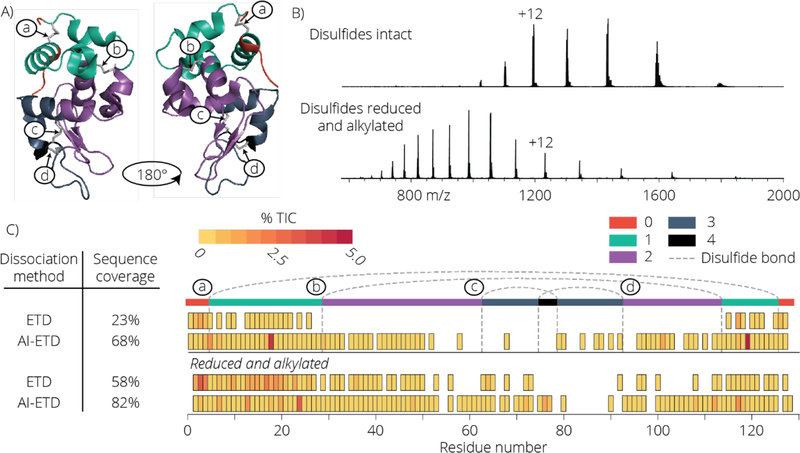
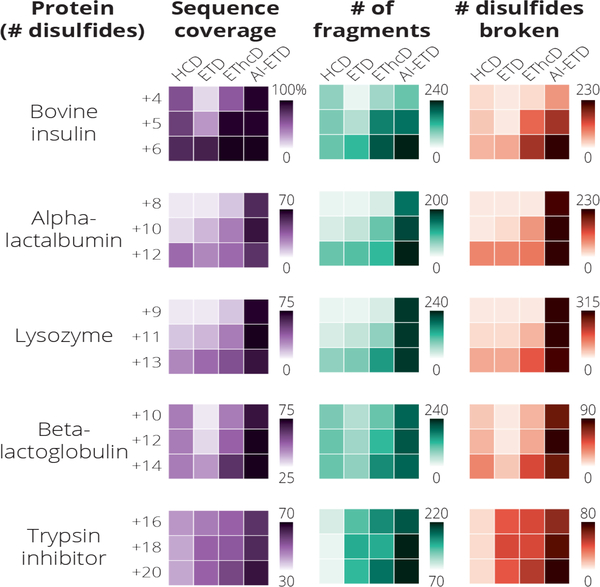
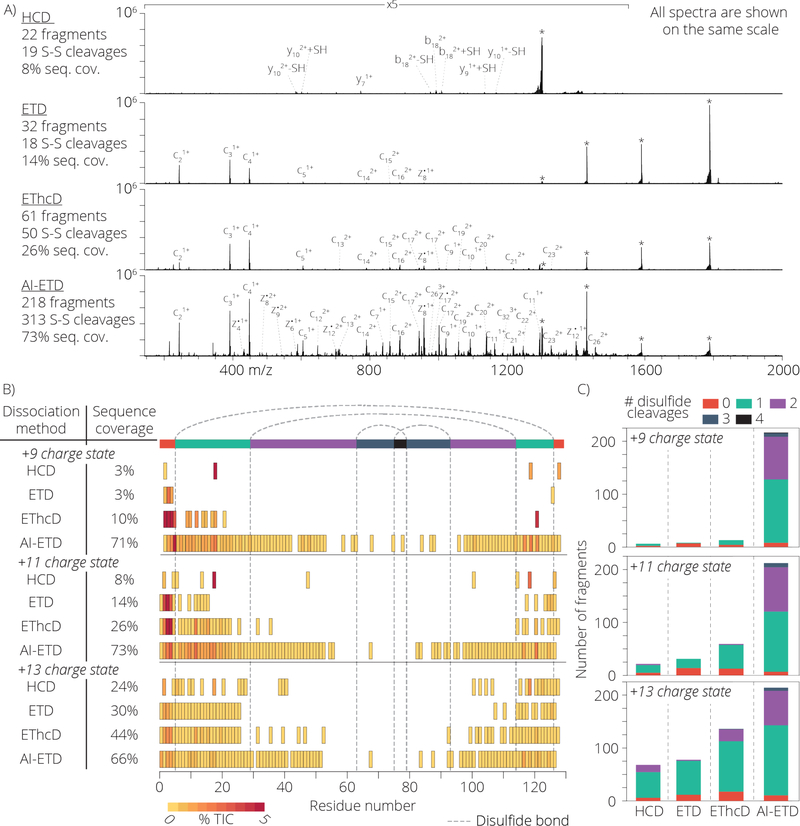
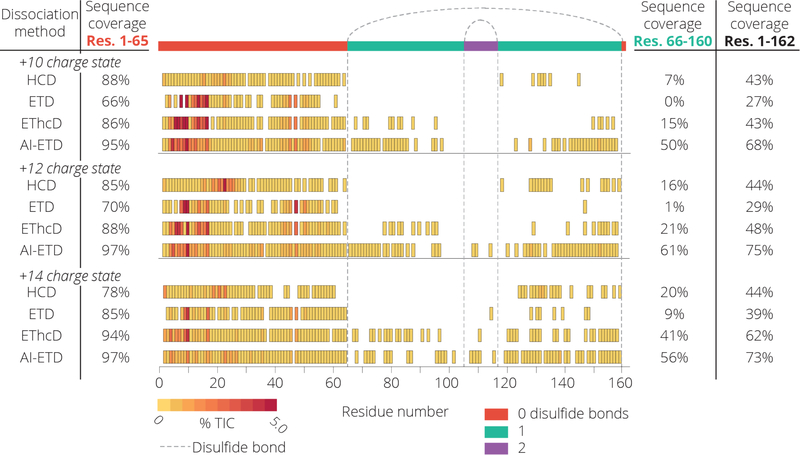
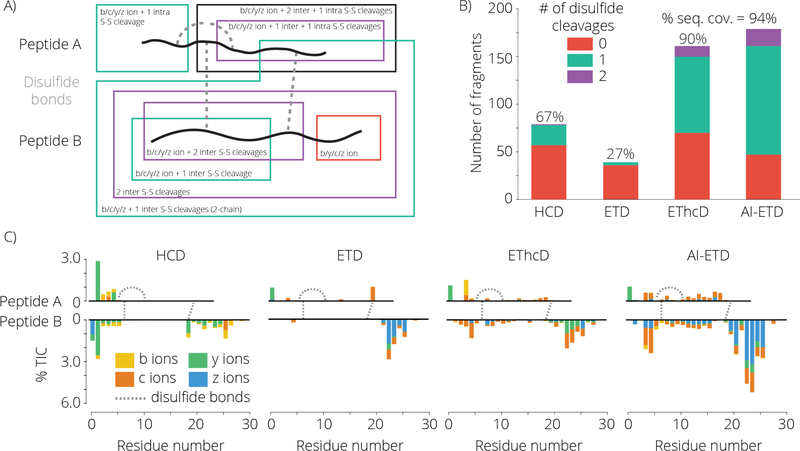
Here we report the fragmentation of disulfide linked intact proteins using activated-ion electron transfer dissociation (AI-ETD) for top-down protein characterization. This fragmentation method is then compared to the alternative methods of beam-type collisional activation (HCD), electron transfer dissociation (ETD), and electron transfer and higher-energy collision dissociation (EThcD). We analyzed multiple precursor charge states of the protein standards bovine insulin, α-lactalbumin, lysozyme, β-lactoglobulin, and trypsin inhibitor. In all cases, we found that AI-ETD provides a boost in protein sequence coverage information and the generation of fragment ions from within regions enclosed by disulfide bonds. AI-ETD shows the largest improvement over the other techniques when analyzing highly disulfide linked and low charge density precursor ions. This substantial improvement is attributed to the concurrent irradiation of the gas phase ions while the electron-transfer reaction is taking place, mitigating nondissociative electron transfer, helping unfold the gas phase protein during the electron transfer event, and preventing disulfide bond reformation. We also show that AI-ETD is able to yield comparable sequence coverage information when disulfide bonds are left intact relative to proteins that have been reduced and alkylated. This work demonstrates that AI-ETD is an effective fragmentation method for the analysis of proteins with intact disulfide bonds, dramatically enhancing sequence ion generation and total sequence coverage compared to HCD and ETD.
我们在此报告了使用活化离子电子转移解离(AI-ETD)对二硫键连接的完整蛋白质进行碎片化,以进行自上而下的蛋白质特征分析。然后,将这种碎片化方法与替代方法进行比较,包括束型碰撞激活(HCD)、电子转移解离(ETD)和电子转移和更高能量碰撞解离(EThcD)。我们分析了蛋白质标准品牛胰岛素、α-乳白蛋白、溶菌酶、β-乳球蛋白和胰蛋白酶抑制剂的多个前体电荷态。在所有情况下,我们发现 AI-ETD 提供了蛋白质序列覆盖信息的提升,并在二硫键封闭区域内生成了片段离子。在分析高度二硫键连接和低电荷密度前体离子时,AI-ETD 相对于其他技术显示出最大的改进。这种实质性的改进归因于在电子转移反应发生的同时对气相离子进行同时辐照,从而减轻非解离电子转移,帮助气相蛋白质在电子转移事件中展开,并防止二硫键重新形成。我们还表明,与已经还原和烷基化的蛋白质相比,当二硫键保持完整时,AI-ETD 能够产生可比的序列覆盖信息。这项工作表明,AI-ETD 是一种有效的完整二硫键蛋白质分析碎片化方法,与 HCD 和 ETD 相比,显著增加了序列离子的生成和总序列覆盖。