Bagacean Cristina, Tempescul Adrian, Le Dantec Christelle, Bordron Anne, Mohr Audrey, Saad Hussam, Olivier Valerie, Zdrenghea Mihnea, Cristea Victor, Cartron Pierre-François, Douet-Guilbert Nathalie, Berthou Christian, Renaudineau Yves
U1227 B Lymphocytes and Autoimmunity, University of Brest, INSERM, IBSAM, Labex IGO, Networks IC-CGO and REpiCGO from Cancéropôle Grand Ouest, Brest, France.
Laboratory of Immunology and Immunotherapy, Brest University Medical School Hospital, Brest, France.
Oncotarget. 2017 Aug 9;8(39):65699-65716. doi: 10.18632/oncotarget.20081. eCollection 2017 Sep 12.
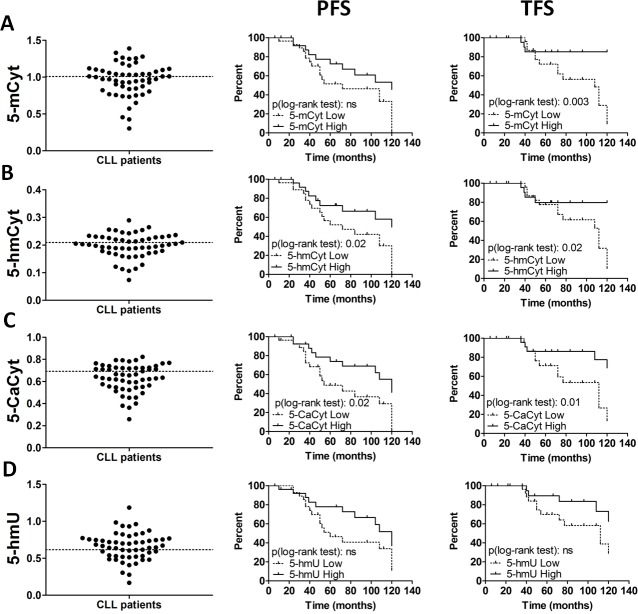
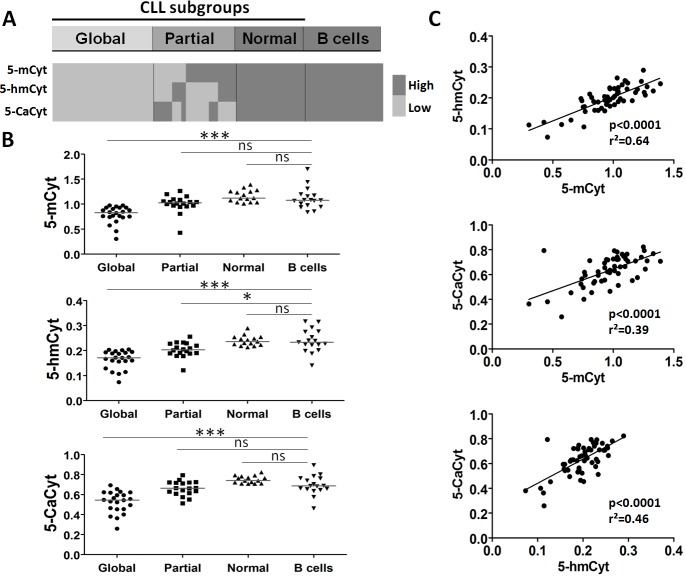
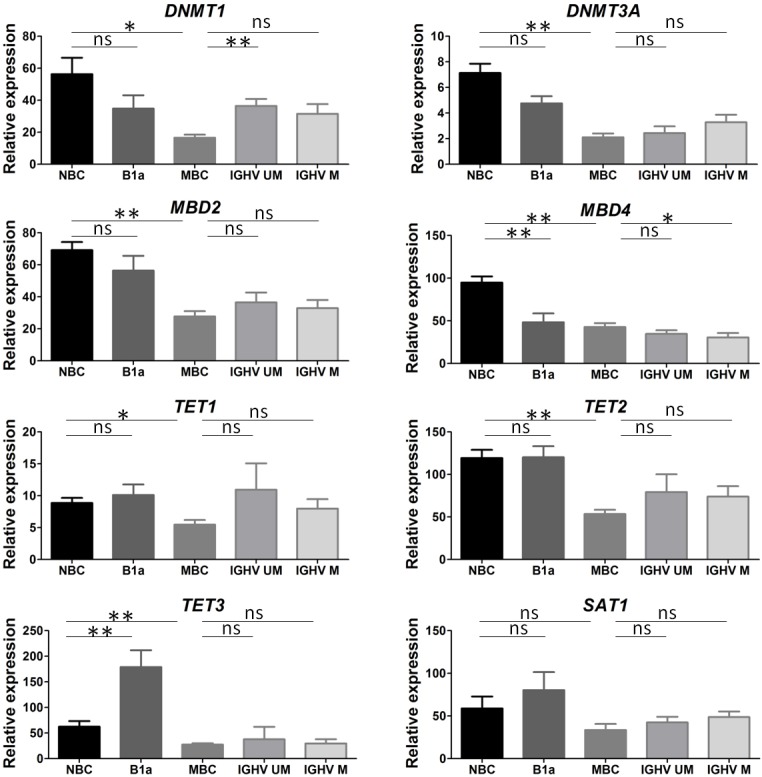
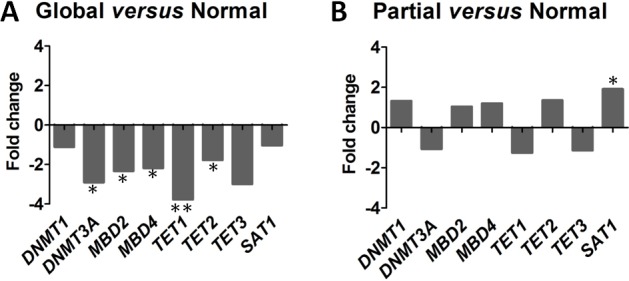
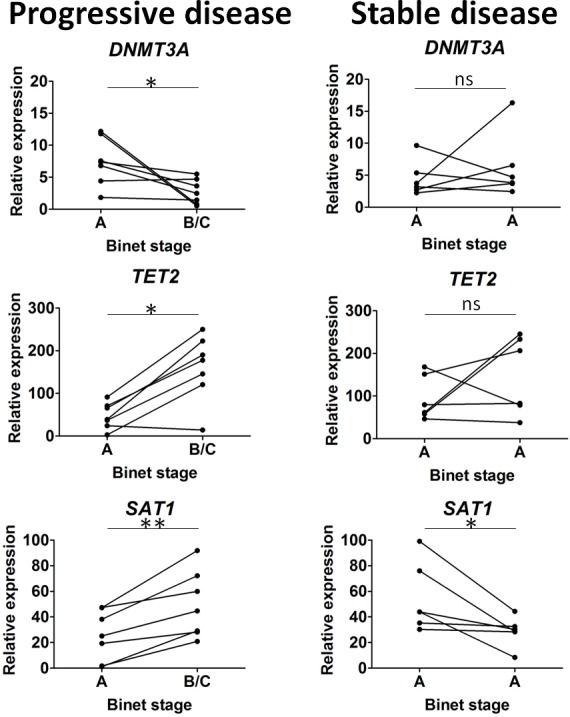
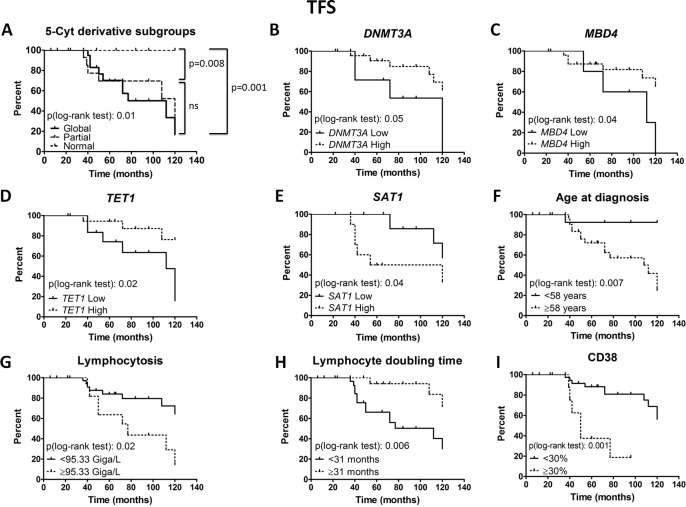
Cytosine derivative dysregulations represent important epigenetic modifications whose impact on the clinical outcome in chronic lymphocytic leukemia (CLL) is incompletely understood. Hence, global levels of 5-methylcytosine (5-mCyt), 5-hydroxymethylcytosine (5-hmCyt), 5-carboxylcytosine (5-CaCyt) and 5-hydroxymethyluracil were tested in purified B cells from CLL patients ( = 55) and controls ( = 17). The DNA methylation 'writers' (DNA methyltransferases []), 'readers' (methyl-CpG-binding domain []), 'editors' (ten-eleven translocation []) and 'modulators' () were also evaluated. Accordingly, patients were stratified into three subgroups. First, a subgroup with a global deficit in cytosine derivatives characterized by hyperlymphocytosis, reduced median progression free survival (PFS = 52 months) and shorter treatment free survival (TFS = 112 months) was identified. In this subgroup, major epigenetic modifications were highlighted including a reduction of 5-mCyt, 5-hmCyt, 5-CaCyt associated with , and downregulation. Second, the cytosine derivative analysis revealed a subgroup with a partial deficit (PFS = 84, TFS = 120 months), mainly affecting DNA demethylation (5-hmCyt reduction, induction). Third, a subgroup epigenetically similar to controls was identified (PFS and TFS > 120 months). The prognostic impact of stratifying CLL patients within three epigenetic subgroups was confirmed in a validation cohort. In conclusion, our results suggest that dysregulations of cytosine derivative regulators represent major events acquired during CLL progression and are independent from mutational status.
胞嘧啶衍生物失调代表重要的表观遗传修饰,其对慢性淋巴细胞白血病(CLL)临床结局的影响尚未完全明确。因此,我们检测了55例CLL患者和17例对照的纯化B细胞中5-甲基胞嘧啶(5-mCyt)、5-羟甲基胞嘧啶(5-hmCyt)、5-羧基胞嘧啶(5-CaCyt)和5-羟甲基尿嘧啶的整体水平。我们还评估了DNA甲基化“书写者”(DNA甲基转移酶)、“阅读者”(甲基化CpG结合结构域)、“编辑者”(十一易位蛋白)和“调节者”。据此,患者被分为三个亚组。首先,我们鉴定出一个胞嘧啶衍生物整体缺乏的亚组,其特征为淋巴细胞增多、中位无进展生存期缩短(PFS = 52个月)和无治疗生存期缩短(TFS = 112个月)。在这个亚组中,主要的表观遗传修饰包括5-mCyt、5-hmCyt、5-CaCyt的减少,以及、和的下调。其次,胞嘧啶衍生物分析显示一个部分缺乏的亚组(PFS = 84,TFS = 120个月),主要影响DNA去甲基化(5-hmCyt减少,诱导)。第三,我们鉴定出一个表观遗传上与对照相似的亚组(PFS和TFS > 120个月)。在一个验证队列中证实了将CLL患者分为三个表观遗传亚组的预后影响。总之,我们的结果表明,胞嘧啶衍生物调节因子的失调代表了CLL进展过程中获得的主要事件,并且独立于突变状态。