Department of Parasitology, Faculty of Medicine and Pharmacy, Cheikh Anta Diop University, Dakar, Senegal.
Malaria Branch, Division of Parasitic Diseases and Malaria, U.S. Centers for Disease Control and Prevention, President's Malaria Initiative, Atlanta, GA, USA.
Malar J. 2017 Oct 13;16(1):413. doi: 10.1186/s12936-017-2055-x.
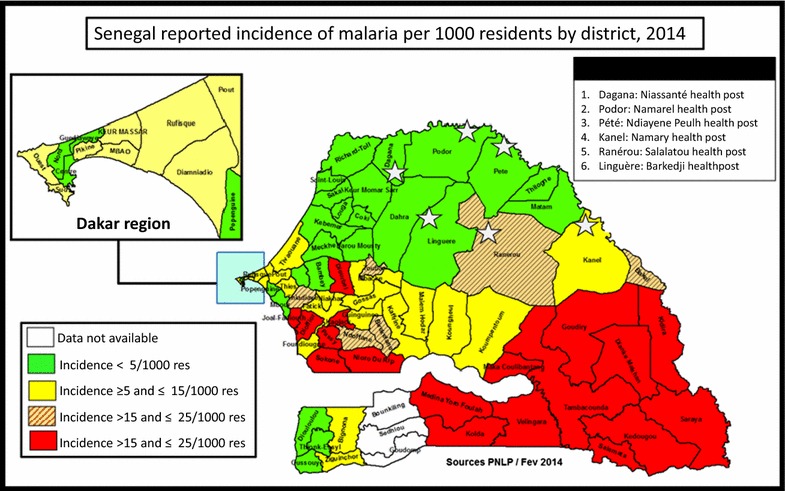
Malaria transmission in Senegal is highly stratified, from low in the dry north to moderately high in the moist south. In northern Senegal, along the Senegal River Valley and in the Ferlo semi-desert region, annual incidence is less than five cases per 1000 inhabitants. Many nomadic pastoralists have permanent dwellings in the Ferlo Desert and Senegal River Valley, but spend dry season in the south with their herds, returning north when the rains start, leading to a concern that this population could contribute to ongoing transmission in the north.
A modified snowball sampling survey was conducted at six sites in northern Senegal to determine the malaria prevention and treatment seeking practices and parasite prevalence among nomadic pastoralists in the Senegal River Valley and the Ferlo Desert. Nomadic pastoralists aged 6 months and older were surveyed during September and October 2014, and data regarding demographics, access to care and preventive measures were collected. Parasite infection was detected using rapid diagnostic tests (RDTs), microscopy (thin and thick smears) and polymerase chain reaction (PCR). Molecular barcodes were determined by high resolution melting (HRM).
Of 1800 participants, 61% were male. Sixty-four percent had at least one bed net in the household, and 53% reported using a net the night before. Only 29% had received a net from a mass distribution campaign. Of the 8% (142) who reported having had fever in the last month, 55% sought care, 20% of whom received a diagnostic test, one-third of which (n = 5) were reported to be positive. Parasite prevalence was 0.44% by thick smear and 0.50% by PCR. None of the molecular barcodes identified among the nomadic pastoralists had been previously identified in Senegal.
While access to and utilization of malaria control interventions among nomadic pastoralists was lower than the general population, parasite prevalence was lower than expected and sheds doubt on the perception that they are a source of ongoing transmission in the north. The National Malaria Control Program is making efforts to improve access to malaria prevention and case management for nomadic populations.
塞内加尔的疟疾传播呈高度分层分布,从北部干燥地区到南部湿润地区的发病率逐渐升高。在塞内加尔北部,沿着塞内加尔河谷和费罗半沙漠地区,每年每 1000 名居民中的发病率不到 5 例。许多游牧牧民在费罗沙漠和塞内加尔河谷地区拥有固定住所,但在旱季与他们的畜群一起在南部度过,当雨季开始时返回北部,这导致人们担心这些人口可能会对北部的持续传播做出贡献。
在塞内加尔北部的六个地点进行了一项改良的雪球抽样调查,以确定塞内加尔河谷和费罗沙漠地区游牧牧民的疟疾预防和治疗寻求行为以及寄生虫流行率。2014 年 9 月至 10 月期间,对 6 个月及以上的游牧牧民进行了调查,并收集了人口统计学、获得护理和预防措施的数据。使用快速诊断测试(RDT)、显微镜(薄涂片和厚涂片)和聚合酶链反应(PCR)检测寄生虫感染。通过高分辨率熔解(HRM)确定分子条码。
在 1800 名参与者中,61%为男性。64%的家庭至少有一个蚊帐,53%的人报告前一天晚上使用了蚊帐。只有 29%的人从大规模分发运动中获得了蚊帐。在过去一个月报告有发热的 8%(142 人)中,55%的人寻求了治疗,其中 20%的人接受了诊断测试,其中三分之一(n=5)报告为阳性。厚涂片的寄生虫流行率为 0.44%,PCR 的寄生虫流行率为 0.50%。在游牧牧民中发现的分子条码没有一个以前在塞内加尔被识别出来。
尽管游牧牧民获得和利用疟疾控制干预措施的机会低于一般人群,但寄生虫流行率低于预期,这对他们是北部持续传播源的看法提出了质疑。国家疟疾控制规划正在努力改善游牧人口获得疟疾预防和病例管理的机会。