Mei Yudong, Chen Haotian, Shen Wenbiao, Shen Wei, Huang Liqin
College of Life Sciences, Laboratory Center of Life Sciences, Nanjing Agricultural University, Nanjing, 210095, China.
College of Sciences, Nanjing Agricultural University, Nanjing, 210095, China.
BMC Plant Biol. 2017 Oct 13;17(1):162. doi: 10.1186/s12870-017-1110-7.
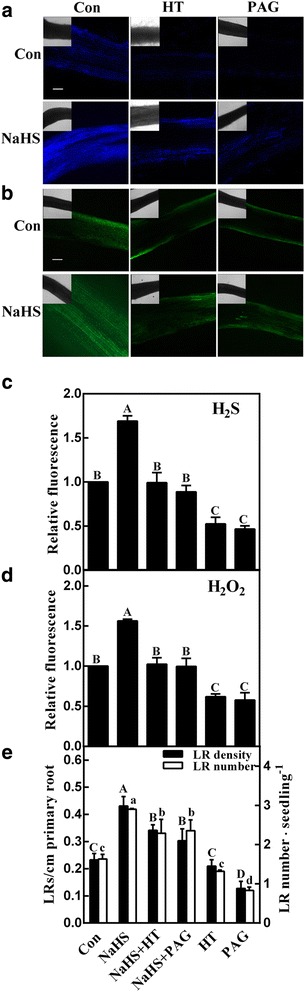
Both hydrogen sulfide (HS) and hydrogen peroxide (HO) are separately regarded as a highly reactive molecule involved in root morphogenesis. In this report, corresponding causal link governing lateral root formation was investigated.
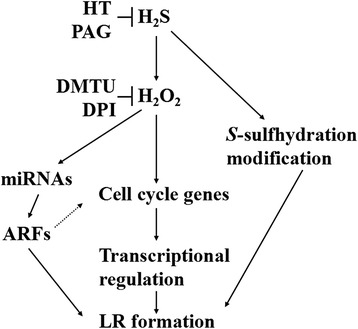
By using pharmacological, anatomic, and molecular approaches, evidence presented here revealed the molecular mechanism underlying tomato lateral root development triggered by HS.
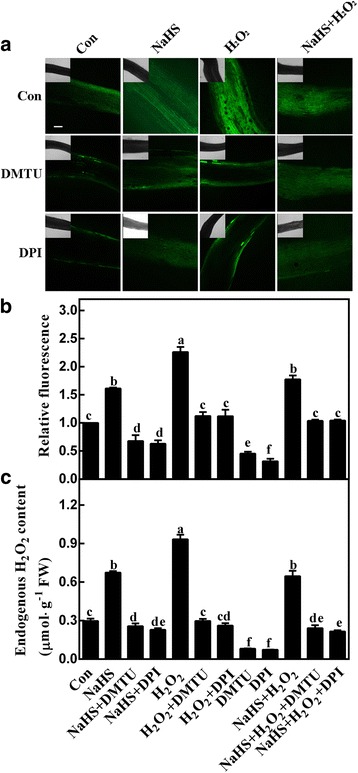
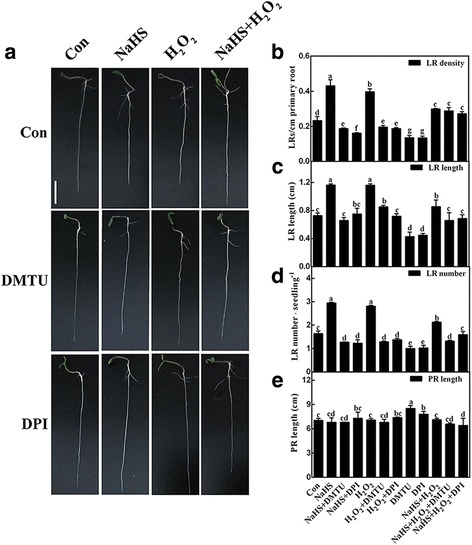
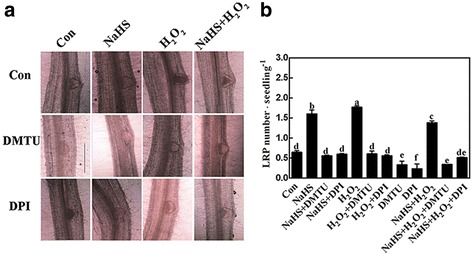
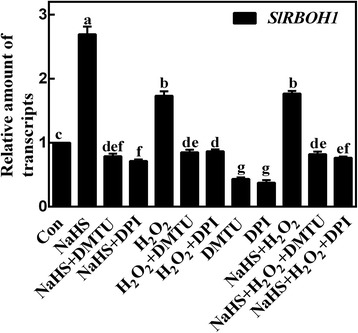
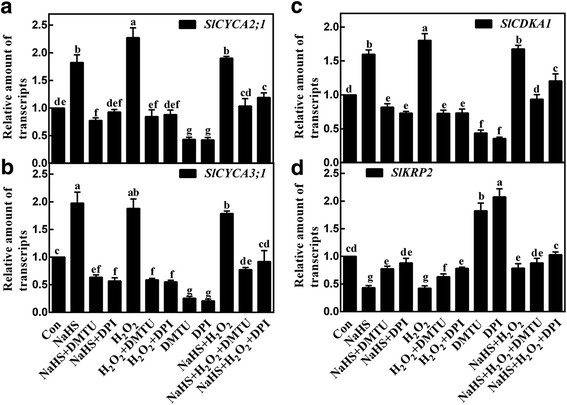
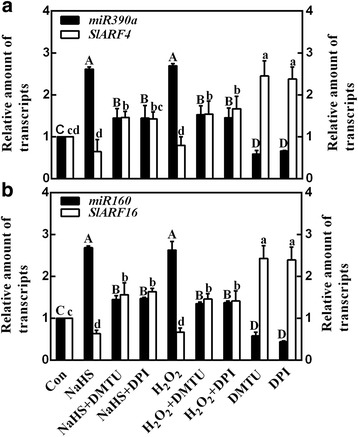
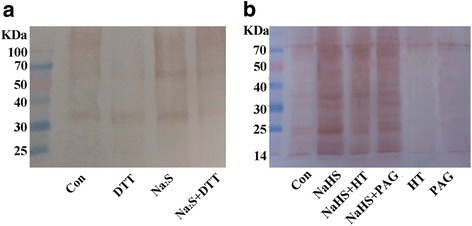
A HS donor sodium hydrosulfide (NaHS) triggered the accumulation of HO, the up-regulation of RBOH1 transcript, and thereafter tomato lateral root formation. Above responses were sensitive to the HO scavenger (dimethylthiourea; DMTU) and the inhibitor of NADPH oxidase (diphenylene idonium; DPI), showing that the accumulations of HO and increased RBOH1 transcript were respectively prevented. Lateral root primordial and lateral root formation were also impaired. Further molecular evidence revealed that HS-modulated gene expression of cell cycle regulatory genes, including up-regulation of SlCYCA2;1, SlCYCA3;1, and SlCDKA1, and the down-regulation of SlKRP2, were prevented by the co-treatment with DMTU or DPI. Above mentioned inducing phenotypes were consistent with the changes of lateral root formation-related microRNA transcripts: up-regulation of miR390a and miR160, and with the opposite tendencies of their target genes (encoding auxin response factors). Contrasting tendencies were observed when DMTU or DPI was added together. The occurrence of HS-mediated S-sulfhydration during above responses was preliminarily discovered.
Overall, these results suggested an important role of RBOH1-mediated HO in HS-elicited tomato lateral root development, and corresponding HS-target proteins regulated at transcriptional and post-translational levels.
硫化氢(HS)和过氧化氢(HO)都分别被视为参与根系形态发生的高反应性分子。在本报告中,研究了控制侧根形成的相应因果联系。
通过药理学、解剖学和分子学方法,本文提供的证据揭示了HS触发番茄侧根发育的分子机制。
HS供体硫氢化钠(NaHS)触发了HO的积累、RBOH1转录本的上调,进而引发番茄侧根形成。上述反应对HO清除剂(二甲基硫脲;DMTU)和NADPH氧化酶抑制剂(二亚苯基碘鎓;DPI)敏感,表明HO的积累和RBOH1转录本的增加分别受到抑制。侧根原基和侧根形成也受到损害。进一步的分子证据表明HS对细胞周期调控基因的表达调节,包括SlCYCA2;1、SlCYCA3;1和SlCDKA1的上调以及SlKRP2的下调,在与DMTU或DPI共同处理时受到抑制。上述诱导表型与侧根形成相关微小RNA转录本的变化一致:miR390a和miR160上调,且与其靶基因(编码生长素反应因子)呈相反趋势。当加入DMTU或DPI时观察到相反趋势。初步发现了上述反应过程中HS介导的S-巯基化现象。
总体而言,这些结果表明RBOH1介导的HO在HS诱导的番茄侧根发育中起重要作用,以及相应的HS靶蛋白在转录和翻译后水平受到调控。