Environmental Health Unit, National Institute for Health and Welfare, Kuopio, Finland.
Plant and Microbial Biology, University of California, Berkeley, California, USA.
Microbiome. 2017 Oct 13;5(1):138. doi: 10.1186/s40168-017-0356-5.
The limited understanding of microbial characteristics in moisture-damaged buildings impedes efforts to clarify which adverse health effects in the occupants are associated with the damage and to develop effective building intervention strategies. The objectives of this current study were (i) to characterize fungal and bacterial microbiota in house dust of severely moisture-damaged residences, (ii) to identify microbial taxa associated with moisture damage renovations, and (iii) to test whether the associations between the identified taxa and moisture damage are replicable in another cohort of homes. We applied bacterial 16S rRNA gene and fungal ITS amplicon sequencing complemented with quantitative PCR and chemical-analytical approaches to samples of house dust, and also performed traditional cultivation of bacteria and fungi from building material samples.
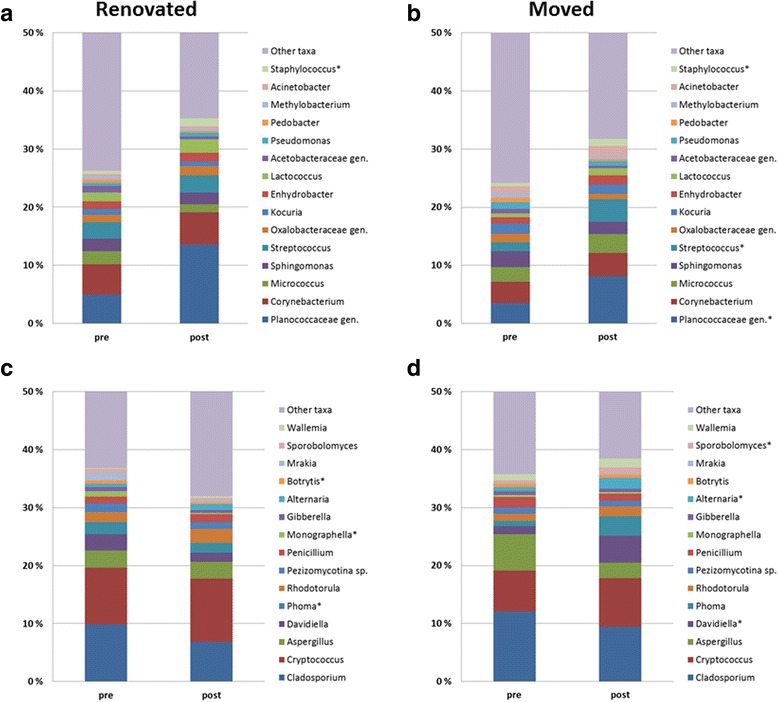
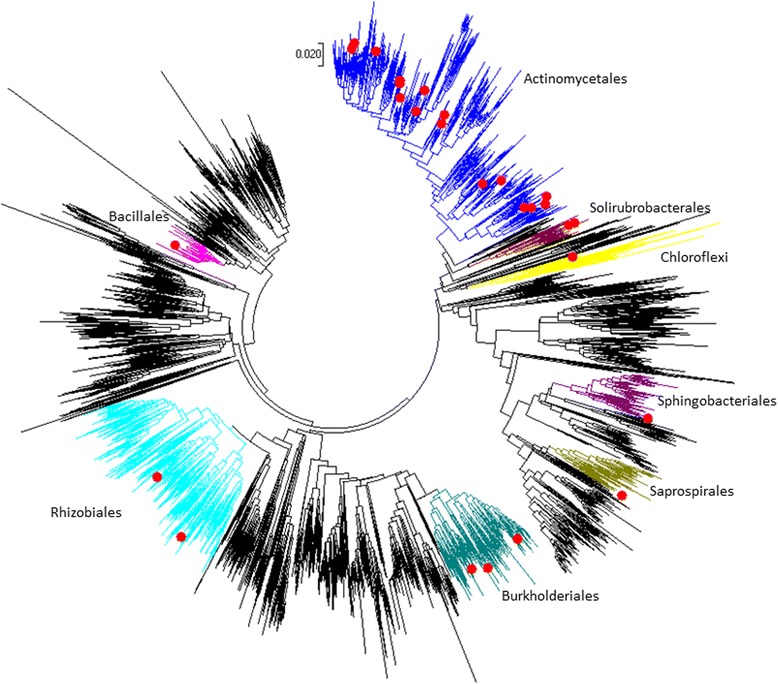
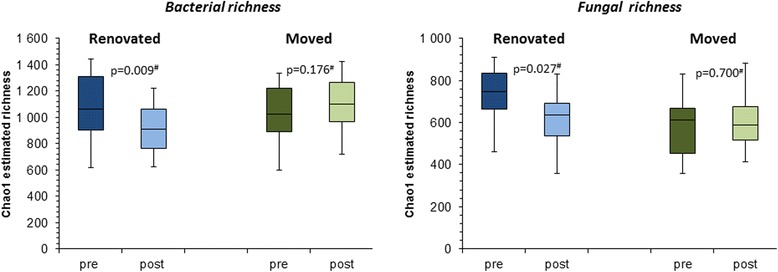
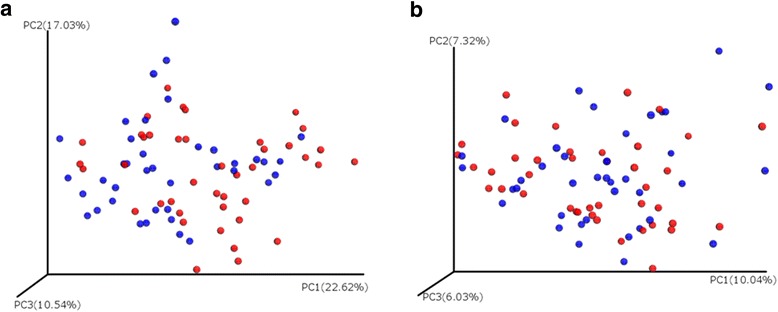
Active microbial growth on building materials had significant though small influence on the house dust bacterial and fungal communities. Moisture damage interventions-including actual renovation of damaged homes and cases where families moved to another home-had only a subtle effect on bacterial community structure, seen as shifts in abundance weighted bacterial profiles after intervention. While bacterial and fungal species richness were reduced in homes that were renovated, they were not reduced for families that moved houses. Using different discriminant analysis tools, we were able identify taxa that were significantly reduced in relative abundance during renovation of moisture damage. For bacteria, the majority of candidates belonged to different families within the Actinomycetales order. Results for fungi were overall less consistent. A replication study in approximately 400 homes highlighted some of the identified taxa, confirming associations with observations of moisture damage and mold.
The present study is one of the first studies to analyze changes in microbiota due to moisture damage interventions using high-throughput sequencing. Our results suggest that effects of moisture damage and moisture damage interventions may appear as changes in the abundance of individual, less common, and especially bacterial taxa, rather than in overall community structure.
由于对潮湿受损建筑中微生物特性的了解有限,人们难以明确居住者的哪些健康不良影响与损害有关,并制定有效的建筑干预策略。本研究的目的是:(i)对严重潮湿受损住宅的室内灰尘中的真菌和细菌微生物群落进行特征描述;(ii)鉴定与潮湿损害修复相关的微生物分类群;(iii)测试在另一组住宅中,所鉴定的分类群与潮湿损害之间的关联是否具有可重复性。我们应用细菌 16S rRNA 基因和真菌 ITS 扩增子测序,并辅以定量 PCR 和化学分析方法,对室内灰尘样本进行分析,还对建筑材料样本中的细菌和真菌进行了传统培养。
建筑材料上的活跃微生物生长对室内灰尘细菌和真菌群落有显著但微小的影响。潮湿损害干预措施——包括实际修复受损房屋以及家庭搬入另一所房屋的情况——对细菌群落结构的影响很小,仅表现为干预后丰度加权细菌分布的变化。尽管在进行潮湿损害修复的房屋中,细菌和真菌的丰富度降低,但对于搬入新家的家庭而言,丰富度并未降低。使用不同的判别分析工具,我们能够鉴定出在修复潮湿损害过程中相对丰度显著降低的分类群。对于细菌而言,大多数候选物属于放线菌目中不同的科。真菌的结果总体上不太一致。在大约 400 所住宅中进行的一项复制研究强调了一些已鉴定的分类群,证实了与潮湿损害和霉菌观察的关联。
本研究是首次使用高通量测序分析因潮湿损害干预而导致的微生物群落变化的研究之一。我们的结果表明,潮湿损害和潮湿损害干预的影响可能表现为个别、较少见且特别是细菌分类群的丰度变化,而不是整体群落结构的变化。