Instituto de Neurociencias de Alicante, Universidad Miguel Hernández-Consejo Superior de Investigaciones Científicas (UMH-CSIC), Avenida Ramón y Cajal, s/n, Sant Joan d'Alacant, Spain.
Southampton General Hospital, Biological Sciences, University of Southampton, South Lab&Path Block, LD80C, MP840, SO166YD, Southampton, United Kingdom.
Dev Neurobiol. 2018 Jun;78(6):561-579. doi: 10.1002/dneu.22545. Epub 2017 Oct 24.
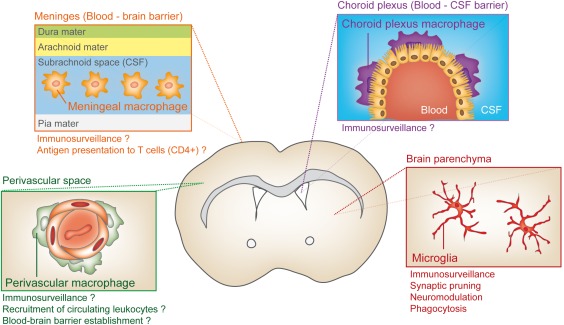
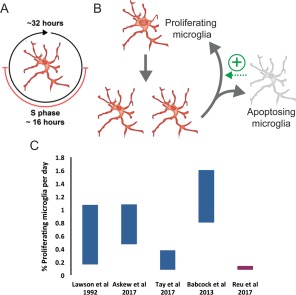
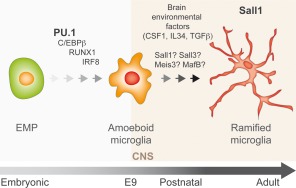
Microglia and non-parenchymal macrophages located in the perivascular space, the meninges and the choroid plexus are independent immune populations that play vital roles in brain development, homeostasis, and tissue healing. Resident macrophages account for a significant proportion of cells in the brain and their density remains stable throughout the lifespan thanks to constant turnover. Microglia develop from yolk sac progenitors, later evolving through intermediate progenitors in a fine-tuned process in which intrinsic factors and external stimuli combine to progressively sculpt their cell type-specific transcriptional profiles. Recent evidence demonstrates that non-parenchymal macrophages are also generated during early embryonic development. In recent years, the development of powerful fate mapping approaches combined with novel genomic and transcriptomic methodologies have greatly expanded our understanding of how brain macrophages develop and acquire specialized functions, and how cell population dynamics are regulated. Here, we review the transcription factors, epigenetic remodeling, and signaling pathways orchestrating the embryonic development of microglia and non-parenchymal macrophages. Next, we describe the dynamics of the macrophage populations of the brain and discuss the role of progenitor cells, to gain a better understanding of their functions in the healthy and diseased brain. © 2017 Wiley Periodicals, Inc. Develop Neurobiol 78: 561-579, 2018.
小胶质细胞和位于血管周围间隙、脑膜和脉络丛的非实质细胞巨噬细胞是独立的免疫群体,它们在大脑发育、稳态和组织修复中发挥着重要作用。驻留巨噬细胞占大脑细胞的很大比例,由于不断的更替,其密度在整个生命周期中保持稳定。小胶质细胞由卵黄囊祖细胞发育而来,后来通过精细的中间祖细胞过程进化,其中内在因素和外部刺激结合起来逐渐塑造其细胞类型特异性转录谱。最近的证据表明,非实质细胞巨噬细胞也在胚胎早期发育过程中产生。近年来,强大的命运图谱方法的发展结合新的基因组和转录组学方法极大地扩展了我们对大脑巨噬细胞如何发育并获得专门功能以及细胞群体动态如何受到调节的理解。在这里,我们回顾了协调小胶质细胞和非实质细胞巨噬细胞胚胎发育的转录因子、表观遗传重塑和信号通路。接下来,我们描述了大脑巨噬细胞群体的动态,并讨论了祖细胞的作用,以更好地理解它们在健康和患病大脑中的功能。©2017Wiley Periodicals,Inc.发育神经生物学 78:561-579,2018。