School of Biosciences, University of Nottingham, Loughborough LE12 5RD, UK.
Department of Molecular Biology and Biotechnology, University of Sheffield, Sheffield S10 2TN, UK.
Curr Biol. 2017 Oct 23;27(20):3183-3190.e4. doi: 10.1016/j.cub.2017.09.006. Epub 2017 Oct 12.
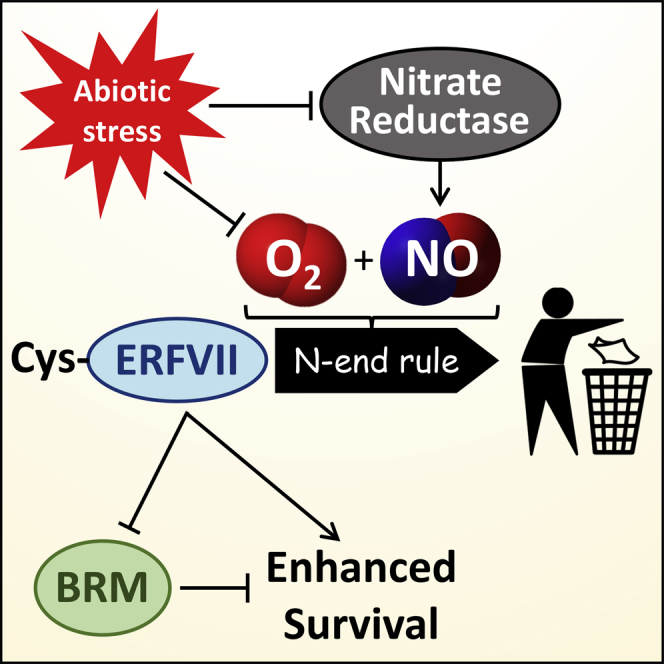
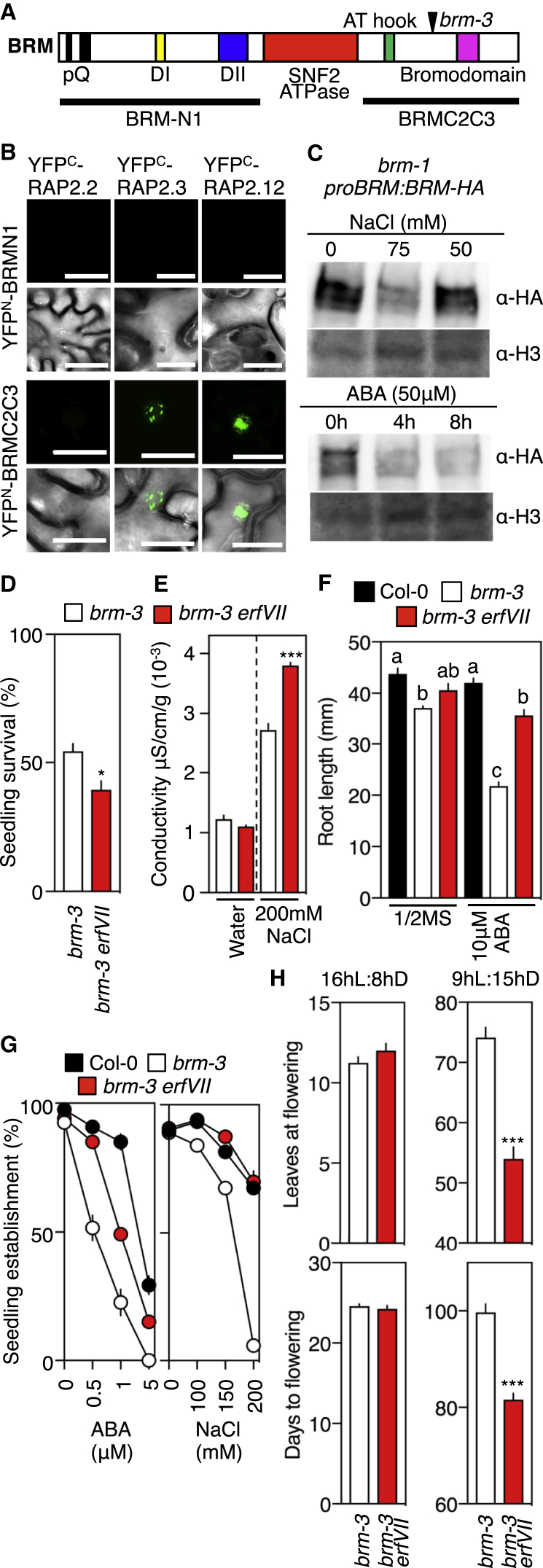
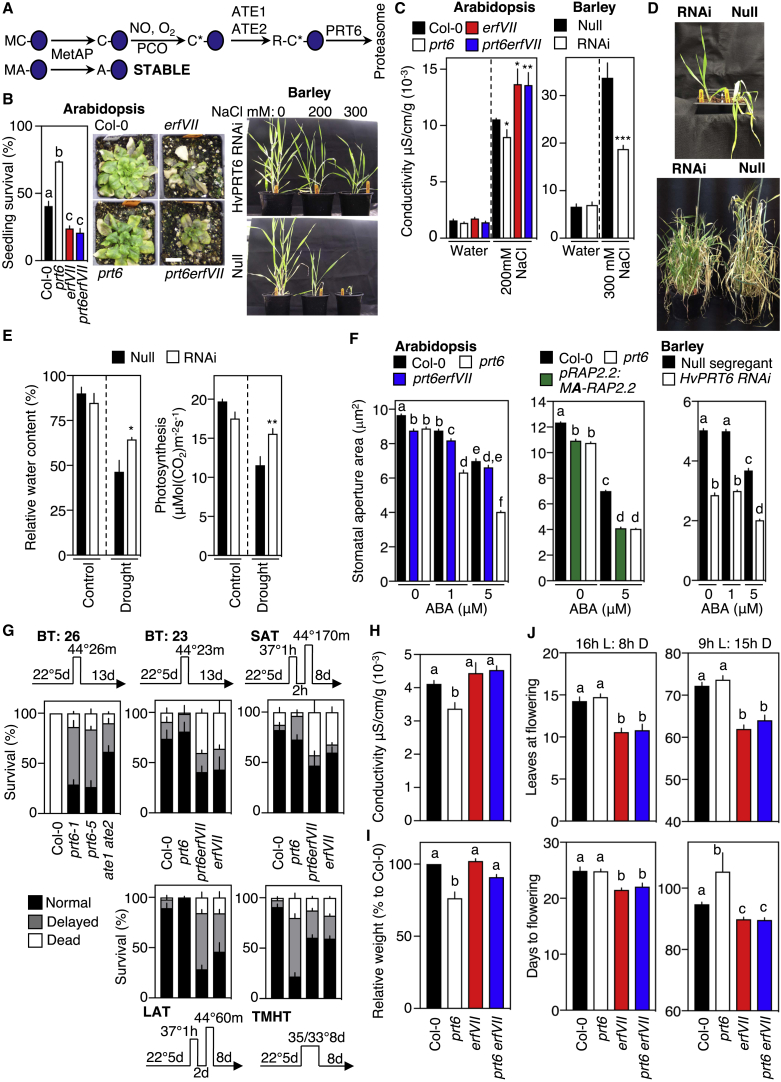
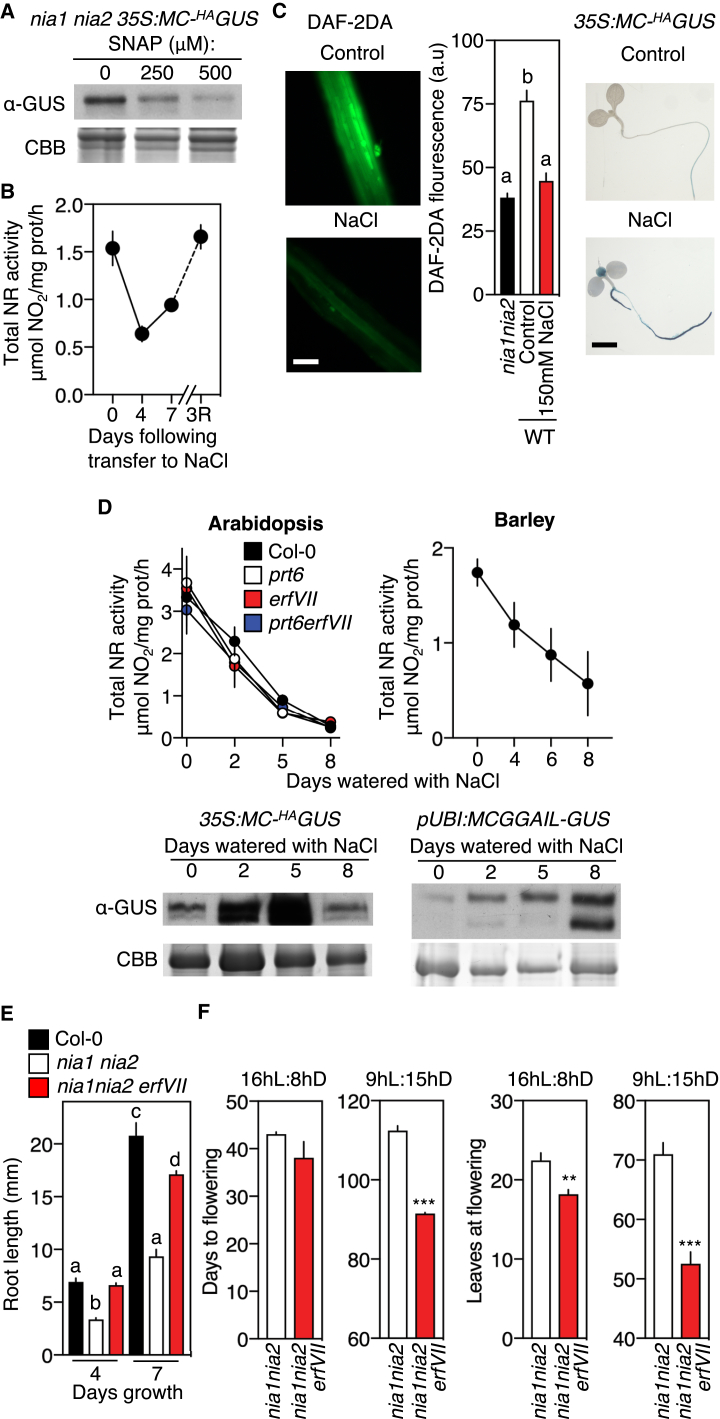
Abiotic stresses impact negatively on plant growth, profoundly affecting yield and quality of crops. Although much is known about plant responses, very little is understood at the molecular level about the initial sensing of environmental stress. In plants, hypoxia (low oxygen, which occurs during flooding) is directly sensed by the Cys-Arg/N-end rule pathway of ubiquitin-mediated proteolysis, through oxygen-dependent degradation of group VII Ethylene Response Factor transcription factors (ERFVIIs) via amino-terminal (Nt-) cysteine [1, 2]. Using Arabidopsis (Arabidopsis thaliana) and barley (Hordeum vulgare), we show that the pathway regulates plant responses to multiple abiotic stresses. In Arabidopsis, genetic analyses revealed that response to these stresses is controlled by N-end rule regulation of ERFVII function. Oxygen sensing via the Cys-Arg/N-end rule in higher eukaryotes is linked through a single mechanism to nitric oxide (NO) sensing [3, 4]. In plants, the major mechanism of NO synthesis is via NITRATE REDUCTASE (NR), an enzyme of nitrogen assimilation [5]. Here, we identify a negative relationship between NR activity and NO levels and stabilization of an artificial Nt-Cys substrate and ERFVII function in response to environmental changes. Furthermore, we show that ERFVIIs enhance abiotic stress responses via physical and genetic interactions with the chromatin-remodeling ATPase BRAHMA. We propose that plants sense multiple abiotic stresses through the Cys-Arg/N-end rule pathway either directly (via oxygen sensing) or indirectly (via NO sensing downstream of NR activity). This single mechanism can therefore integrate environment and response to enhance plant survival.
非生物胁迫会对植物生长产生负面影响,严重影响作物的产量和质量。尽管人们对植物的反应有了很多了解,但对环境胁迫的初始感知在分子水平上的了解却很少。在植物中,缺氧(在水淹时发生的低氧)通过氧依赖性降解组 VII 乙烯响应因子转录因子(ERFVIIs)的泛素介导的蛋白水解途径中的 Cys-Arg/N-末端规则途径直接被感知,通过氨基酸末端(Nt-)半胱氨酸[1,2]。我们使用拟南芥(Arabidopsis thaliana)和大麦(Hordeum vulgare)表明,该途径调节植物对多种非生物胁迫的反应。在拟南芥中,遗传分析表明,这些胁迫的反应受到 N-末端规则对 ERFVII 功能的调节控制。在高等真核生物中,通过 Cys-Arg/N-末端规则进行的氧感应通过单一机制与一氧化氮(NO)感应相关联[3,4]。在植物中,NO 合成的主要机制是通过硝酸盐还原酶(NR),一种氮同化酶[5]。在这里,我们确定了 NR 活性和 NO 水平与人工 Nt-半胱氨酸底物的稳定性之间的负相关关系,以及 ERFVII 功能对环境变化的反应。此外,我们表明 ERFVIIs 通过与染色质重塑 ATP 酶 BRAHMA 的物理和遗传相互作用增强非生物胁迫反应。我们提出,植物通过 Cys-Arg/N-末端规则途径直接(通过氧感应)或间接(通过 NR 活性下游的 NO 感应)感知多种非生物胁迫。因此,这种单一机制可以整合环境和反应,以提高植物的存活率。