Bernard Thomas E, Ashley Candi D, Garzon Ximena P, Kim Jung-Hyun, Coca Aitor
College of Public Health, University of South Florida, USA.
College of Education, University of South Florida, USA.
Ind Health. 2017 Dec 7;55(6):549-554. doi: 10.2486/indhealth.2017-0121. Epub 2017 Oct 14.
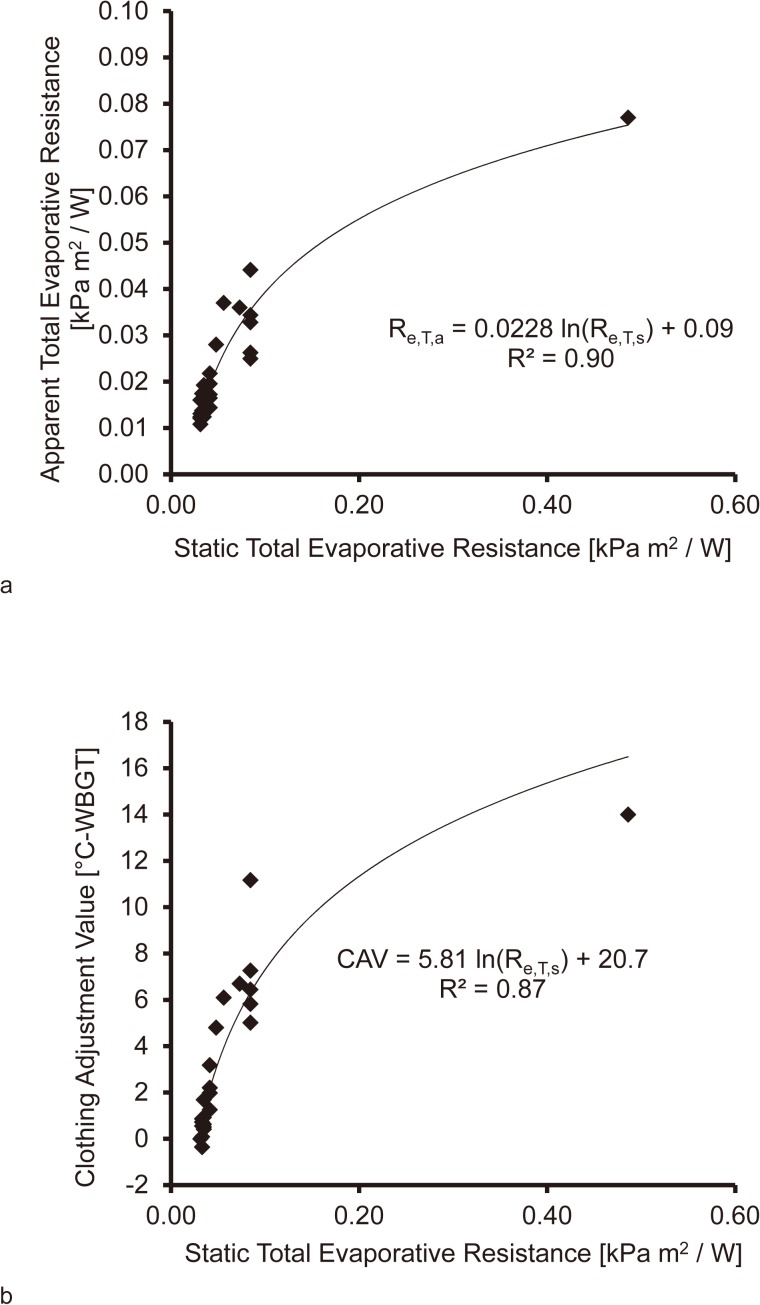
Wet bulb globe temperature (WBGT) index is used by many professionals in combination with metabolic rate and clothing adjustments to assess whether a heat stress exposure is sustainable. The progressive heat stress protocol is a systematic method to prescribe a clothing adjustment value (CAV) from human wear trials, and it also provides an estimate of apparent total evaporative resistance (R). It is clear that there is a direct relationship between the two descriptors of clothing thermal effects with diminishing increases in CAV at high R. There were data to suggest an interaction of CAV and R with relative humidity at high evaporative resistance. Because human trials are expensive, manikin data can reduce the cost by considering the static total evaporative resistance (R). In fact, as the static evaporative resistance increases, the CAV increases in a similar fashion as R. While the results look promising that R can predict CAV, some validation remains, especially for high evaporative resistance. The data only supports air velocities near 0.5 m/s.
湿球黑球温度(WBGT)指数被许多专业人士结合代谢率和衣物调整来使用,以评估热应激暴露是否可持续。渐进式热应激方案是一种从人体穿着试验中规定衣物调整值(CAV)的系统方法,它还能提供表观总蒸发阻力(R)的估计值。很明显,在高R值时,随着CAV的增加逐渐减少,衣物热效应的这两个描述符之间存在直接关系。有数据表明,在高蒸发阻力下,CAV和R与相对湿度存在相互作用。由于人体试验成本高昂,人体模型数据可以通过考虑静态总蒸发阻力(R)来降低成本。事实上,随着静态蒸发阻力增加,CAV以与R类似的方式增加。虽然R能够预测CAV的结果看起来很有前景,但仍需一些验证,特别是对于高蒸发阻力的情况。这些数据仅支持接近0.5米/秒的风速。