Shrestha Pratyush, Thapa Shalima, Shrestha Shikher, Lohani Subash, Bk Suresh, MacCormac Oscar, Thapa Lekhjung, Devkota Upendra Prasad
National Institute of Neurological and Allied Sciences, Kathmandu, Nepal.
Department of Neurosurgery, St Mary's Hospital, London, W2 1NY, UK.
F1000Res. 2017 Aug 21;6:1531. doi: 10.12688/f1000research.12117.2. eCollection 2017.
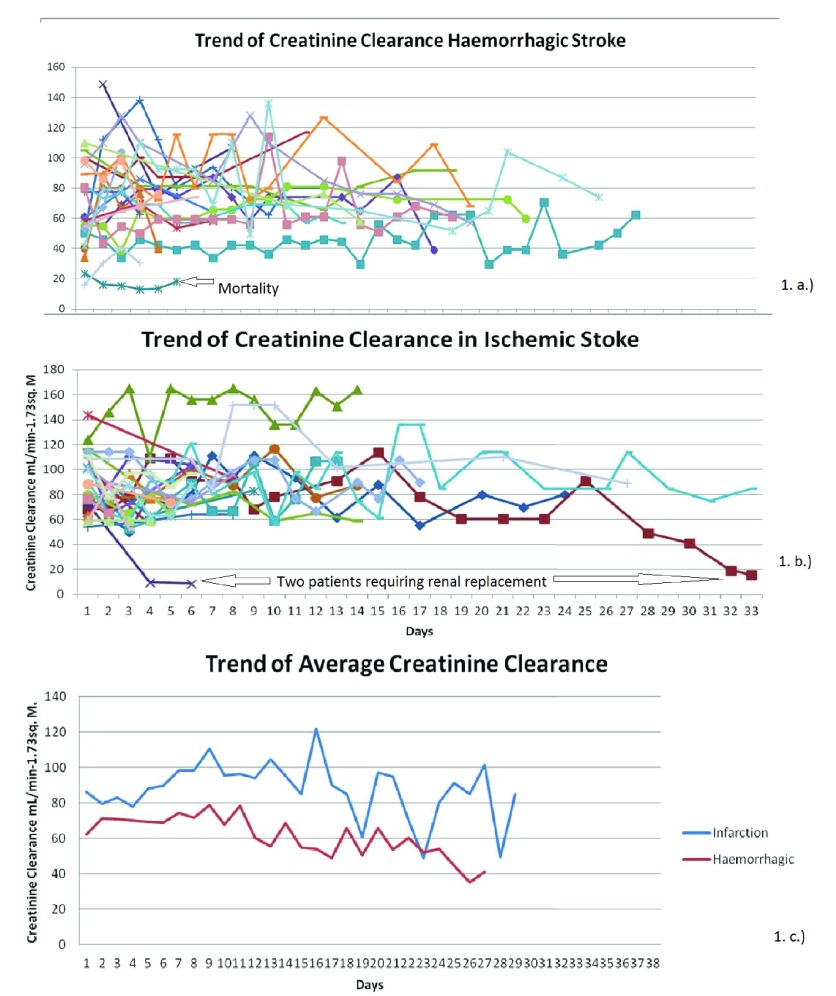
Renal impairment is regularly seen in hospitalized stroke patients, affecting the outcome of patients, as well as causing difficulties in their management. A prospective cohort study was conducted to assess the trend of renal function in hospitalized ischemic and haemorrhagic stroke patients. The incidence of renal impairment in these subgroups, the contributing factors and the need for renal replacement in renal impaired patients was evaluated. Alternate day renal function testing was performed in hospitalized stroke patients. Estimated glomerular filtration rate (e-GFR) was calculated and the trend of renal function in the two stroke subgroups (haemorrhagic and ischemic) was assessed, with renal impairment defined as e-GFR < 60mL/ minute per 1.73m . Among 52 patients, 25 had haemorrhagic stroke (mean age 59.81 ± 14.67) and 27 had ischemic stroke (mean age 56.12 ± 13.08). The mean e-GFR (mL/minute per 1.732m ) at admission in the haemorrhagic stroke subgroup was 64.79 ± 25.85 compared to 86.04 ± 26.09 in the ischemic stroke subgroup (p=0.005). Sixteen out of 25 (64%) patients in the haemorrhagic stroke subgroup and 9 out of 27 (33.3%) patients in the ischemic subgroup developed renal impairment (p=0.027). The location of the bleed (p=0.8), volume of hematoma (p=0.966) and surgical intervention (p=0.4) did not predispose the patients to renal impairment. One out of 16 patients with haemorrhagic stroke (who eventually died), and 2 out of 9 patients with ischemic stroke required renal replacement. : Renal impairment is commonly seen in stroke patients, more so in patients who suffered haemorrhagic strokes. The impairment, however, is transient and rarely requires renal replacement therapy.
住院中风患者经常出现肾功能损害,这不仅会影响患者的预后,还会给治疗带来困难。一项前瞻性队列研究旨在评估住院缺血性和出血性中风患者的肾功能变化趋势。评估了这些亚组中肾功能损害的发生率、相关因素以及肾功能受损患者进行肾脏替代治疗的必要性。对住院中风患者每隔一天进行一次肾功能检测。计算估计肾小球滤过率(e-GFR),并评估两个中风亚组(出血性和缺血性)的肾功能变化趋势,肾功能损害定义为e-GFR<60mL/分钟/1.73m²。52例患者中,25例为出血性中风(平均年龄59.81±14.67岁),27例为缺血性中风(平均年龄56.12±13.08岁)。出血性中风亚组入院时的平均e-GFR(mL/分钟/1.732m²)为64.79±25.85,而缺血性中风亚组为86.04±26.09(p=0.005)。出血性中风亚组25例患者中有16例(64%)出现肾功能损害,缺血性亚组27例患者中有9例(33.3%)出现肾功能损害(p=0.027)。出血部位(p=0.8)、血肿体积(p=0.966)和手术干预(p=0.4)均未使患者易患肾功能损害。16例出血性中风患者中有1例(最终死亡),9例缺血性中风患者中有2例需要肾脏替代治疗。结论:肾功能损害在中风患者中很常见,出血性中风患者更为常见。然而,这种损害是短暂的,很少需要肾脏替代治疗。