Department of Bacteria, Parasites and Fungi - Neisseria and Streptococcus Reference Laboratory, Statens Serum Institut, Copenhagen, Denmark.
Respiratory and Vaccine Preventable Bacteria Reference Unit, Public Health England-National Infection Service, London, UK.
Sci Rep. 2017 Oct 16;7(1):13280. doi: 10.1038/s41598-017-13605-8.
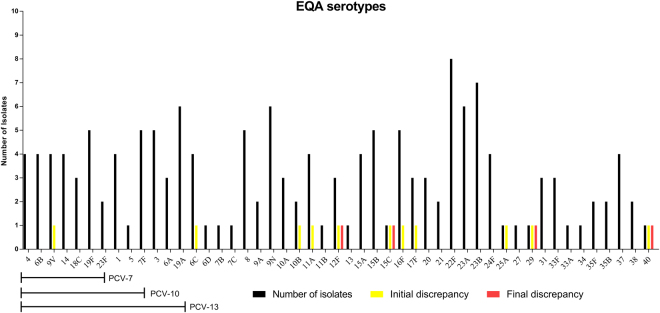
An external quality assessment (EQA) scheme for pneumococcal serotype identification has been performed over a period of 11 years, by a network of European pneumococcal reference laboratories. We report the results from the EQA, and present an assessment of the acceptability and utility of the EQA scheme. Reports from 22 EQA panels distributed in 2005-2016 were analysed. Each EQA panel consisted of seven isolates. A questionnaire including seven questions related to the acceptability and utility of the EQA scheme was distributed to all participating laboratories. Altogether, 154 pneumococcal isolates were tested. Of the 92 serologically distinct serotypes currently defined, 49 serotypes were included in the rounds. Discrepant results were observed in eight EQA rounds, involving 11 isolates (7.1%, 95% CI: 4% to 12%). All participating laboratories reported that the EQA scheme was useful for quality assurance purposes. Our results show that comparable serotyping data can be obtained in different laboratories. The EQA participation helps to keep the typing procedures at a high standard and provides data for accreditation purposes. The EQA is helpful when new technologies are introduced, and reveal limitations of both genotypic and phenotypic methods. Continuation of the presented EQA scheme is planned.
一项针对肺炎球菌血清型鉴定的外部质量评估(EQA)计划已在欧洲肺炎球菌参考实验室网络中进行了 11 年。我们报告了 EQA 的结果,并对 EQA 计划的可接受性和实用性进行了评估。对 2005-2016 年分发的 22 个 EQA 小组的报告进行了分析。每个 EQA 小组由 7 个分离株组成。向所有参与实验室分发了一份包括 7 个与 EQA 计划的可接受性和实用性相关问题的调查问卷。共测试了 154 株肺炎球菌分离株。在目前定义的 92 个血清学上不同的血清型中,有 49 个血清型包含在轮次中。在 8 个 EQA 轮次中观察到了 11 个分离株(7.1%,95%CI:4%至 12%)的不一致结果。所有参与实验室均报告 EQA 计划对质量保证目的有用。我们的结果表明,不同实验室可以获得可比的血清分型数据。EQA 参与有助于保持高标准的分型程序,并为认证目的提供数据。当引入新技术时,EQA 很有帮助,并揭示了基因分型和表型方法的局限性。计划继续进行目前提出的 EQA 计划。