McLeay Yanita, Stannard Stephen, Barnes Matthew
School of Sport, Exercise, and Nutrition, Massey University, Palmerston North 4474, New Zealand.
Antioxidants (Basel). 2017 Oct 17;6(4):79. doi: 10.3390/antiox6040079.
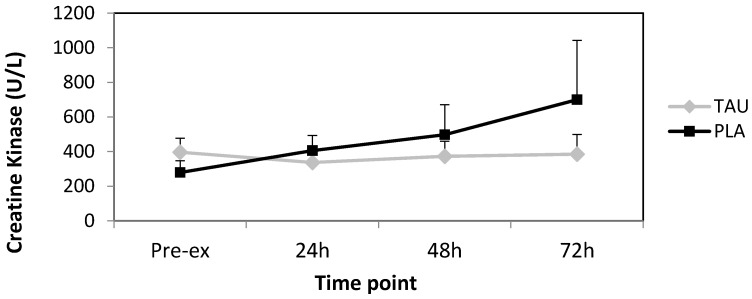
Eccentric exercise is known to bring about microstructural damage to muscle, initiating an inflammatory cascade involving various reactive oxygen species. This, in turn, can significantly impair physical performance over subsequent days. Taurine, a powerful endogenous antioxidant, has previously been shown to have a beneficial effect on muscle damage markers and recovery when taken for a few days to several weeks prior to eccentric exercise. However, to date no studies have looked at the effects of supplementing over the days following eccentric exercise on performance recovery. Thus, this study aimed to determine whether supplementing with taurine over three days following eccentric exercise attenuated the rise in serum creatine kinase and improved performance recovery in males. In a blinded, randomized, crossover design, ten recreationally-fit male participants completed 60 eccentric contractions of the biceps brachii muscle at maximal effort. Following this, participants were supplemented with 0.1 g∙kg body weight∙day of either taurine or rice flour in capsules. Over the next three mornings participants underwent blood tests for the analysis of the muscle damage marker creatine kinase and carried out performance measures on the isokinetic dynamometer. They also continued to consume the capsules in the morning and evening. The entire protocol was repeated two weeks later on the alternate arm and supplement. Significant decreases were seen in all performance measures from pre- to 24-h post-eccentric exercise ( < 0.001) for both taurine and placebo, indicating the attainment of muscle damage. Significant treatment effects were observed only for peak eccentric torque ( < 0.05). No significant time × treatment effects were observed (all > 0.05). Serum creatine kinase levels did not significantly differ over time for either treatments, nor between treatments ( > 0.05). These findings suggest that taurine supplementation taken twice daily for 72 h following eccentric exercise-induced muscle damage may help improve eccentric performance recovery of the biceps brachii.
已知离心运动可导致肌肉微观结构损伤,引发涉及各种活性氧的炎症级联反应。这进而会在随后几天显著损害身体机能。牛磺酸是一种强大的内源性抗氧化剂,此前研究表明,在离心运动前几天至几周服用牛磺酸,对肌肉损伤标志物和恢复具有有益作用。然而,迄今为止,尚无研究探讨在离心运动后的数天内补充牛磺酸对机能恢复的影响。因此,本研究旨在确定在离心运动后的三天内补充牛磺酸是否能减轻男性血清肌酸激酶的升高,并改善机能恢复情况。在一项双盲、随机、交叉设计中,十名健康的男性参与者以最大努力完成了肱二头肌的60次离心收缩。此后,参与者被随机分配,每天服用0.1 g∙kg体重的牛磺酸胶囊或米粉胶囊。在接下来的三个早晨,参与者接受血液检测以分析肌肉损伤标志物肌酸激酶,并在等速测力计上进行机能测试。他们还继续在早晚服用胶囊。两周后,在另一只手臂上重复整个实验流程,并更换补充剂。牛磺酸组和安慰剂组在离心运动前至运动后24小时的所有机能测试指标均显著下降(< 0.001),表明出现了肌肉损伤。仅在峰值离心扭矩方面观察到显著的治疗效果(< 0.05)。未观察到显著的时间×治疗交互作用(所有P > 0.05)。两种治疗方法的血清肌酸激酶水平在不同时间以及不同治疗组之间均无显著差异(P > 0.05)。这些结果表明,在离心运动引起肌肉损伤后,每天两次服用72小时的牛磺酸补充剂可能有助于改善肱二头肌的离心机能恢复。