Tants Jan-Niklas, Fesser Stephanie, Kern Thomas, Stehle Ralf, Geerlof Arie, Wunderlich Christoph, Juen Michael, Hartlmüller Christoph, Böttcher Romy, Kunzelmann Stefan, Lange Oliver, Kreutz Christoph, Förstemann Klaus, Sattler Michael
Institute of Structural Biology, Helmholtz Zentrum München, 85764 Neuherberg, Germany.
Center for Integrated Protein Science Munich at Chair of Biomolecular NMR Spectroscopy, Department Chemie, Technische Universität München, 85748 Garching, Germany.
Nucleic Acids Res. 2017 Dec 1;45(21):12536-12550. doi: 10.1093/nar/gkx886.
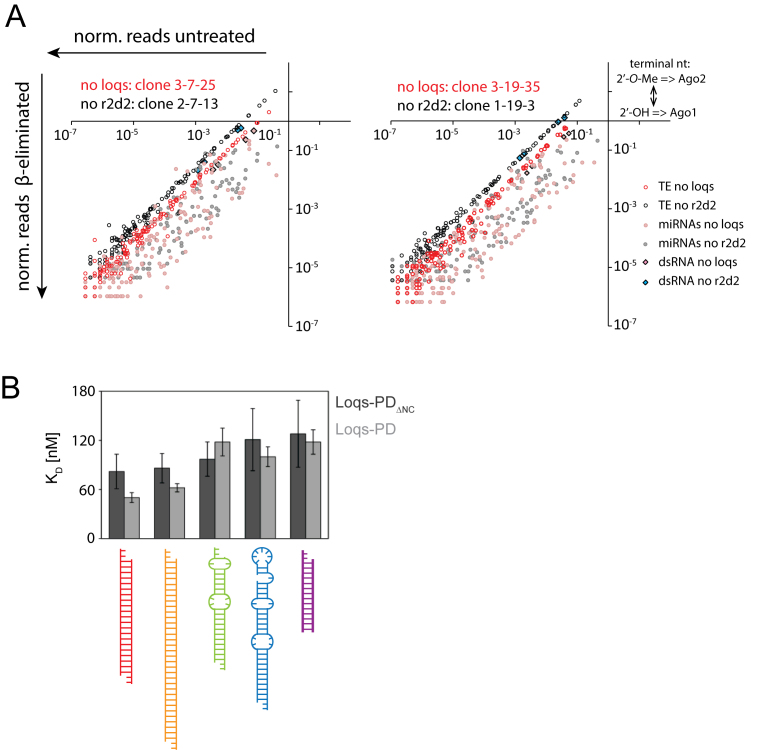
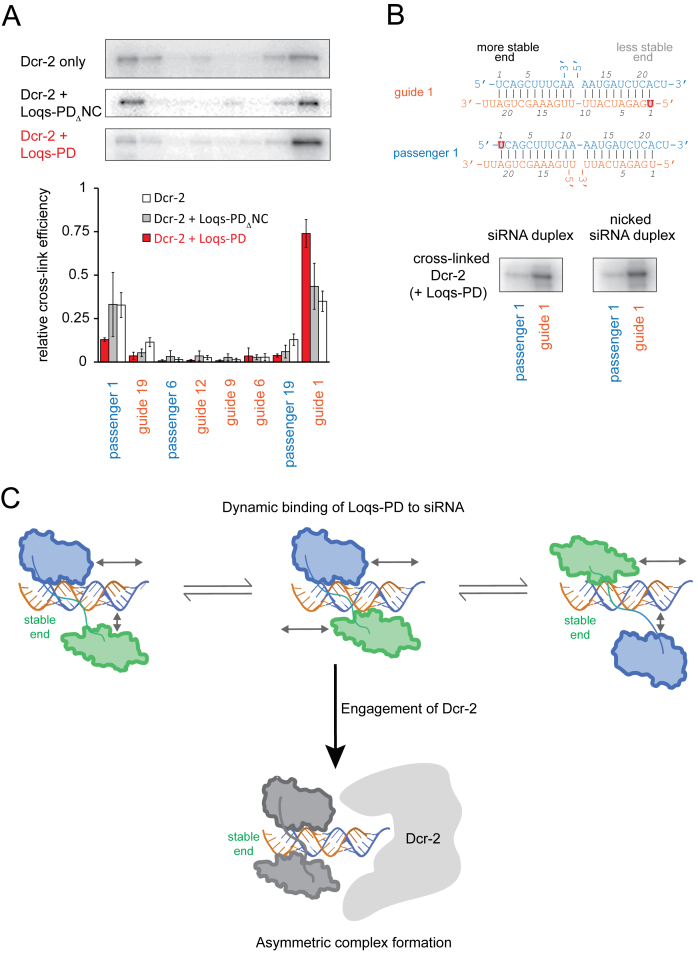
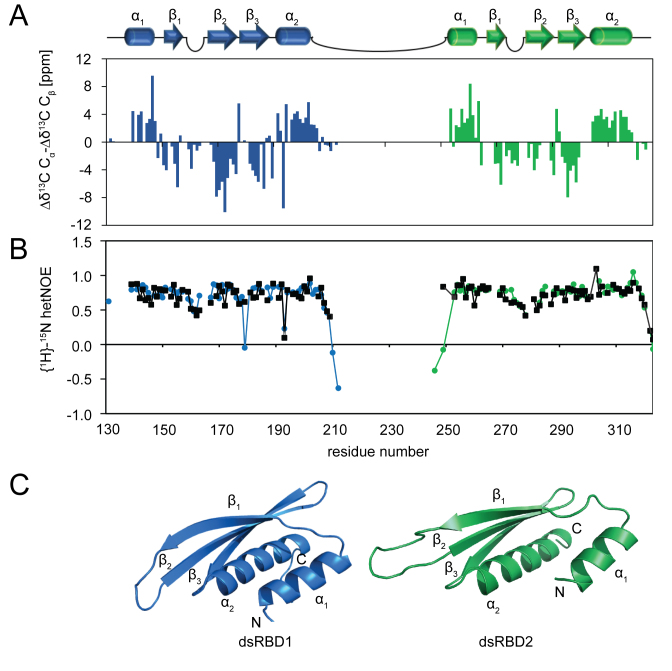
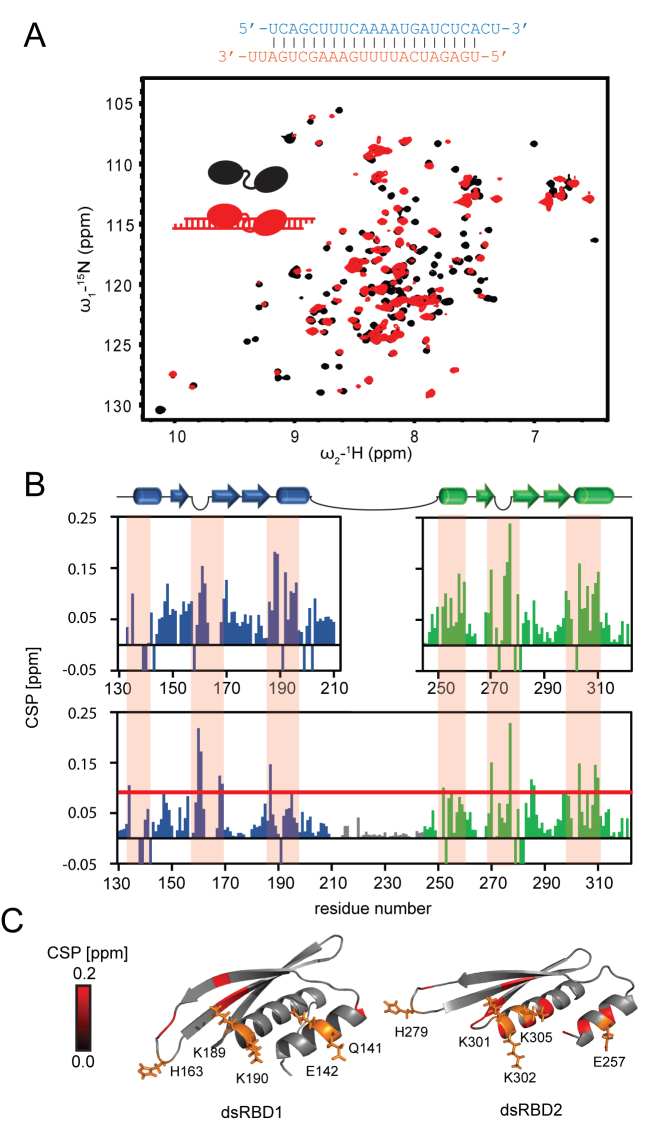
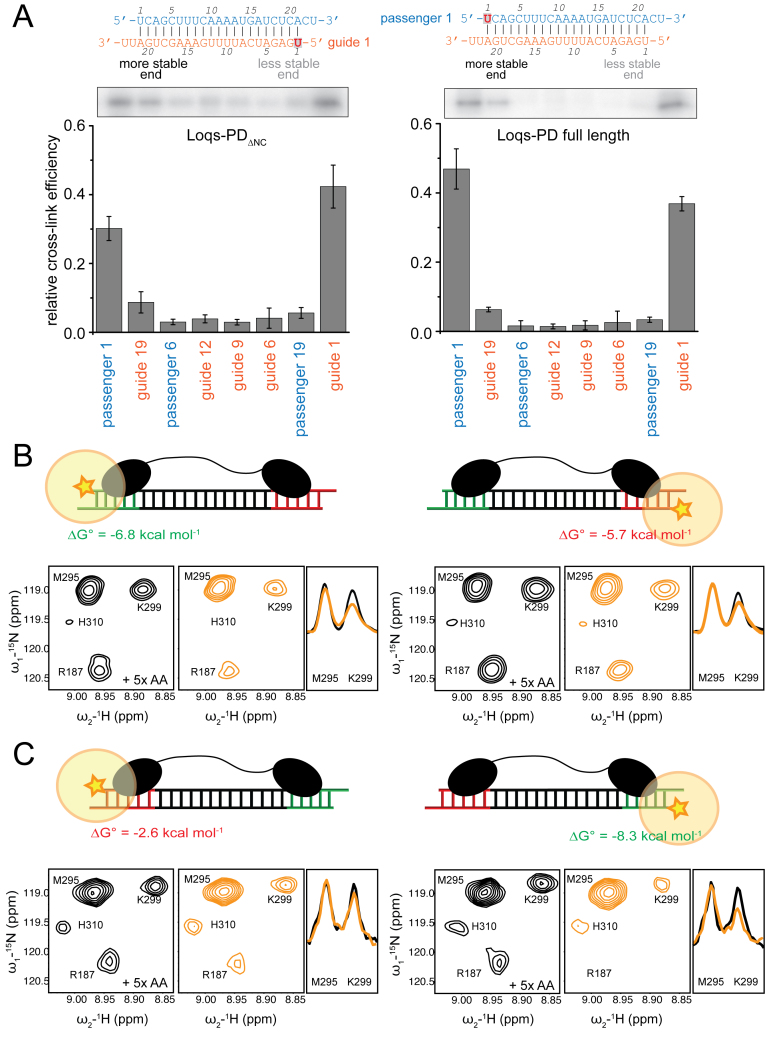
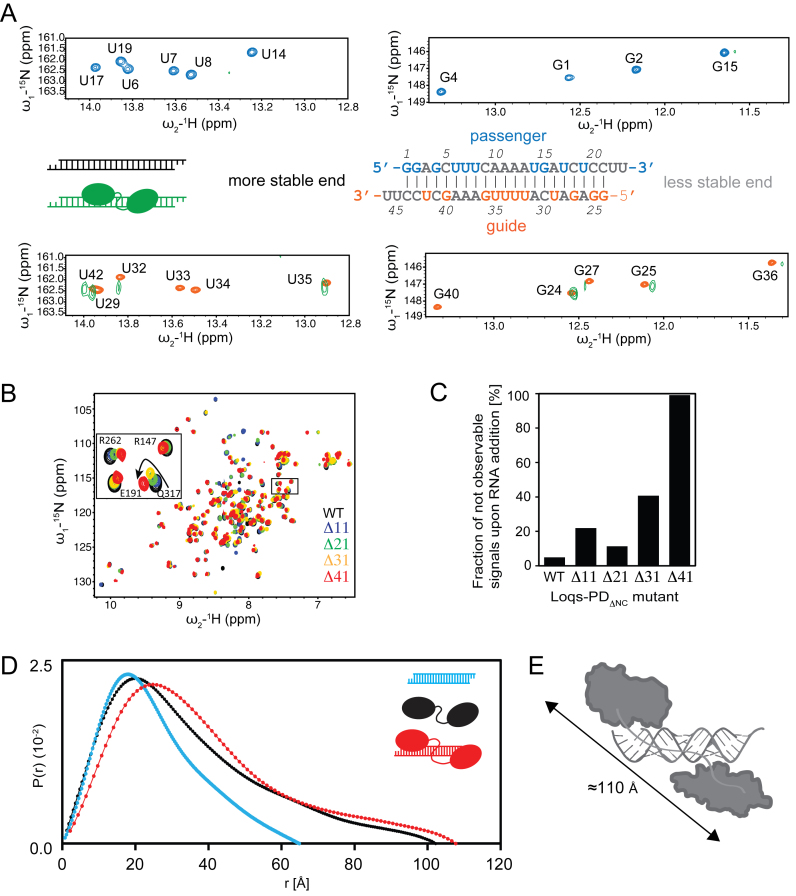
RNA interference defends against RNA viruses and retro-elements within an organism's genome. It is triggered by duplex siRNAs, of which one strand is selected to confer sequence-specificity to the RNA induced silencing complex (RISC). In Drosophila, Dicer-2 (Dcr-2) and the double-stranded RNA binding domain (dsRBD) protein R2D2 form the RISC loading complex (RLC) and select one strand of exogenous siRNAs according to the relative thermodynamic stability of base-pairing at either end. Through genome editing we demonstrate that Loqs-PD, the Drosophila homolog of human TAR RNA binding protein (TRBP) and a paralog of R2D2, forms an alternative RLC with Dcr-2 that is required for strand choice of endogenous siRNAs in S2 cells. Two canonical dsRBDs in Loqs-PD bind to siRNAs with enhanced affinity compared to miRNA/miRNA* duplexes. Structural analysis, NMR and biophysical experiments indicate that the Loqs-PD dsRBDs can slide along the RNA duplex to the ends of the siRNA. A moderate but notable binding preference for the thermodynamically more stable siRNA end by Loqs-PD alone is greatly amplified in complex with Dcr-2 to initiate strand discrimination by asymmetry sensing in the RLC.
RNA干扰可抵御生物基因组内的RNA病毒和逆转录元件。它由双链小干扰RNA(siRNA)触发,其中一条链被选出来赋予RNA诱导沉默复合体(RISC)序列特异性。在果蝇中,Dicer-2(Dcr-2)和双链RNA结合结构域(dsRBD)蛋白R2D2形成RISC装载复合体(RLC),并根据两端碱基配对的相对热力学稳定性选择一条外源siRNA链。通过基因组编辑,我们证明了果蝇中人类TAR RNA结合蛋白(TRBP)的同源物、R2D2的旁系同源物Loqs-PD与Dcr-2形成了一种替代的RLC,这是S2细胞中内源性siRNA链选择所必需的。与微小RNA/微小RNA*双链体相比,Loqs-PD中的两个典型dsRBD以更高的亲和力结合siRNA。结构分析、核磁共振和生物物理实验表明,Loqs-PD的dsRBD可以沿着RNA双链滑动到siRNA的末端。单独的Loqs-PD对热力学上更稳定的siRNA末端有适度但明显的结合偏好,在与Dcr-2形成的复合物中这种偏好会大大增强,从而通过RLC中的不对称感应启动链识别。