Weng Jiaxin, Zhao Shichao, Li Zhiting, Ricardo Karen B, Zhou Feng, Kim Hyojeong, Liu Haitao
College of Materials & Environmental Engineering, Hangzhou Dianzi University, Hangzhou 310018, China.
Department of Chemistry, University of Pittsburgh, Pittsburgh, Pennsylvania, PA 15260, USA.
Nanomaterials (Basel). 2017 Oct 19;7(10):337. doi: 10.3390/nano7100337.
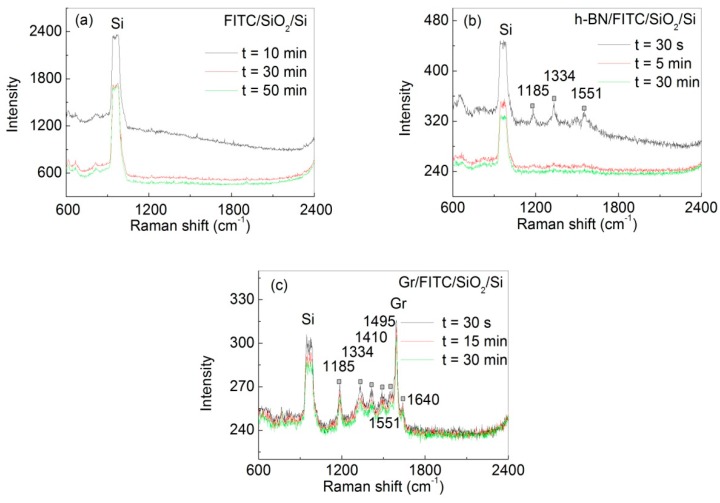
Fluorescent organic dyes photobleach under intense light. Graphene has been shown to improve the photo-stability of organic dyes. In this paper, we investigated the Raman spectroscopy and photo-bleaching kinetics of dyes in the absence/presence of chemical vapor deposition (CVD)-grown graphene. We show that graphene enhances the Raman signal of a wide range of dyes. The photo-bleaching of the dyes was reduced when the dyes were in contact with graphene. In contrast, monolayer hexagonal boron nitride (h-BN) was much less effective in reducing the photo-bleaching rate of the dyes. We attribute the suppression of photo-bleaching to the energy or electron transfer from dye to graphene. The results highlight the potential of CVD graphene as a substrate for protecting and enhancing Raman response of organic dyes.
荧光有机染料在强光下会发生光漂白。石墨烯已被证明可以提高有机染料的光稳定性。在本文中,我们研究了在有无化学气相沉积(CVD)生长的石墨烯存在下染料的拉曼光谱和光漂白动力学。我们表明,石墨烯增强了多种染料的拉曼信号。当染料与石墨烯接触时,染料的光漂白作用会减弱。相比之下,单层六方氮化硼(h-BN)在降低染料光漂白速率方面的效果要差得多。我们将光漂白的抑制归因于从染料到石墨烯的能量或电子转移。这些结果突出了CVD石墨烯作为保护和增强有机染料拉曼响应的衬底的潜力。