Kim Yoonjung, Cho Mee-Yon, Kim Juwon, Kim Sung Nam, Oh Seoung Chul, Lee Kyung-A
Department of Laboratory Medicine, Yonsei University College of Medicine, Seoul, Korea.
Department of Pathology, Yonsei University Wonju College of Medicine, Wonju, Korea.
Oncotarget. 2017 Jul 22;8(41):69888-69905. doi: 10.18632/oncotarget.19435. eCollection 2017 Sep 19.
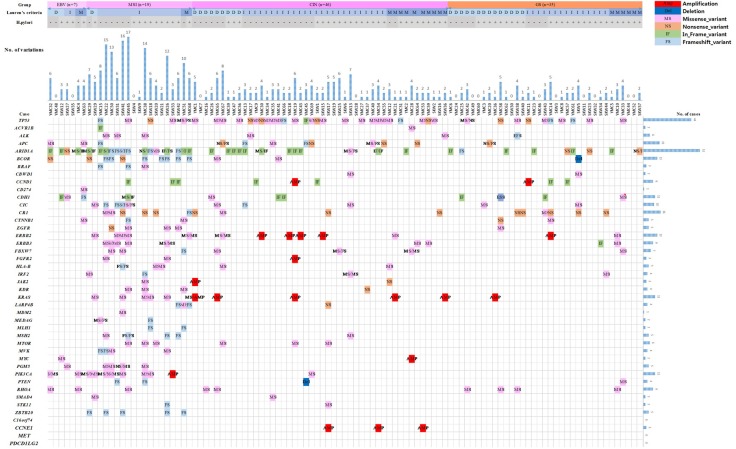
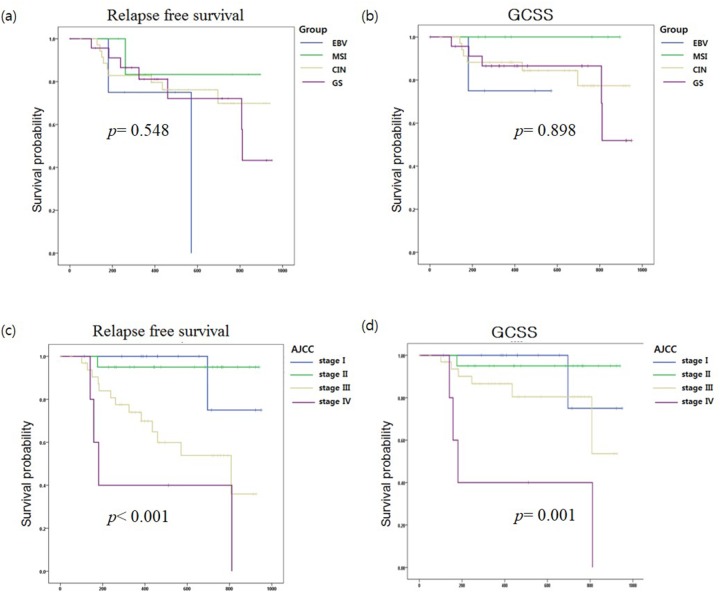
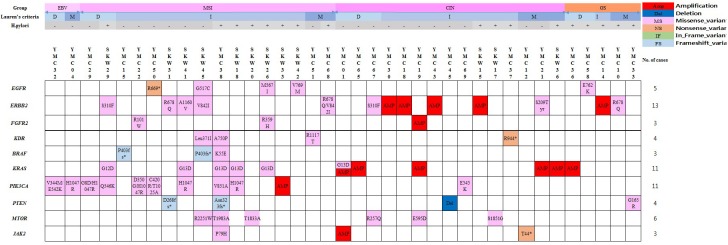
Recently, the Cancer Genome Atlas (TCGA) Research Network and Asian Cancer Research Group provided a new classification of gastric cancer (GC) to aid the development of biomarkers for targeted therapy and predict prognosis. We studied associations between genetically aberrant profiles of cancer-related genes, environmental factors, and histopathological features in 107 paired gastric tumor-non-tumor tissue GC samples. 6.5% of our GC cases were classified as the EBV subtype, 17.8% as the MSI subtype, 43.0% as the CIN subtype, and 32.7% as the GS subtype. The distribution of four GC subgroups based on the TCGA and our dataset were similar. The MSI subtype showed a hyper-mutated status and the best prognosis among molecular subtype. However, molecular classification based on the four GC subtypes showed no significant survival differences in terms of overall survival (= 0.548) or relapse-free survival (RFS, =0.518). The P619fs43 in was limited to MSI group (n= 5/19, 26.3%), showing similar trends observed in TCGA dataset. Genetic alterations of the RTK/RAS/MAPK and PI3K/AKT/mTOR pathways were detected in 34.6% of GC cases (37 individual cases). We also found two cases with likely pathogenic variants (NM_004360.4: c. 2494 G>A, ) in the gene. Here, we classified molecular subtypes of GC according to the TCGA system and provide a critical starting point for the design of more appropriate clinical trials based on a comprehensive analysis of genetic alterations in Korean GC patients.
最近,癌症基因组图谱(TCGA)研究网络和亚洲癌症研究小组对胃癌(GC)进行了新的分类,以帮助开发用于靶向治疗的生物标志物并预测预后。我们研究了107对胃癌肿瘤-非肿瘤组织GC样本中癌症相关基因的基因异常谱、环境因素和组织病理学特征之间的关联。我们的GC病例中有6.5%被分类为EBV亚型,17.8%为微卫星高度不稳定(MSI)亚型,43.0%为染色体不稳定(CIN)亚型,32.7%为基因组稳定(GS)亚型。基于TCGA和我们的数据集的四种GC亚组的分布相似。MSI亚型表现出高突变状态,是分子亚型中预后最好的。然而,基于四种GC亚型的分子分类在总生存期(=0.548)或无复发生存期(RFS,=0.518)方面没有显著的生存差异。中的P619fs43仅限于MSI组(n = 5/19,26.3%),显示出与TCGA数据集中观察到的相似趋势。在34.6%的GC病例(37例个体病例)中检测到RTK/RAS/MAPK和PI3K/AKT/mTOR途径的基因改变。我们还在基因中发现了两例可能的致病变异(NM_004360.4:c. 2494 G>A,)。在这里,我们根据TCGA系统对GC的分子亚型进行了分类,并基于对韩国GC患者基因改变的综合分析,为设计更合适的临床试验提供了关键的起点。