Mehaisen Gamal M K, Ibrahim Rania M, Desoky Adel A, Safaa Hosam M, El-Sayed Osama A, Abass Ahmed O
Department of Animal Production, Faculty of Agriculture, Cairo University, Giza, Egypt.
Poultry Cellular and Molecular Physiology Laboratory, Faculty of Agriculture, Cairo University, Giza, Egypt.
PLoS One. 2017 Oct 20;12(10):e0186907. doi: 10.1371/journal.pone.0186907. eCollection 2017.
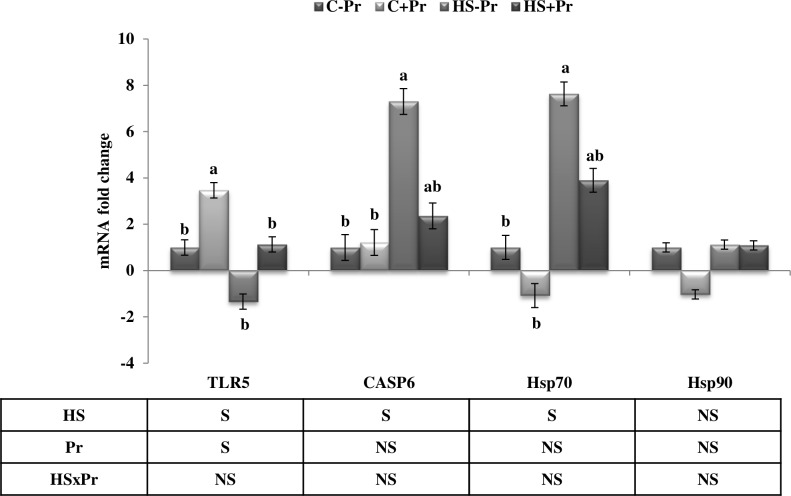
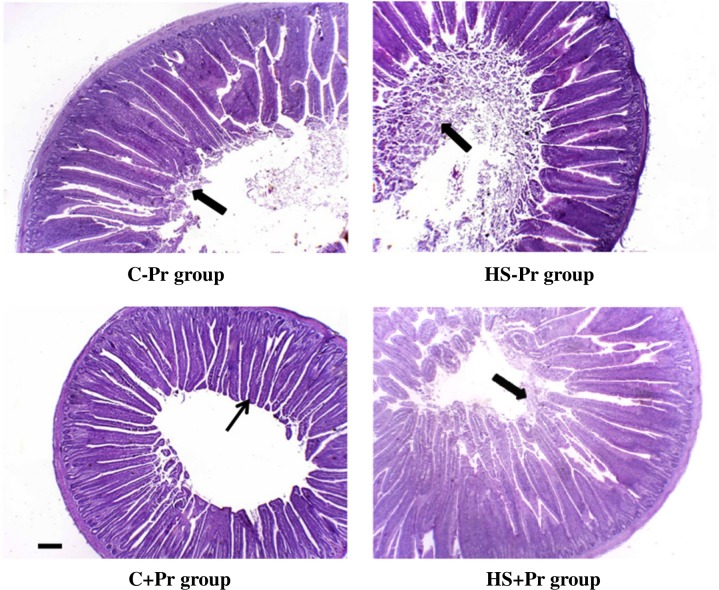
Heat stress is one of the most detrimental confrontations in tropical and subtropical regions of the world, causing considerable economic losses in poultry production. Propolis, a resinous product of worker honeybees, possesses several biological activities that could be used to alleviate the deleterious effects of high environmental temperature on poultry production. The current study was aimed at evaluating the effects of propolis supplementation to Japanese quail (Coturnix coturnix japonica) diets on the production performance, intestinal histomorphology, relative physiological and immunological parameters, and selected gene expression under heat stress conditions. Three hundred one-day-old Japanese quail chicks were randomly distributed into 20 wired-cages. At 28 d of age, the birds were divided into 2 temperature treatment groups; a normal at 24°C (C group) and a heat stress at 35°C (HS group). The birds in each group were further assigned to 2 subgroups; one of them was fed on a basal diet without propolis supplementation (-Pr subgroup) while the other was supplemented with propolis (+Pr subgroup). Production performance including body weight gain, feed intake and feed conversion ratio were measured. The intestinal histomorphological measurements were also performed for all treatment groups. Relative physiological parameters including body temperature, corticosterone hormone level, malondialdehyde (MDA) and free triiodothyronine hormone (fT3), as well as the relative immunological parameters including the total white blood cells count (TWBC's), heterophil/lymphocyte (H/L) ratio and lymphocyte proliferation index, were also measured. Furthermore, the mRNA expression for toll like receptor 5 (TLR5), cysteine-aspartic protease-6 (CASP6) and heat shock proteins 70 and 90 (Hsp70 and Hsp90) genes was quantified in this study. The quail production performance was significantly (P<0.05) impaired by HS treatment, while Pr treatment significantly improved the quail production performance. The villus width and area were significantly (P<0.05) lower in the HS compared to the C group, while Pr treatment significantly increased crypts depth of quail. A negative impact of HS treatment was observed on the physiological status of quail; however, propolis significantly alleviated this negative effect. Moreover, quail of the HS group expressed lower immunological parameters than C group, while propolis enhanced the immune status of the quail. The relative mRNA expression of TLR5 gene was down-regulated by HS treatment while it was up-regulated by the Pr treatment. Furthermore, the positive effects of propolis in HS-quail were evidenced by normalizing the high expressions of CASP6 and Hsp70 genes when compared to the C group. Based on these results, the addition of propolis to quail diets as a potential nutritional strategy in order to improve their performance, especially under heat stress conditions, is recommended.
热应激是世界热带和亚热带地区最有害的应激之一,给家禽生产造成了相当大的经济损失。蜂胶是工蜂的一种树脂状产物,具有多种生物活性,可用于减轻高温环境对家禽生产的有害影响。本研究旨在评估向日粮中添加蜂胶对日本鹌鹑(Coturnix coturnix japonica)在热应激条件下的生产性能、肠道组织形态学、相关生理和免疫参数以及选定基因表达的影响。300只1日龄日本鹌鹑雏鸡被随机分配到20个铁丝笼中。在28日龄时,将这些鸟分为2个温度处理组;一组处于24°C的正常温度环境(C组),另一组处于35°C的热应激环境(HS组)。每组的鸟进一步分为2个亚组;其中一个亚组饲喂不添加蜂胶的基础日粮(-Pr亚组),另一个亚组添加蜂胶(+Pr亚组)。测定生产性能,包括体重增加、采食量和饲料转化率。对所有处理组也进行了肠道组织形态学测量。还测量了相关生理参数,包括体温、皮质酮激素水平、丙二醛(MDA)和游离三碘甲状腺原氨酸激素(fT3),以及相关免疫参数,包括白细胞总数(TWBC's)、嗜异性粒细胞/淋巴细胞(H/L)比率和淋巴细胞增殖指数。此外,本研究还对Toll样受体5(TLR5)、半胱天冬酶-6(CASP6)以及热休克蛋白70和90(Hsp70和Hsp90)基因的mRNA表达进行了定量分析。热应激处理显著(P<0.05)损害了鹌鹑的生产性能,而蜂胶处理显著改善了鹌鹑的生产性能。与C组相比,热应激组的绒毛宽度和面积显著(P<0.05)降低,而蜂胶处理显著增加了鹌鹑的隐窝深度。观察到热应激处理对鹌鹑的生理状态有负面影响;然而,蜂胶显著减轻了这种负面影响。此外,热应激组鹌鹑的免疫参数低于C组,而蜂胶提高了鹌鹑的免疫状态。热应激处理下调了TLR5基因的相对mRNA表达,而蜂胶处理上调了该基因的表达。此外,与C组相比,蜂胶使CASP6和Hsp70基因的高表达恢复正常,从而证明了蜂胶对热应激鹌鹑的积极作用。基于这些结果,建议向日粮中添加蜂胶作为一种潜在的营养策略,以提高鹌鹑的性能,特别是在热应激条件下。