Pokorna Bronislava, Stefancova Slavomira, Tauberova Veronika, Petrovova Eva, Luptakova Lenka
Department of Biology and Physiology, University of Veterinary Medicine and Pharmacy in Kosice, Komenskeho 68/73, Kosice, 041 81, Slovakia.
Small Animal Clinic, University of Veterinary Medicine and Pharmacy in Kosice, Komenskeho 68/73, Kosice, 041 81, Slovakia.
Vet Anim Sci. 2025 Jul 15;29:100486. doi: 10.1016/j.vas.2025.100486. eCollection 2025 Sep.
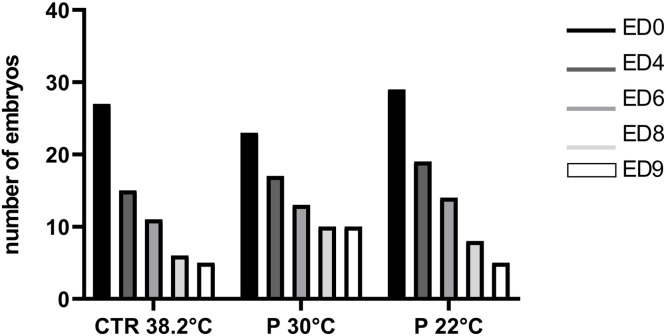
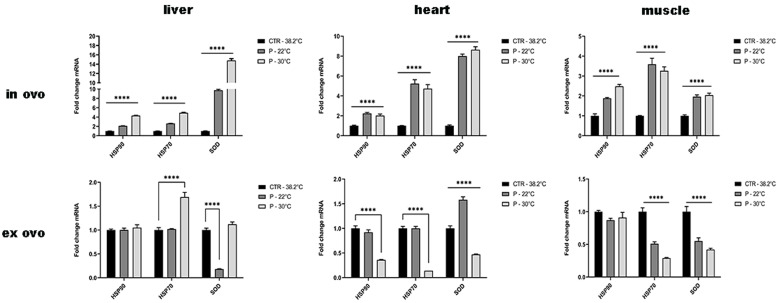
Extreme temperatures, whether excessively high or low, are critical environmental stressors for organisms, profoundly impacting cellular metabolism and homeostasis. The presented study addresses the effects of varying incubation conditions on the expression of key stress-related genes (HSP70, HSP90, and SOD1) during quail development. Quail eggs were incubated using three distinct methods: standard incubation at 38.2°C and preincubation at either 22°C or 30°C in both and conditions. Results revealed a distinctive contrast in survival rates: embryos cultured showed significantly lower viability (26.41 %) compared to the method (87.66 %). Among groups, preincubation at 30°C yielded the highest survival rate (43.48 %), highlighting the critical role of optimal preincubation temperature. The preincubation period resulted in a notable increase in the total weight of embryos in the group when compared to the group. Additionally, preincubation at 30°C resulted in increased weight of the heart and liver in the group. Gene expression analysis showed clear differences between incubation methods. While incubation led to uniformly increased gene expression across all examined organs (liver, heart, and breast muscle) at both preincubation temperatures, the conditions exhibited mixed results: decreased gene expression in the liver (SOD1) and muscle (HSP70, SOD1) but notable increased in the liver (HSP70) and heart (SOD1). Our findings suggest that preincubating quail eggs at 30°C for 12 h is associated with improved survival under conditions, providing insights into optimizing incubation practices.
极端温度,无论过高还是过低,都是生物体面临的关键环境压力源,会深刻影响细胞代谢和体内平衡。本研究探讨了不同孵化条件对鹌鹑发育过程中关键应激相关基因(HSP70、HSP90和SOD1)表达的影响。鹌鹑蛋采用三种不同方法孵化:在38.2°C进行标准孵化,以及在22°C或30°C进行预孵化,分别处于 和 条件下。结果显示存活率存在显著差异:与 方法(87.66%)相比,在 条件下培养的胚胎存活率显著较低(26.41%)。在 组中,30°C预孵化的存活率最高(43.48%),突出了最佳预孵化温度的关键作用。与 组相比,预孵化期导致 组胚胎总重量显著增加。此外,30°C预孵化导致 组心脏和肝脏重量增加。基因表达分析表明孵化方法之间存在明显差异。虽然在两种预孵化温度下, 孵化导致所有检测器官(肝脏、心脏和胸肌)的基因表达均一致增加,但 条件下结果不一:肝脏(SOD1)和肌肉(HSP70、SOD1)中的基因表达降低,但肝脏(HSP70)和心脏(SOD1)中的基因表达显著增加。我们的研究结果表明,将鹌鹑蛋在30°C预孵化12小时与在 条件下提高存活率相关,为优化 孵化实践提供了见解。