Luncz Lydia V, Svensson Magdalena S, Haslam Michael, Malaivijitnond Suchinda, Proffitt Tomos, Gumert Michael
School of Anthropology and Museum Ethnography, University of Oxford, Oxford, OX2 6PE UK.
School of Archaeology, University of Oxford, Oxford, OX1 2PG UK.
Int J Primatol. 2017;38(5):872-880. doi: 10.1007/s10764-017-9985-6. Epub 2017 Aug 29.
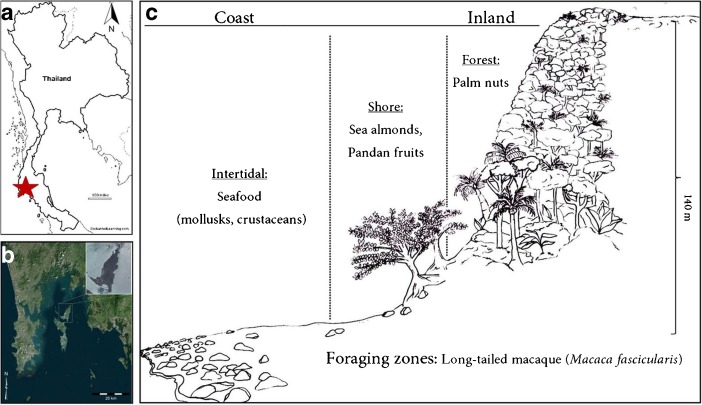
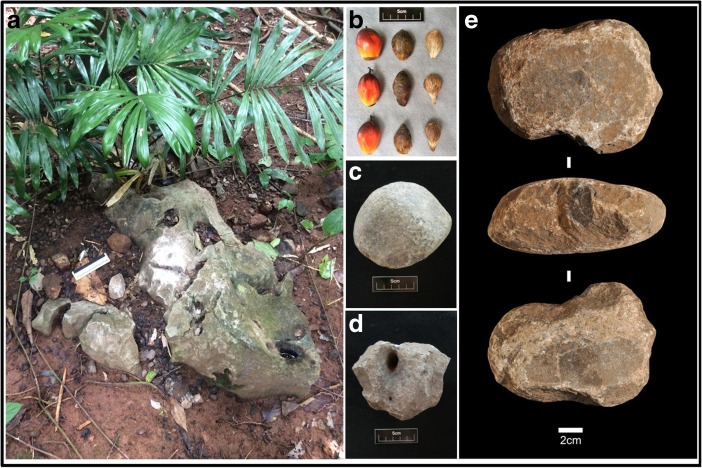
Anthropogenic disturbances have a detrimental impact on the natural world; the vast expansion of palm oil monocultures is one of the most significant agricultural influences. Primates worldwide consequently have been affected by the loss of their natural ecosystems. Long-tailed macaques () in Southern Thailand have, however, learned to exploit oil palm nuts using stone tools. Using camera traps, we captured the stone tool behavior of one macaque group in Ao Phang-Nga National Park. Line transects placed throughout an abandoned oil palm plantation confirmed a high abundance of nut cracking sites. Long-tailed macaques previously have been observed using stone tools to harvest shellfish along the coasts of Thailand and Myanmar. The novel nut processing behavior indicates the successful transfer of existing lithic technology to a new food source. Such behavioral plasticity has been suggested to underlie cultural behavior in animals, suggesting that long-tailed macaques have potential to exhibit cultural tendencies. The use of tools to process oil palm nuts across multiple primate species allows direct comparisons between stone tool using nonhuman primates living in anthropogenic environments.
人为干扰对自然世界产生了不利影响;油棕单一栽培的大规模扩张是最重大的农业影响之一。因此,全球的灵长类动物都受到了其天然生态系统丧失的影响。然而,泰国南部的长尾猕猴()已经学会使用石器工具来获取油棕坚果。我们通过相机陷阱,捕捉到了攀牙湾国家公园中一个猕猴群体的石器工具行为。在整个废弃油棕种植园内设置的样线证实了坚果开裂地点的高丰度。此前曾观察到长尾猕猴在泰国和缅甸沿海使用石器工具捕捞贝类。这种新的坚果加工行为表明,现有的石器技术成功转移到了一种新的食物来源上。有人认为这种行为可塑性是动物文化行为的基础机制,这表明长尾猕猴有表现出文化倾向的潜力。跨多种灵长类物种使用工具加工油棕坚果,使得生活在人为环境中的使用石器工具的非人灵长类动物之间能够进行直接比较。