Mohamad Nurul Elyani, Yeap Swee Keong, Ky Huynh, Ho Wan Yong, Boo Sook Yee, Chua Joelle, Beh Boon-Kee, Sharifuddin Shaiful Adzni, Long Kamariah, Alitheen Noorjahan Banu
Department of Cell and Molecular Biology, Faculty of Biotechnology and Biomolecular Science, Malaysia Agricultural Research and Development Institute (MARDI), Serdang, Malaysia.
China-ASEAN College of Marine Sciences, Xiamen University Malaysia, Sepang, Malaysia.
Food Nutr Res. 2017 Sep 21;61(1):1368322. doi: 10.1080/16546628.2017.1368322. eCollection 2017.
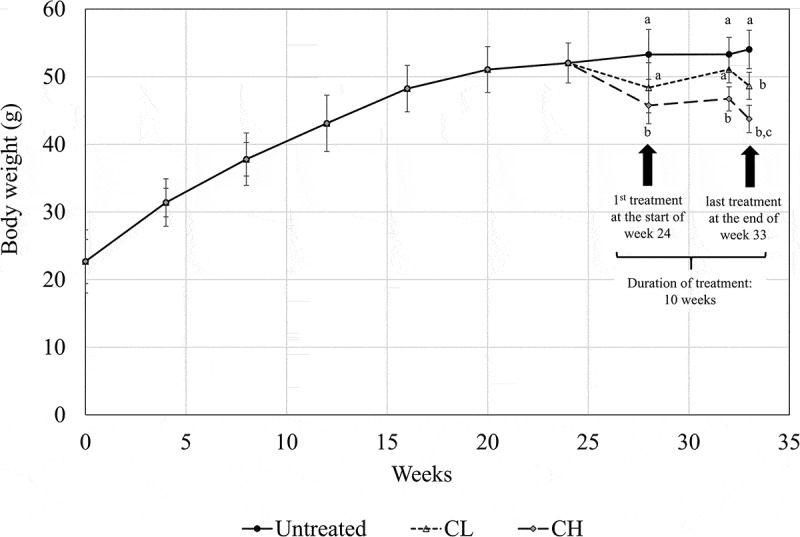
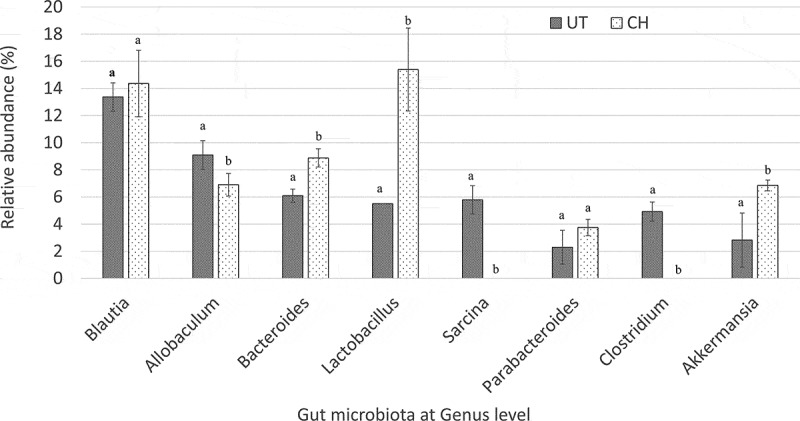
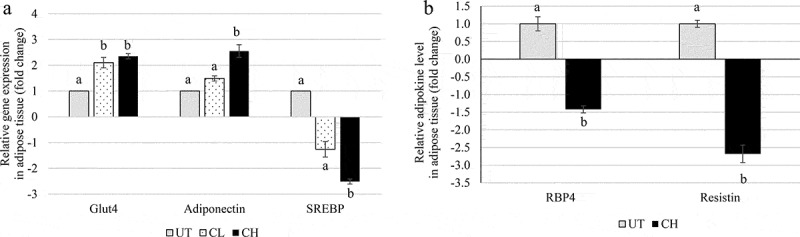
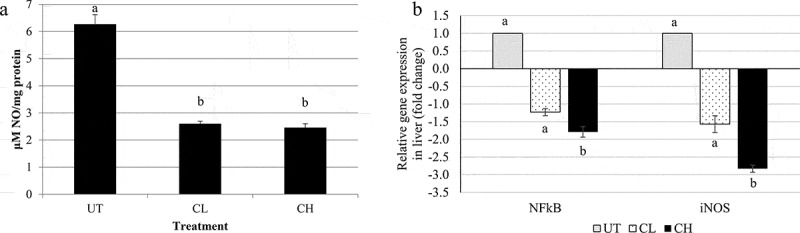
Obesity has become a serious health problem worldwide. Various types of healthy food, including vinegar, have been proposed to manage obesity. However, different types of vinegar may have different bioactivities. This study was performed to evaluate the anti-obesity and anti-inflammatory effects of coconut water vinegar on high-fat-diet (HFD)-induced obese mice. Changes in the gut microbiota of the mice were also evaluated. To induce obesity, C57/BL mice were continuously fed an HFD for 33 weeks. Coconut water vinegar (0.08 and 2 ml/kg body weight) was fed to the obese mice from early in week 24 to the end of week 33. Changes in the body weight, fat-pad weight, serum lipid profile, expression of adipogenesis-related genes and adipokines in the fat pad, expression of inflammatory-related genes, and nitric oxide levels in the livers of the untreated and coconut water vinegar-treated mice were evaluated. Faecal samples from the untreated and coconut water vinegar-treated mice (2 ml/kg body weight) were subjected to 16S metagenomic analysis to compare their gut microbiota. The oral intake of coconut water vinegar significantly ( < 0.05) reduced the body weight, fat-pad weight, and serum lipid profile of the HFD-induced obese mice in a dose-dependent manner. We also observed up-regulation of adiponectin and down-regulation of sterol regulatory element-binding protein-1, retinol-binding protein-4, and resistin expression. The coconut water vinegar also reduced HFD-induced inflammation by down-regulating nuclear factor-κB and inducible nitric oxide synthase expression, which consequently reduced the nitric oxide level in the liver. Alterations in the gut microbiota due to an increase in the populations of the and genera by the coconut water vinegar may have helped to overcome the obesity and inflammation caused by the HFD. These results provide valuable insights into coconut water vinegar as a potential food ingredient with anti-obesity and anti-inflammatory effects.
肥胖已成为全球严重的健康问题。包括醋在内的各种健康食品已被提议用于控制肥胖。然而,不同类型的醋可能具有不同的生物活性。本研究旨在评估椰子水醋对高脂饮食(HFD)诱导的肥胖小鼠的抗肥胖和抗炎作用。还评估了小鼠肠道微生物群的变化。为诱导肥胖,C57/BL小鼠连续33周喂食高脂饮食。从第24周初至第33周末,给肥胖小鼠喂食椰子水醋(0.08和2毫升/千克体重)。评估未处理和椰子水醋处理小鼠的体重、脂肪垫重量、血清脂质谱、脂肪垫中脂肪生成相关基因和脂肪因子的表达、炎症相关基因的表达以及肝脏中的一氧化氮水平。对未处理和椰子水醋处理小鼠(2毫升/千克体重)的粪便样本进行16S宏基因组分析,以比较它们的肠道微生物群。口服椰子水醋以剂量依赖方式显著(<0.05)降低了HFD诱导的肥胖小鼠的体重、脂肪垫重量和血清脂质谱。我们还观察到脂联素上调以及固醇调节元件结合蛋白-1、视黄醇结合蛋白-4和抵抗素表达下调。椰子水醋还通过下调核因子-κB和诱导型一氧化氮合酶的表达来减轻HFD诱导的炎症,从而降低肝脏中的一氧化氮水平。椰子水醋导致 属和 属种群增加,从而引起肠道微生物群的改变,这可能有助于克服HFD引起的肥胖和炎症。这些结果为椰子水醋作为一种具有抗肥胖和抗炎作用的潜在食品成分提供了有价值的见解。