Vat Lidewij Eva, Ryan Devonne, Etchegary Holly
Training and Capacity Lead, NL SUPPORT Unit, Memorial University of Newfoundland, Faculty of Medicine, Room 4M104, St. John's, NF A1B 3V6 Canada.
Research Assistant/ PhD Candidate, Memorial University of Newfoundland, Clinical Epidemiology Unit, Faculty of Medicine, Suite 4M120, St. John's, NF A1B 3V6 Canada.
Res Involv Engagem. 2017 Aug 21;3:15. doi: 10.1186/s40900-017-0067-x. eCollection 2017.
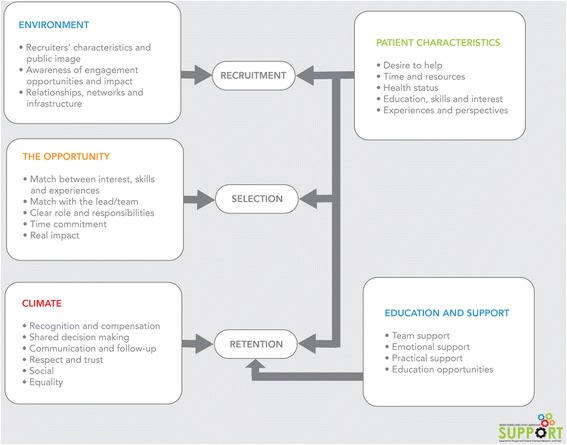
Increasingly, funders and researchers want to partner with patients in health research, but it can be challenging for researchers to find patient partners. More than taking part in research as participants, patient partners help design, carry out and manage research projects. The goal of this study was to describe ways that patient partners have been recruited by researchers and patient engagement leads (individuals within organizations responsible for promoting and supporting patients as research partners). We talked with researchers and patient engagement leads in Canada and the United Kingdom, as well as a patient representative. We found three ways that could help researchers and patients find each other. One way is a case-by-case basis, where patients are often sought with experience of a health condition that is the focus of the research. The other ways involved directories where projects were posted and could be found by patients and researchers, or a third party matched patients with research projects. We found four recruitment strategies:Social marketingCommunity outreachHealth systemPartnering with other organizations (e.g., advocacy groups) There are many influences on finding, selecting and retaining patient partners: patient characteristics, the local setting, the opportunity, work climate, education and support. We hope study results will provide a useful starting point for research teams in recruiting their patient partners.
Patient engagement in clinical trials and other health research continues to gain momentum. While the benefits of patient engagement in research are emerging, relatively little is known about recruiting patients as research partners. The purpose of this study was to describe recruitment strategies and models of recruiting patients as partners in health research. Qualitative descriptive study. Thirteen patient engagement leads and health researchers from Canada and the United Kingdom, as well as one patient representative from a national patient organization (7 female) completed semi-structured interviews. Recruitment infrastructures available to respondents varied, but could be categorized into three models including the traditional, third-party and directory models. Four categories of recruitment strategies were identified, representing multiple ways of recruiting patient partners: social marketing recruitment, community outreach recruitment, health system recruitment, and partnering recruitment. Multiple recruitment strategies were identified for engaging patient partners in research, and some common factors influenced recruitment. Study findings contribute to the evidence base in patient engagement and provide guidance for research teams to help identify potential recruitment methods for their patient partners.
越来越多的资助者和研究人员希望在健康研究中与患者合作,但研究人员找到患者合作伙伴可能具有挑战性。患者合作伙伴不仅仅是作为参与者参与研究,还会帮助设计、开展和管理研究项目。本研究的目的是描述研究人员以及患者参与负责人(组织内负责促进和支持患者成为研究合作伙伴的人员)招募患者合作伙伴的方式。我们与加拿大和英国的研究人员、患者参与负责人以及一位患者代表进行了交谈。我们发现了三种可以帮助研究人员和患者相互找到对方的方法。一种方法是逐案处理,通常会寻找患有研究重点关注的健康状况的患者。其他方法包括发布项目的目录,患者和研究人员可以在其中找到项目,或者第三方将患者与研究项目进行匹配。我们发现了四种招募策略:社会营销、社区外展、卫生系统、与其他组织(如倡导团体)合作。在寻找、选择和留住患者合作伙伴方面存在许多影响因素:患者特征、当地环境、机会、工作氛围、教育和支持。我们希望研究结果将为研究团队招募患者合作伙伴提供一个有用的起点。
患者参与临床试验和其他健康研究的势头持续增强。虽然患者参与研究的益处正在显现,但对于招募患者作为研究合作伙伴的了解相对较少。本研究的目的是描述招募患者作为健康研究合作伙伴的策略和模式。定性描述性研究。来自加拿大和英国的13名患者参与负责人、健康研究人员以及一名来自全国患者组织的患者代表(7名女性)完成了半结构化访谈。受访者可用的招募基础设施各不相同,但可分为三种模式,包括传统模式、第三方模式和目录模式。确定了四类招募策略,代表了招募患者合作伙伴的多种方式:社会营销招募、社区外展招募、卫生系统招募和合作招募。确定了多种招募患者合作伙伴参与研究的策略,并且一些共同因素影响了招募。研究结果有助于丰富患者参与方面的证据基础,并为研究团队提供指导,以帮助他们确定潜在的患者合作伙伴招募方法。
