Lu Yuan
Key Lab of Industrial Biocatalysis, Ministry of Education, Department of Chemical Engineering, Tsinghua University, Beijing 100084, China.
Institute of Biochemical Engineering, Department of Chemical Engineering, Tsinghua University, Beijing 100084, China.
Synth Syst Biotechnol. 2017 Mar 3;2(1):23-27. doi: 10.1016/j.synbio.2017.02.003. eCollection 2017 Mar.
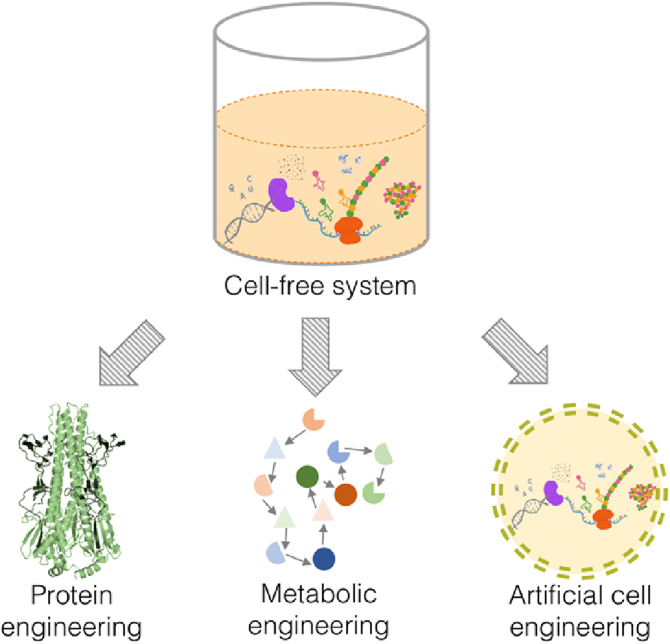
Cell-free synthetic biology emerges as a powerful and flexible enabling technology that can engineer biological parts and systems for life science applications without using living cells. It provides simpler and faster engineering solutions with an unprecedented freedom of design in an open environment than cell system. This review focuses on recent developments of cell-free synthetic biology on biological engineering fields at molecular and cellular levels, including protein engineering, metabolic engineering, and artificial cell engineering. In cell-free protein engineering, the direct control of reaction conditions in cell-free system allows for easy synthesis of complex proteins, toxic proteins, membrane proteins, and novel proteins with unnatural amino acids. Cell-free systems offer the ability to design metabolic pathways towards the production of desired products. Buildup of artificial cells based on cell-free systems will improve our understanding of life and use them for environmental and biomedical applications.
无细胞合成生物学作为一种强大且灵活的使能技术应运而生,它无需使用活细胞就能为生命科学应用设计生物部件和系统。与细胞系统相比,它在开放环境中提供了更简单、更快速的工程解决方案,且具有前所未有的设计自由度。本综述聚焦于无细胞合成生物学在分子和细胞水平的生物工程领域的最新进展,包括蛋白质工程、代谢工程和人工细胞工程。在无细胞蛋白质工程中,无细胞系统中反应条件的直接控制便于合成复杂蛋白质、有毒蛋白质、膜蛋白以及含非天然氨基酸的新型蛋白质。无细胞系统具备设计代谢途径以生产所需产物的能力。基于无细胞系统构建人工细胞将增进我们对生命的理解,并将其用于环境和生物医学应用。